

 登录
登录
Do you believe one person can sing two pitches(音高)at the same time? This is Khoomei(呼麦), or Mongolian throat singing, a special art form of the Mongolian ethnic group(蒙古族).
A Khoomei singer uses his or her voice in a special way to produce two or more pitches at the same time. The singer creates a low, deep sound from the throat as the base. At the same time, the singer changes the shape of the mouth and where the tongue is placed; a high whistle-like sound comes out on top. The distance between the low and high sounds can be as wide as six octaves(八度)!
Khoomei dates back to about 2,300 years ago. At that time, ancient people hunted and lived as nomads(牧民)on the grassland. They heard the sounds of nature—waterfalls, wind, and animals. They believed that by imitating the sounds, they could connect with nature and the universe. This was the beginning of Khoomei.
Khoomei became popular during the 13th century on the Mongolian grassland. In the 20th century, it almost disappeared in some places. But since the 1980s, people in Inner Mongolia have worked hard to bring it back. Today, more young musicians are mixing Khoomei with modern music, and it is winning fans all over the world.
In 2009, UNESCO added it to the list of Intangible Cultural Heritage of Humanity(人类非物质文化遗产). Khoomei is more than just singing. It is a window into the Mongolian people's spirit and reflects their love for nature.
根据短文内容,完成表格中所缺的信息。(每空一词)
Khoomei—a Unique Mongolian Art
The special 1 of Khoomei
◆ Low sound comes from the throat.
◆ High sound comes out by changing the shape of mouth and the 2 of the tongue.
The development of Khoomei
◆ 2,300 years ago: People tried to 3 with nature and the universe.
◆ In the 13th century: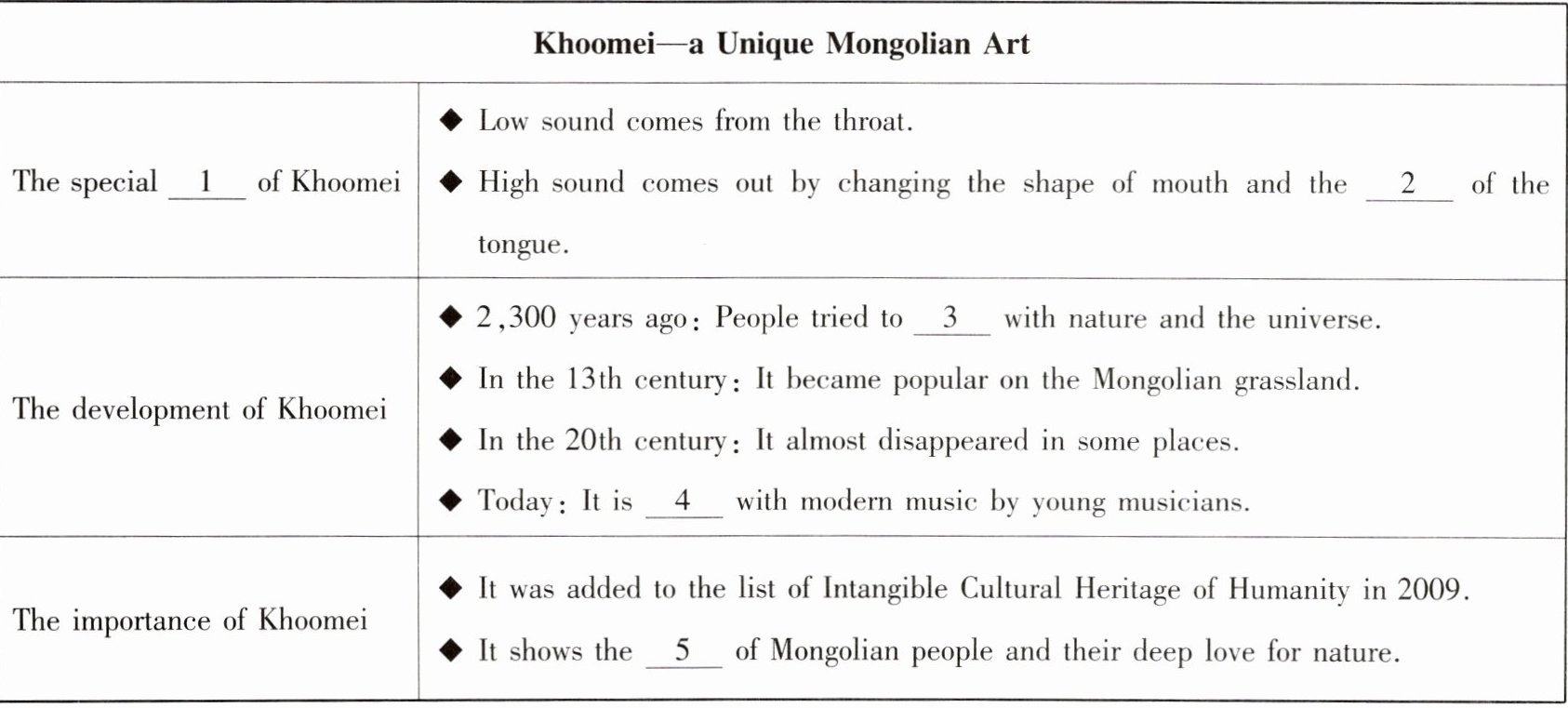 became popular on the Mongolian grassland.
◆ In the 20th century: It almost disappeared in some places.
◆ Today: It is 4 with modern music by young musicians.
The importance of Khoomei
◆ It was added to the list of Intangible Cultural Heritage of Humanity in 2009.
◆ It shows the 5 of Mongolian people and their deep love for nature.
1.
A Khoomei singer uses his or her voice in a special way to produce two or more pitches at the same time. The singer creates a low, deep sound from the throat as the base. At the same time, the singer changes the shape of the mouth and where the tongue is placed; a high whistle-like sound comes out on top. The distance between the low and high sounds can be as wide as six octaves(八度)!
Khoomei dates back to about 2,300 years ago. At that time, ancient people hunted and lived as nomads(牧民)on the grassland. They heard the sounds of nature—waterfalls, wind, and animals. They believed that by imitating the sounds, they could connect with nature and the universe. This was the beginning of Khoomei.
Khoomei became popular during the 13th century on the Mongolian grassland. In the 20th century, it almost disappeared in some places. But since the 1980s, people in Inner Mongolia have worked hard to bring it back. Today, more young musicians are mixing Khoomei with modern music, and it is winning fans all over the world.
In 2009, UNESCO added it to the list of Intangible Cultural Heritage of Humanity(人类非物质文化遗产). Khoomei is more than just singing. It is a window into the Mongolian people's spirit and reflects their love for nature.
根据短文内容,完成表格中所缺的信息。(每空一词)
Khoomei—a Unique Mongolian Art
The special 1 of Khoomei
◆ Low sound comes from the throat.
◆ High sound comes out by changing the shape of mouth and the 2 of the tongue.
The development of Khoomei
◆ 2,300 years ago: People tried to 3 with nature and the universe.
◆ In the 13th century:
became popular on the Mongolian grassland.◆ In the 20th century: It almost disappeared in some places.
◆ Today: It is 4 with modern music by young musicians.
The importance of Khoomei
◆ It was added to the list of Intangible Cultural Heritage of Humanity in 2009.
◆ It shows the 5 of Mongolian people and their deep love for nature.
1.
skill/technique
2. position
3. connect
4. mixed
5. spirit
答案
1. skill/technique
2. position
3. connect
4. mixed
5. spirit
2. position
3. connect
4. mixed
5. spirit
解析
【分析】
要完成表格填空,需先明确每个空的主题,再定位原文对应内容:1空对应呼麦的特殊属性,2空对应舌头的状态,3空对应2300年前人们的行为,4空对应如今呼麦与现代音乐的结合,5空对应呼麦体现的蒙古族特质,通过查找原文对应信息得出答案。
【解析】
1. 定位原文第二段对呼麦发声方式的描述,可知这是呼麦的特殊技巧,故填skill/technique;
2. 原文第二段提到“changes the shape of the mouth and where the tongue is placed”,“where the tongue is placed”即舌头的位置,对应填position;
3. 原文第三段明确“they could connect with nature and the universe”,故填connect;
4. 原文第四段“more young musicians are mixing Khoomei with modern music”,此处为被动语态,故填mixed;
5. 原文第五段“window into the Mongolian people's spirit”,可知呼麦体现蒙古族的精神,故填spirit。
【答案】
1. skill/technique 2. position 3. connect 4. mixed 5. spirit
【知识点】
英语阅读理解;信息匹配;词汇运用
【点评】
本题为信息匹配类阅读理解题,需学生快速定位原文对应内容,考查细节信息提取和词汇运用能力,难度适中。
【难度系数】
0.6
要完成表格填空,需先明确每个空的主题,再定位原文对应内容:1空对应呼麦的特殊属性,2空对应舌头的状态,3空对应2300年前人们的行为,4空对应如今呼麦与现代音乐的结合,5空对应呼麦体现的蒙古族特质,通过查找原文对应信息得出答案。
【解析】
1. 定位原文第二段对呼麦发声方式的描述,可知这是呼麦的特殊技巧,故填skill/technique;
2. 原文第二段提到“changes the shape of the mouth and where the tongue is placed”,“where the tongue is placed”即舌头的位置,对应填position;
3. 原文第三段明确“they could connect with nature and the universe”,故填connect;
4. 原文第四段“more young musicians are mixing Khoomei with modern music”,此处为被动语态,故填mixed;
5. 原文第五段“window into the Mongolian people's spirit”,可知呼麦体现蒙古族的精神,故填spirit。
【答案】
1. skill/technique 2. position 3. connect 4. mixed 5. spirit
【知识点】
英语阅读理解;信息匹配;词汇运用
【点评】
本题为信息匹配类阅读理解题,需学生快速定位原文对应内容,考查细节信息提取和词汇运用能力,难度适中。
【难度系数】
0.6
