

 登录
Ⅱ. 阅读理解
A
Ai Chang, 14, from Shanghai, China
All of my family like folk music and we all like playing the guitar and singing. My parents are going to buy me a better guitar for my next birthday. This summer, we are all going to the Beijing Folk Festival to enjoy the beauty of the music. We're going to camp for three nights and listen to lots of bands.
Paul, 13, from Leeds, the UK
I love singing and I play lots of different instruments. The most difficult instrument I play is the violin but I love it. I play the violin in my school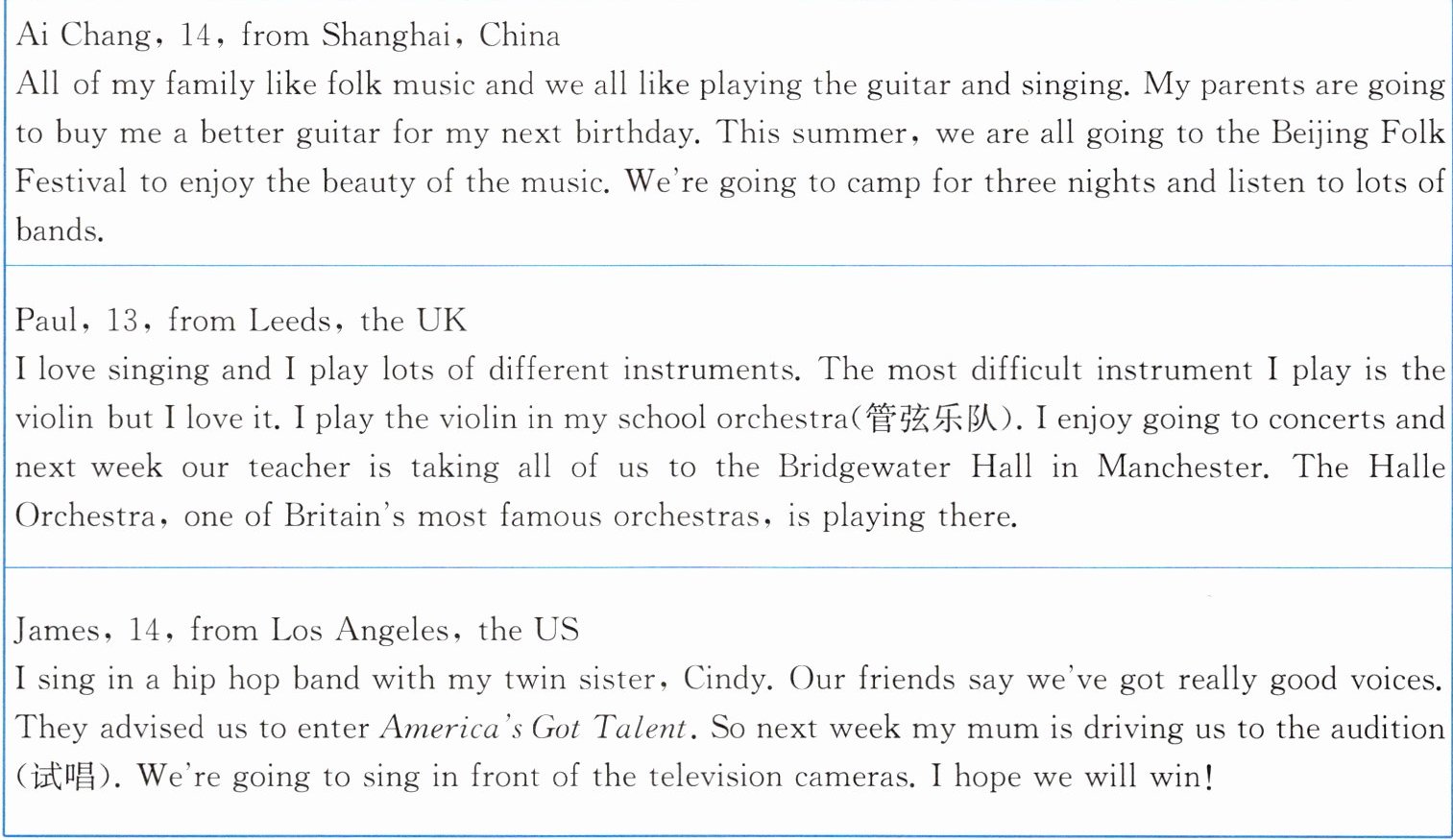 chestra(管弦乐队). I enjoy going to concerts and next week our teacher is taking all of us to the Bridgewater Hall in Manchester. The Halle Orchestra, one of Britain's most famous orchestras, is playing there.
James, 14, from Los Angeles, the US
I sing in a hip hop band with my twin sister, Cindy. Our friends say we've got really good voices. They advised us to enter America’s Got Talent. So next week my mum is driving us to the audition(试唱). We're going to sing in front of the television cameras. I hope we will win!
1. What is Ai Chang going to do this summer?
A. Buy a new guitar.
B. Attend a music festival.
C. Celebrate her birthday.
D. Set up a guitar band.
2. Where will Paul's teacher take the class next week?
A. Leeds.
B. London.
C. China.
D. Manchester.
3. Who will James enter America’s Got Talent with?
A. His mother.
B. His friend.
C. His sister.
D. His classmate.
4. What can we know from the passage?
A. Cindy is 14 years old.
B. James plays the violin best.
C. Ai Chang dislikes camping.
D. James has many kinds of instruments.
5. Where can you probably read the passage?
A. In a news report.
B. In a guidebook.
C. In a music magazine.
D. On a science website.
B
A
Ai Chang, 14, from Shanghai, China
All of my family like folk music and we all like playing the guitar and singing. My parents are going to buy me a better guitar for my next birthday. This summer, we are all going to the Beijing Folk Festival to enjoy the beauty of the music. We're going to camp for three nights and listen to lots of bands.
Paul, 13, from Leeds, the UK
I love singing and I play lots of different instruments. The most difficult instrument I play is the violin but I love it. I play the violin in my school
chestra(管弦乐队). I enjoy going to concerts and next week our teacher is taking all of us to the Bridgewater Hall in Manchester. The Halle Orchestra, one of Britain's most famous orchestras, is playing there.James, 14, from Los Angeles, the US
I sing in a hip hop band with my twin sister, Cindy. Our friends say we've got really good voices. They advised us to enter America’s Got Talent. So next week my mum is driving us to the audition(试唱). We're going to sing in front of the television cameras. I hope we will win!
1. What is Ai Chang going to do this summer?
A. Buy a new guitar.
B. Attend a music festival.
C. Celebrate her birthday.
D. Set up a guitar band.
2. Where will Paul's teacher take the class next week?
A. Leeds.
B. London.
C. China.
D. Manchester.
3. Who will James enter America’s Got Talent with?
A. His mother.
B. His friend.
C. His sister.
D. His classmate.
4. What can we know from the passage?
A. Cindy is 14 years old.
B. James plays the violin best.
C. Ai Chang dislikes camping.
D. James has many kinds of instruments.
5. Where can you probably read the passage?
A. In a news report.
B. In a guidebook.
C. In a music magazine.
D. On a science website.
B
答案
A 本文是一篇应用文,主要介绍了三位爱好音乐的学生。
1. B 细节理解题。根据“This summer, we are all going to the Beijing Folk Festival to enjoy the beauty of the music.”可知,今年夏天,艾畅一家都要去北京民俗节欣赏音乐之美。故选 B。
2. D 细节理解题。根据“... next week our teacher is taking all of us to the Bridgewater Hall in Manchester.”可知,下周,保罗的老师将带班里所有的同学去曼彻斯特的布里奇沃特音乐厅。故选 D。
3. C 细节理解题。根据“I sing in a hip hop band with my twin sister, Cindy ... They advised us to enter America’s Got Talent. So next week my mum is driving us to the audition.”可知,下周妈妈将带詹姆斯和妹妹去美国达人秀试唱。故选 C。
4. A 细节理解题。根据“James, 14”和“my twin sister, Cindy”可知,詹姆斯和双胞胎妹妹辛迪都是 14 岁。故选 A。
5. C 推理判断题。通读全文可知,本文主要介绍了三位爱好音乐的学生,所以本文可能出现在音乐杂志上。故选 C。
People always say the music from their younger years is the best compared to other times. This may be because of something that can be called the “memory bump(记忆隆起)”.
According to the BBC, the memory bump means that our memories from ages 10 to 30 are very strong. This time heavily shapes our interests, such as our favourite books, films, sports stars, and especially music. This is because there is a “safe” place in our brain to hold the musical memories. The place is well-protected against aging problems. As a result, the music we listen to during these years usually has a long-lasting influence. We usually remember the music in our early years more deeply than music from other times in our lives.
“Music is episodic(连载的),” Professor Robert Cutietta at the USC told the CNN. “If you look at an artwork or something, you can look at it and leave. Music is over time.”
Music is mixed. It can mix happy and sad feelings when we listen to it. When the songs are about our old experiences, memories of those experiences will flood back as we listen to the songs again.
Music is magic. Sometimes, with a change in experience, the sadness we felt before when listening to a song can later turn into joy. This can explain why listening to music from a difficult time in our younger life can bring a feeling of relief(宽慰) now.
6. What is the “memory bump”?
A. A type of music from the 1910s.
B. The happiest memories in the brain.
C. Strong memories from our early years.
D. An interest in books and films.
7. Why do we remember the music from our younger years better?
A. Young people have better memories.
B. The music is easier to understand and remember.
C. We listen to the music more often.
D. A more protected area in the brain holds it.
8. Which opinion about music might Professor Robert Cutietta agree with?
A. Music from our younger years is the best.
B. We can forget music from childhood very quickly.
C. Listening to music is like looking at an artwork.
D. Listening to music can make us think of our old times.
9. What is the possible meaning of the underlined word “flood”?
A. Rush.
B. Save.
C. Cost.
D. Talk.
10. What is the structure of the passage?

According to the BBC, the memory bump means that our memories from ages 10 to 30 are very strong. This time heavily shapes our interests, such as our favourite books, films, sports stars, and especially music. This is because there is a “safe” place in our brain to hold the musical memories. The place is well-protected against aging problems. As a result, the music we listen to during these years usually has a long-lasting influence. We usually remember the music in our early years more deeply than music from other times in our lives.
“Music is episodic(连载的),” Professor Robert Cutietta at the USC told the CNN. “If you look at an artwork or something, you can look at it and leave. Music is over time.”
Music is mixed. It can mix happy and sad feelings when we listen to it. When the songs are about our old experiences, memories of those experiences will flood back as we listen to the songs again.
Music is magic. Sometimes, with a change in experience, the sadness we felt before when listening to a song can later turn into joy. This can explain why listening to music from a difficult time in our younger life can bring a feeling of relief(宽慰) now.
6. What is the “memory bump”?
A. A type of music from the 1910s.
B. The happiest memories in the brain.
C. Strong memories from our early years.
D. An interest in books and films.
7. Why do we remember the music from our younger years better?
A. Young people have better memories.
B. The music is easier to understand and remember.
C. We listen to the music more often.
D. A more protected area in the brain holds it.
8. Which opinion about music might Professor Robert Cutietta agree with?
A. Music from our younger years is the best.
B. We can forget music from childhood very quickly.
C. Listening to music is like looking at an artwork.
D. Listening to music can make us think of our old times.
9. What is the possible meaning of the underlined word “flood”?
A. Rush.
B. Save.
C. Cost.
D. Talk.
10. What is the structure of the passage?
答案
本文主要讲述了“记忆隆起”现象及其对音乐记忆的影响,解释了为什么人们更容易记住年轻时听的音乐,并探讨了音乐对情感的作用。
6. C 细节理解题。根据“According to the BBC, the memory bump means that our memories from ages 10 to 30 are very strong.”可知,“记忆隆起”指的是我们年轻时(10 岁到 30 岁)的强烈记忆。故选 C。
7. D 细节理解题。根据“This is because there is a ‘safe’ place in our brain to hold the musical memories. The place is well-protected against aging problems.”可知,我们年轻时听的音乐之所以记得更清楚,是因为大脑中有一个受保护的区域专门存储这些音乐记忆。故选 D。
8. D 推理判断题。根据“Music is episodic”和“If you look at an artwork or something, you can look at it and leave. Music is over time.”可知,音乐是连载的,欣赏艺术品时你可以看一眼就离开,但音乐是随时间流淌的,由此可知,教授认为音乐能让人联想到过去的时光。故选 D。
9. A 词义猜测题。根据“Music is mixed. It can mix happy and sad feelings when we listen to it. When the songs are about our old experiences, memories of those experiences will flood back as we listen to the songs again.”可知,当歌曲是关于我们过去的经历时,当我们再次听这些歌曲,那些经历的记忆会“flood back(涌回来)”,与 rush back 意思相近。故选 A。
10. B 文章结构题。文章第一段引出“记忆隆起”的概念;第二段具体解释“记忆隆起”以及为什么早年的音乐记忆深刻;第三段引用教授的话说明音乐的连续性;第四段阐述音乐是混合的,能混合快乐和悲伤的感觉;第五段说明音乐是神奇的,能让之前的悲伤转变为快乐。三、四、五段是并列段,一、二段不是并列段,B 选项结构符合。故选 B。
