

 登录
Dujiangyan is an ancient irrigation(灌溉) system in Sichuan, China. It was designed by Li Bing, a local governor, and built over 2,200 years ago. Unlike modern dams(水坝), Dujiangyan has no walls to prevent water running. Instead, it uses three main parts to control flooding and irrigate farmland.
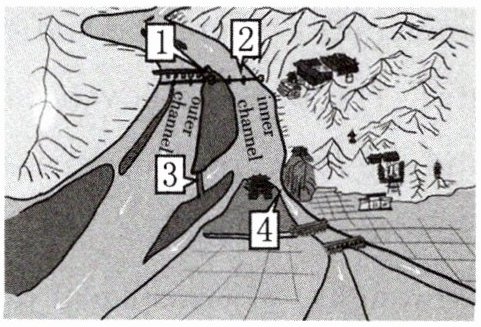
The first part is the "Fish Mouth". Shaped like a fish's mouth, it stands in the middle of the
Min River. Because of its special shape, it divides the river into two channels: the inner channel(内江) for watering crops and the outer channel for taking away extra water during floods. The second part is the "Flying Sand Weir(飞沙堰)". This is built to slacken the water as it passes through. The action makes the water less forceful. When the water loses its strength, it can no longer hold the heavy sediment(沉积物). The sand and mud then drop to the bottom. This keeps the inner channel clean without using machines. The third part is the "Bottle-Neck Channel". This is a narrow passage cut through the mountain rock. Just like a natural valve(阀门), it controls how much water enters the farmlands. This prevents flooding and provides a steady flow of clean water.
Dujiangyan solved two major problems in ancient Sichuan: floods and droughts. Before it was built, floods did great harm to crops every summer. In winter, however, droughts dried up fields. Today, Dujiangyan is still in use. It irrigates over 5,300 square kilometres of land, supporting six million people. In 2000, UNESCO named it a World Heritage Site for its "scientific and technological achievements".
(
C
)53. According to the article, Dujiangyan is different from modern dams because it .A. supports six million people
B. is made up of three main parts
C. prevents water without walls
D. can irrigate farmland and control floods
(
C
)54. What does the underlined word "slacken" mean in the article?A. Clean up.
B. Speed up.
C. Slow down.
D. Freeze down.
(
A
)55. Which part in the picture is the "Fish Mouth"?A. Part 1.
B. Part 2.
C. Part 3.
D. Part 4.
(
C
)56. What is the main purpose of this article?A. To describe why Li Bing built Dujiangyan.
B. To compare Dujiangyan with modern dams.
C. To explain how Dujiangyan works and its importance.
D. To introduce a well-known tourist attraction in Sichuan.
答案
53. C 54. C 55. A 56. C
解析
【分析】
先明确每道题的考查类型,再对应原文定位解题:
1. 第53题是细节理解题,需查找都江堰与现代水坝的不同之处,定位原文第一段相关语句;
2. 第54题是词义猜测题,需结合后文对该词作用的描述推断词义;
3. 第55题是图文对应题,需结合原文对“鱼嘴”的描述匹配图片序号;
4. 第56题是主旨大意题,需梳理全文内容提炼核心目的。
【解析】
53. 细节理解题:根据原文第一段“Unlike modern dams, Dujiangyan has no walls to prevent water running”可知,都江堰没有挡水的墙,这是与现代水坝的不同之处,对应选项C。
54. 词义猜测题:后文提到该动作让水的力量变小(makes the water less forceful),说明“slacken”意为“减慢(速度)”,对应选项C。
55. 图文对应题:原文指出“Fish Mouth”位于岷江中间,将河流分为内江和外江,图中序号1的位置是分水的鱼嘴,对应选项A。
56. 主旨大意题:全文介绍了都江堰的组成部分、工作原理、解决的问题及重要性,核心是解释其运作方式和重要性,对应选项C。
【答案】
53. C 54. C 55. A 56. C
【知识点】
阅读理解、细节理解、词义猜测
【点评】
本题以都江堰的说明文为载体,结合图片考查学生的阅读能力,涵盖细节查找、词义推断和主旨把握,题目设置贴合基础阅读要求,难度适中。
【难度系数】
0.7
