

 登录
Ⅵ. 中考趋势 短文还原
从方框中选出能填入空白处的最佳选项。选项中有两项多余。
After years of planning, the final group of villagers from Jigkyob village, one of the highest in Xizang, have recently completed their relocation(搬迁). Last week, 143 villagers moved from their high-altitude village 4,900 metres above sea level to a new home lower down. 1.
2.
difficulties and making it impossible for all vehicles(车辆) to get through. 3.
This relocation project aims to provide more convenience to the community, allowing them to get important public services such as education and healthcare facilities(设施). 4.
The relocation project was supported by Aid-Xizang teams from Shanghai. After over a year of hard work, the first step of the project has been completed. 5.
“As a result, the quality of life and growth chances for the villagers are expected to be greatly improved,” Kelsang Gyatso said.
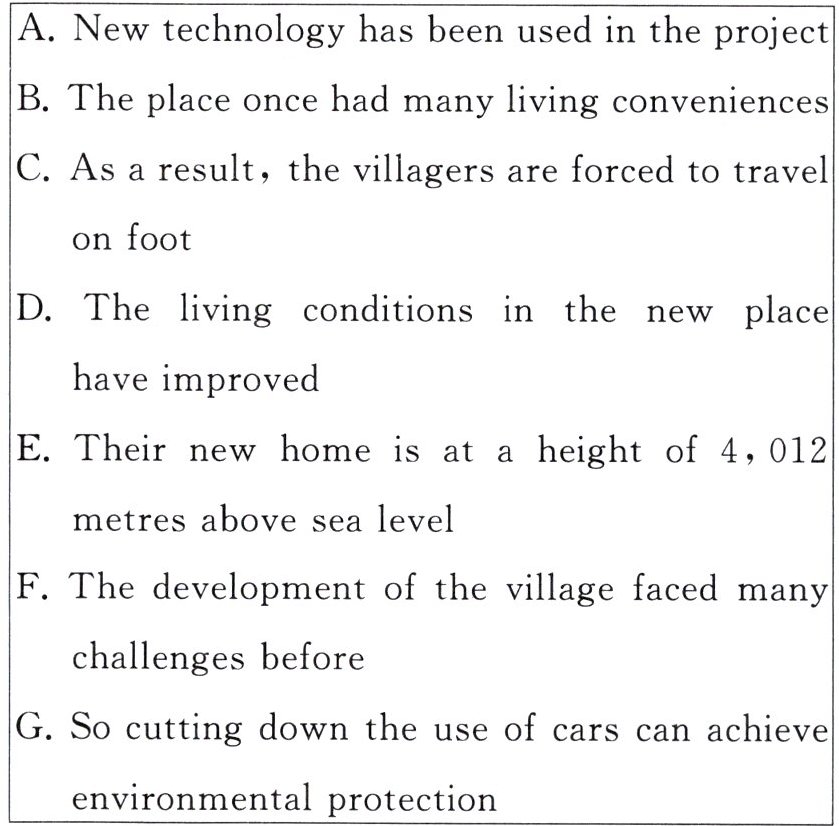
从方框中选出能填入空白处的最佳选项。选项中有两项多余。
After years of planning, the final group of villagers from Jigkyob village, one of the highest in Xizang, have recently completed their relocation(搬迁). Last week, 143 villagers moved from their high-altitude village 4,900 metres above sea level to a new home lower down. 1.
E
. This change provides them with better public services and a brighter future.2.
F
. Jigkyob is the highest village in Lhaze county. People there make a living by farming animals and working in another place. Kelsang Gyatso, a leader of Jigkyob village, said, “The high altitude(海拔), cold climate, and thin air are the most serious challenges for the villagers.” Besides, heavy snow usually starts from October every year, causing trafficdifficulties and making it impossible for all vehicles(车辆) to get through. 3.
C
.This relocation project aims to provide more convenience to the community, allowing them to get important public services such as education and healthcare facilities(设施). 4.
D
. Their houses have public services including water and electricity, and are connected to the network. They live in a place with convenient transportation and complete local facilities.The relocation project was supported by Aid-Xizang teams from Shanghai. After over a year of hard work, the first step of the project has been completed. 5.
A
. The new residential site emphasizes the use of clean energy and gives priority to environmentally friendly projects.“As a result, the quality of life and growth chances for the villagers are expected to be greatly improved,” Kelsang Gyatso said.
答案
1. E 2. F 3. C 4. D 5. A
【语篇解读】本文是一篇新闻类说明文,主要介绍西藏吉克觉村村民搬迁后的生活改善,以及该项目解决旧址存在的问题、推进绿色发展的作用。
Ⅶ.任务型阅读
根据短文内容,在表格里填入最恰当的内容,1-6题每空1词,第7题请用一句话作答。
If we want our society to get better, we need development. But sometimes development means old things must make way for new things. When we move towards the future, we cannot keep everything from the past. Finding a good balance between progress and protecting cultural sites can be a big challenge. However, big challenges can sometimes lead to good solutions.
In the 1950s, the Egyptian government wanted to build a new dam(水坝) across the Nile. The dam could help control floods, make electricity, and bring water to more farmers. But many people protested the plan. They worried that water from the dam would damage temples and destroy cultural relics. These were important parts of Egypt's cultural heritage(遗产). The government listened to scientists and citizens who lived near the dam. In 1959, they turned to the United Nations for help.
Soon, a committee was set up. Their job was to protect the temples and cultural relics(文物) from being damaged or lost. The group asked for help from different departments and raised money from countries around the world. Experts studied the problem, did many tests, and came up with a way to save the buildings. In 1960, a document was signed and the work began.
Governments and environmentalists from all over the world joined the project. Temples and other cultural sites were taken down piece by piece. They were moved to a safe place and put back together again. In 1961, German engineers moved the first temple. With help from around the world, 22 temples and countless relics were moved to safety over 20 years. The total cost was about 80 million, half of which was donated by some 50 countries.The project ended in 1980. It was seen as a great success. These countries found a way to move forward while protecting the relics of the past. If a problem is too hard for one country to solve, sometimes the global community can help.| Introduction: | Balancing progress and protection is hard, but challenges can 1. ______ solutions. || --- | --- || Egypt's dam project | Problem: A dam was planned for flood control, electricity, and farming, but it was a 2. ______ to cultural heritage.Actions: • The government turned to the United Nations for help.• Experts found a solution and workers 3. ______ 22 temples and countless relics.• Some 50 countries donated about half of the 80 million total cost.
4. _________: The project was a great success. These countries developed 5. _________ destroying their cultural relics and learned that working together builds a better future. |
| Conclusion: | UNESCO's work shows that countries working together can solve problems no single nation can deal with 6. _________. |
| Your thought: | Do you think it was worth spending 20 years and 80 million to save the temples? Why or why not?
7. _________ |
答案
【语篇解读】本文是一篇说明性短文,主要介绍埃及为修建水坝而开展的国际文化遗产保护项目,说明国际合作能平衡发展与保护。
1. bring 2. risk/danger 3. moved 4. Result
5. without 6. alone
7. Yes, because the temples are irreplaceable cultural treasures and saving them benefits future generations.
