

 登录
4. different /'dɪfrənt/ adj. 不同的
n.
复数(pl.)
反义词:
短语:与……不同
☆教材中的句子:我们都很不同。
句子:
我的书包和她的不同。
我们有不同的爱好。
n.
difference
不同点复数(pl.)
differences
反义词:
same
短语:与……不同
be different from
☆教材中的句子:我们都很不同。
We are all different.
句子:
我的书包和她的不同。
My schoolbag is different from hers.
我们有不同的爱好。
We have different hobbies.
答案
4. difference;differences;same;
be different from;
We are all different.
My schoolbag is different from hers.
We have different hobbies.
5. violin /vaɪə'lɪn/ n. 小提琴
复数(pl.)
n. 小提琴家
☆教材中的短语:拉小提琴
☆教材中的句子:我小提琴拉得真的很好。
句子:
我的爸爸是一名小提琴家。他擅长拉小提琴。
复数(pl.)
violins
n. 小提琴家
violinist
☆教材中的短语:拉小提琴
play the violin
☆教材中的句子:我小提琴拉得真的很好。
I play the violin really well.
句子:
我的爸爸是一名小提琴家。他擅长拉小提琴。
My father is a violinist. He is good at playing the violin.
答案
5. violins;violinist;
play the violin
I play the violin really well.
My father is a violinist. He is good at playing the violin.
1. 朗读教材 page 31 3a 活动表格中的句子,圈出其中的主语和动词,并分析一般现在时的句子结构。
| | 肯定句 |
| | 主语(人称:
| | Teng Fei and his grandpa play ping-pong every week. | Teng Fei's grandpa loves sport. |
| | They have some nice ping-pong bats. | Teng Fei's father has a fishing rod. |
| | 否定句 |
| | 主语 +
| | I don't like gardening. | He doesn't like gardening. |
| | 一般疑问句 |
| |
| | Do you play the piano? | Yes, I do. / No, I don't. |
| |
| | Does your father spend a lot of time fishing? | Yes, he does. / No, he doesn't. |
| | 特殊疑问句 |
| | 特殊疑问词 +
| | What do they like? | What does he like? |
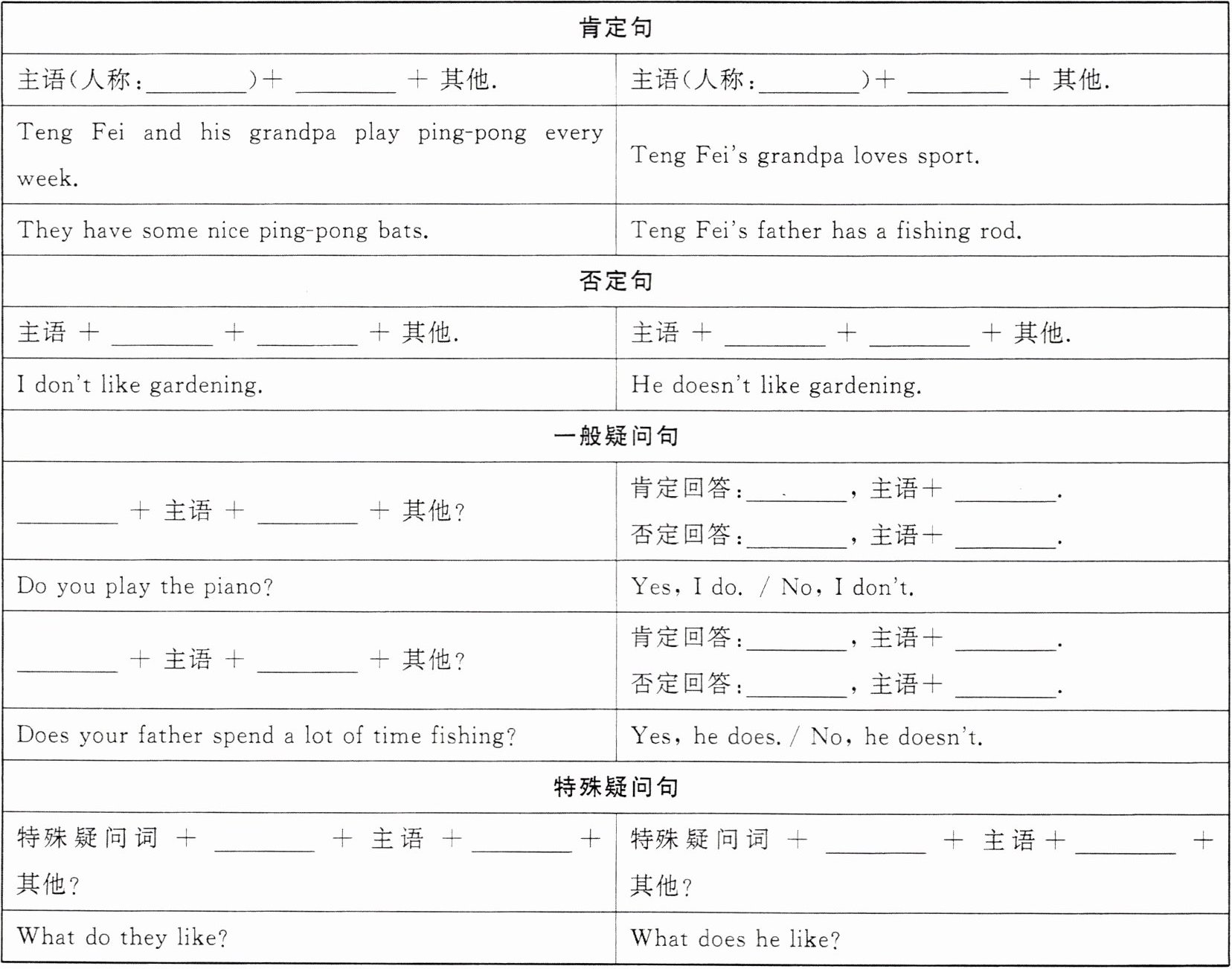
【注意】在口语中,do not 经常缩略为 don't, does not 经常缩略为 doesn't。
| | 肯定句 |
| | 主语(人称:
第一、二人称、第三人称且为复数
)+动词原形
+ 其他. | 主语(人称:第三人称单数
)+动词第三人称单数
+ 其他. || | Teng Fei and his grandpa play ping-pong every week. | Teng Fei's grandpa loves sport. |
| | They have some nice ping-pong bats. | Teng Fei's father has a fishing rod. |
| | 否定句 |
| | 主语 +
don't
+动词原形
+ 其他. | 主语 +doesn't
+动词原形
+ 其他. || | I don't like gardening. | He doesn't like gardening. |
| | 一般疑问句 |
| |
Do
+ 主语 +动词原形
+ 其他? | 肯定回答:Yes
, 主语 +do
. || | Do you play the piano? | Yes, I do. / No, I don't. |
| |
Does
+ 主语 +动词原形
+ 其他? | 肯定回答:Yes
, 主语 +does
. || | Does your father spend a lot of time fishing? | Yes, he does. / No, he doesn't. |
| | 特殊疑问句 |
| | 特殊疑问词 +
do
+ 主语 +动词原形
+ 其他? | 特殊疑问词 +does
+ 主语 +动词原形
+ 其他? || | What do they like? | What does he like? |
【注意】在口语中,do not 经常缩略为 don't, does not 经常缩略为 doesn't。
答案
1.
肯定句
主语(人称:第一、二人称、第三人称且为复数)+ 动词原形+ 其他.
主语(人称:第三人称单数)+ 动词第三人称单数 + 其他.
否定句
主语+don't+动词原形+ 其他.
主语+doesn't+动词原形+ 其他.
一般疑问句
Do+ 主语 +动词原形+ 其他?
肯定回答: Yes,主语+do.
Does+ 主语 +动词原形+ 其他?
肯定回答: Yes,主语+does.
特殊疑问句
特殊疑问词 +do+ 主语 +动词原形+ 其他?
特殊疑问词 +does+ 主语 +动词原形+ 其他?
