

 登录
登录
七、Read and finish. 科学杂志上刊登了一篇短文。请读一读,完成下列任务。
The Sun, the Moon and the stars are all in the sky. We can see the Sun in the daytime. It gives us light and heat (热). We can see the Moon and the stars at night. The Sun is much bigger than the Moon. The Moon is smaller than Earth. The stars look smaller than the Sun and the Moon because they are very far away from us. In 1969, two Americans got to the Moon by spaceship. They found no life there. And there is no air or water. The temperature (温度) on the Moon can reach 127 ℃ during the day and drop (下降) to -183 ℃ at night. It is too hot in the day and too cold at night. So nothing can live on the Moon. Everything on the Moon is much lighter. So we can jump higher on the Moon than on Earth. It’s not easy to walk on the Moon. Walking on the Moon is like jumping and flying.
任务一:根据短文内容,判断下列句子的正(T)误(F)。
(
(
(
(
(
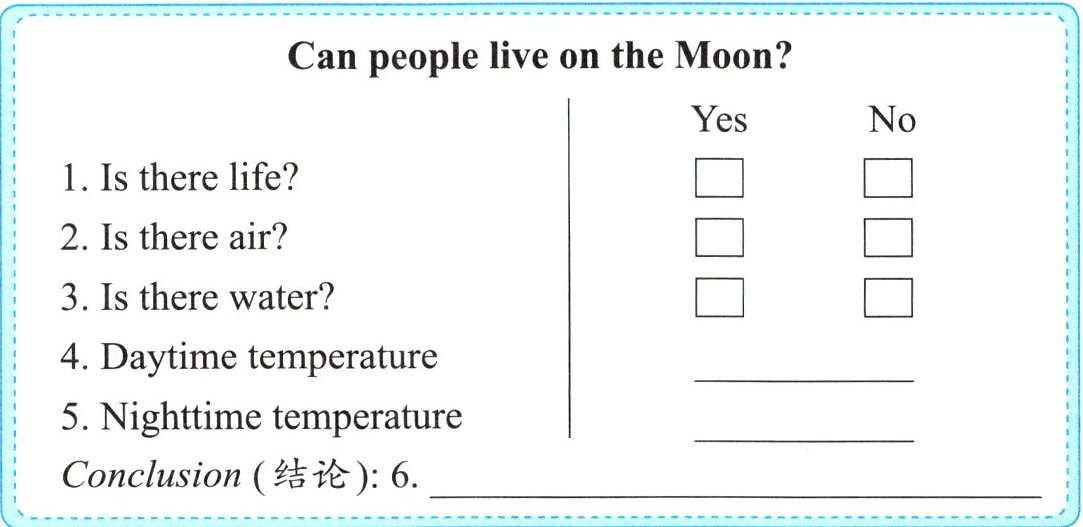
任务二:根据短文内容,分析月球是否适合人类生存,并完成下面的调查报告。
The Sun, the Moon and the stars are all in the sky. We can see the Sun in the daytime. It gives us light and heat (热). We can see the Moon and the stars at night. The Sun is much bigger than the Moon. The Moon is smaller than Earth. The stars look smaller than the Sun and the Moon because they are very far away from us. In 1969, two Americans got to the Moon by spaceship. They found no life there. And there is no air or water. The temperature (温度) on the Moon can reach 127 ℃ during the day and drop (下降) to -183 ℃ at night. It is too hot in the day and too cold at night. So nothing can live on the Moon. Everything on the Moon is much lighter. So we can jump higher on the Moon than on Earth. It’s not easy to walk on the Moon. Walking on the Moon is like jumping and flying.
任务一:根据短文内容,判断下列句子的正(T)误(F)。
(
T
)1. The Sun can give us light and heat.(
F
)2. The Moon is bigger than Earth.(
F
)3. In 1969, two Japanese got to the Moon by spaceship.(
T
)4. Everything is lighter on the Moon than on Earth.(
F
)5. Walking on the Moon is not difficult.任务二:根据短文内容,分析月球是否适合人类生存,并完成下面的调查报告。
答案
任务一:1. T 2. F 3. F 4. T 5. F
任务二:1. No $\boxed{\surd}$ 2. No $\boxed{\surd}$ 3. No $\boxed{\surd}$
4. $127\ °\mathrm{C}$ 5. $-183\ °\mathrm{C}$
6. Nothing can live on the Moon.(答案不唯一)
任务二:1. No $\boxed{\surd}$ 2. No $\boxed{\surd}$ 3. No $\boxed{\surd}$
4. $127\ °\mathrm{C}$ 5. $-183\ °\mathrm{C}$
6. Nothing can live on the Moon.(答案不唯一)
解析
【分析】
本题分为任务一和任务二,需依据短文内容提取关键信息完成作答。任务一为判断正误,需逐句定位短文对应描述:第1题对应太阳的作用,第2题对应月球与地球的大小关系,第3题对应登月人员国籍,第4题对应月球物体重量,第5题对应月球行走难易程度;任务二为分析月球是否适合人类生存,需提取月球的生命、空气、水、温度等条件,再得出结论。
【解析】
任务一:
1. 短文明确提到“The Sun... gives us light and heat”,故该句正确,填T;
2. 短文指出“The Moon is smaller than Earth”,说明月球比地球小,该句错误,填F;
3. 短文说明“In 1969, two Americans got to the Moon”,不是日本人,该句错误,填F;
4. 短文提到“Everything on the Moon is much lighter”,该句正确,填T;
5. 短文表述“It’s not easy to walk on the Moon”,即行走困难,该句错误,填F。
任务二:
1. 短文提到月球无生命,选No;
2. 短文指出月球无空气,选No;
3. 短文说明月球无水,选No;
4. 白天温度为127℃;
5. 夜晚温度为-183℃;
6. 结论:Nothing can live on the Moon.
【答案】
任务一:1. T 2. F 3. F 4. T 5. F
任务二:1. No $\boxed{\surd}$ 2. No $\boxed{\surd}$ 3. No $\boxed{\surd}$ 4. $127\ °\mathrm{C}$ 5. $-183\ °\mathrm{C}$ 6. Nothing can live on the Moon.
【知识点】
英语阅读理解、天文常识
【点评】
本题通过短文阅读考察学生提取信息的能力,结合天文知识,需学生仔细定位原文细节,难度适中。
【难度系数】
0.7
本题分为任务一和任务二,需依据短文内容提取关键信息完成作答。任务一为判断正误,需逐句定位短文对应描述:第1题对应太阳的作用,第2题对应月球与地球的大小关系,第3题对应登月人员国籍,第4题对应月球物体重量,第5题对应月球行走难易程度;任务二为分析月球是否适合人类生存,需提取月球的生命、空气、水、温度等条件,再得出结论。
【解析】
任务一:
1. 短文明确提到“The Sun... gives us light and heat”,故该句正确,填T;
2. 短文指出“The Moon is smaller than Earth”,说明月球比地球小,该句错误,填F;
3. 短文说明“In 1969, two Americans got to the Moon”,不是日本人,该句错误,填F;
4. 短文提到“Everything on the Moon is much lighter”,该句正确,填T;
5. 短文表述“It’s not easy to walk on the Moon”,即行走困难,该句错误,填F。
任务二:
1. 短文提到月球无生命,选No;
2. 短文指出月球无空气,选No;
3. 短文说明月球无水,选No;
4. 白天温度为127℃;
5. 夜晚温度为-183℃;
6. 结论:Nothing can live on the Moon.
【答案】
任务一:1. T 2. F 3. F 4. T 5. F
任务二:1. No $\boxed{\surd}$ 2. No $\boxed{\surd}$ 3. No $\boxed{\surd}$ 4. $127\ °\mathrm{C}$ 5. $-183\ °\mathrm{C}$ 6. Nothing can live on the Moon.
【知识点】
英语阅读理解、天文常识
【点评】
本题通过短文阅读考察学生提取信息的能力,结合天文知识,需学生仔细定位原文细节,难度适中。
【难度系数】
0.7
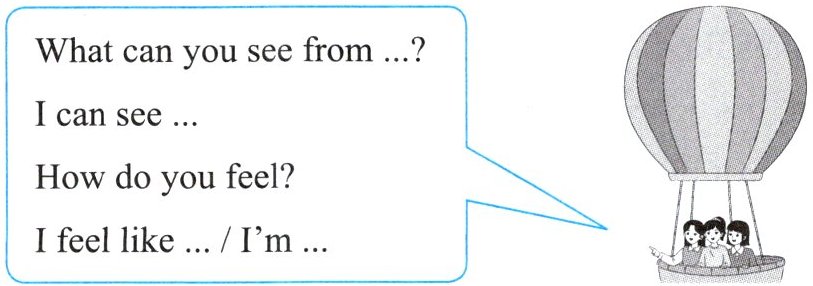
八、Think and say. 假如你获得了一次乘坐热气球进行“云端漫游”的机会。请和同伴一起想一想,说一说。
答案
参考对话示例:
A: What can you see from the hot air balloon?
B: I can see soft white clouds, small houses and rivers on the ground far below.
A: How do you feel?
B: I feel like I'm flying in the fairy tale world. I'm so excited.
A: What can you see from the hot air balloon?
B: I can see soft white clouds, small houses and rivers on the ground far below.
A: How do you feel?
B: I feel like I'm flying in the fairy tale world. I'm so excited.
解析
【分析】本题是情景口语表达题,需结合乘坐热气球的场景,运用题目给出的句型完成对话。首先根据问题“What can you see from...”,结合高空视角的景物(如云朵、地面的建筑等)作答;再根据问题“How do you feel?”,用指定句型表达乘坐热气球的感受即可。
【解析】按照题目要求,使用给定句型,结合热气球场景组织对话:先回答高空看到的景物,再表达乘坐的感受,符合日常口语表达逻辑。
【答案】A: What can you see from the hot air balloon?
B: I can see soft white clouds, small houses and rivers on the ground far below.
A: How do you feel?
B: I feel like I'm flying in the fairy tale world. I'm so excited.
【知识点】情景对话表达;景物描述;情绪表达
【点评】本题结合生活场景考查英语口语运用,贴近实际,要求学生运用给定句型完成合理对话,难度适中,能有效考查学生的口语表达能力。
【难度系数】0.3
【解析】按照题目要求,使用给定句型,结合热气球场景组织对话:先回答高空看到的景物,再表达乘坐的感受,符合日常口语表达逻辑。
【答案】A: What can you see from the hot air balloon?
B: I can see soft white clouds, small houses and rivers on the ground far below.
A: How do you feel?
B: I feel like I'm flying in the fairy tale world. I'm so excited.
【知识点】情景对话表达;景物描述;情绪表达
【点评】本题结合生活场景考查英语口语运用,贴近实际,要求学生运用给定句型完成合理对话,难度适中,能有效考查学生的口语表达能力。
【难度系数】0.3
