

 登录
11.随着全民健身意识增强,马拉松运动逐渐成为深受群众喜爱的体育健身项目之一。半程马拉松全程长度为21 km,排名第一的选手用时70 min。
(1)这名选手跑完半程马拉松的平均速度是多少?
(2)武汉长江大桥1957年10月15日正式通车,全长1 670 m。以平均速度计算,这名选手通过长江大桥用了多长时间?
(1)这名选手跑完半程马拉松的平均速度是多少?
(2)武汉长江大桥1957年10月15日正式通车,全长1 670 m。以平均速度计算,这名选手通过长江大桥用了多长时间?
答案
1. 半程马拉松路程为 $s=21\ \mathrm{km}=21\ 000\ \mathrm{m}$,所用时间 $t=70\ \mathrm{min}=4\ 200\ \mathrm{s}$,这名选手跑完半程马拉松的平均速度为 $v=\frac{s}{t}=\frac{21\ 000\ \mathrm{m}}{4\ 200\ \mathrm{s}}=5\ \mathrm{m/s}$;
2. 武汉长江大桥全长 $s_\mathrm{桥}=1\ 670\ \mathrm{m}$,由 $v=\frac{s}{t}$可得,这名选手通过长江大桥所用时间为 $t'=\frac{s_\mathrm{桥}}{v}=\frac{1\ 670\ \mathrm{m}}{5\ \mathrm{m/s}}=334\ \mathrm{s}$。
2. 武汉长江大桥全长 $s_\mathrm{桥}=1\ 670\ \mathrm{m}$,由 $v=\frac{s}{t}$可得,这名选手通过长江大桥所用时间为 $t'=\frac{s_\mathrm{桥}}{v}=\frac{1\ 670\ \mathrm{m}}{5\ \mathrm{m/s}}=334\ \mathrm{s}$。
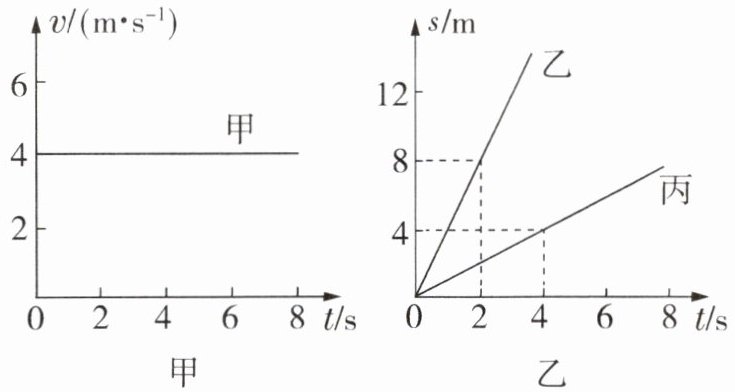
12.甲、乙、丙三辆小车同时、同地向东开始运动,它们运动的图像如图所示。求:
(1)乙车运动的速度。
(2)通过300 m的路程甲车需要行驶的时间。
(3)5 s后甲、丙两车相距的距离。
(1)乙车运动的速度。
(2)通过300 m的路程甲车需要行驶的时间。
(3)5 s后甲、丙两车相距的距离。
答案
1. 由图乙可知,乙车在 2 s 内通过的路程为 8 m,则乙车运动的速度为
$v_\mathrm{乙}=\frac{s_\mathrm{乙}}{t_\mathrm{乙}}=\frac{8\ \mathrm{m}}{2\ \mathrm{s}}=4\ \mathrm{m/s}$;
2. 由图甲可知,甲车的速度 $v_\mathrm{甲}=4\ \mathrm{m/s}$,由 $v=\frac{s}{t}$可知,通过 300 m 的路程甲车需要行驶的时间为
$t_\mathrm{甲}=\frac{s_\mathrm{甲}}{v_\mathrm{甲}}=\frac{300\ \mathrm{m}}{4\ \mathrm{m/s}}=75\ \mathrm{s}$。
3. 由图乙可知,丙车在 4 s 内通过的路程为 4 m,则丙车的速度为
$v_\mathrm{丙}=\frac{s_\mathrm{丙}}{t_\mathrm{丙}}=\frac{4\ \mathrm{m}}{4\ \mathrm{s}}=1\ \mathrm{m/s}$,
由 $v=\frac{s}{t}$ 可知,5 s 内甲车行驶的路程为
$s_1=v_\mathrm{甲}\ t=4\ \mathrm{m/s}×5\ \mathrm{s}=20\ \mathrm{m}$,
5 s 内丙车行驶的路程为
$s_2=v_\mathrm{丙}\ t=1\ \mathrm{m/s}×5\ \mathrm{s}=5\ \mathrm{m}$,
甲、乙、丙三辆小车同时、同地向东开始运动,则 5 s 后甲、丙两车相距的距离为
$\Delta s=s_1-s_2=20\ \mathrm{m}-5\ \mathrm{m}=15\ \mathrm{m}$。
13.如图甲所示,为当今世界最长的跨海大桥——港珠澳大桥,被称为“中国奇迹”的“超级工程”,全长 55 km,图乙是桥上的交通标志牌。求:
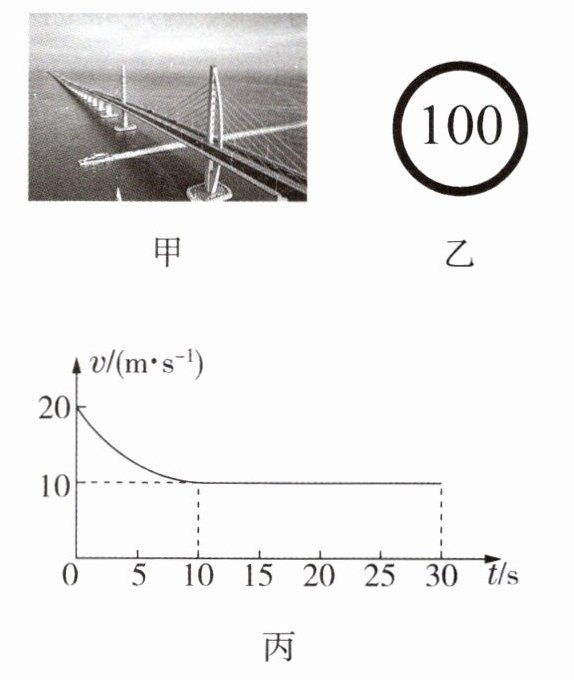
(1)图乙标志牌中的“100”指
(2)一辆小客车匀速通过大桥用时 40 min,该小客车是否超速?
(3)一辆汽车驶入大桥后开始减速,速度与时间的关系如图丙所示,经 10 s 行驶160 m后,开始做匀速直线运动,在这30 s整个过程中,汽车的平均速度是多少?
(1)图乙标志牌中的“100”指
此路段车辆行驶的最大速度不能超过100 km/h
。(2)一辆小客车匀速通过大桥用时 40 min,该小客车是否超速?
(3)一辆汽车驶入大桥后开始减速,速度与时间的关系如图丙所示,经 10 s 行驶160 m后,开始做匀速直线运动,在这30 s整个过程中,汽车的平均速度是多少?
答案
1. 限速 100 km/h
2. 已知港珠澳大桥全长 $s=55\ \mathrm{km}$,小客车通过大桥的时间为 $t=40\ \mathrm{min}=\frac{40}{60}\ \mathrm{h}=\frac{2}{3}\ \mathrm{h}$,根据速度公式,小客车的行驶速度为
$v=\frac{s}{t}=\frac{55\ \mathrm{km}}{\frac{2}{3}\ \mathrm{h}}=82.5\ \mathrm{km/h}$,
因为 $82.5\ \mathrm{km/h}<100\ \mathrm{km/h}$,所以该小客车没有超速。
3. 由图丙可知,汽车先减速行驶 10 s 后,开始做匀速直线运动,此时 $v_\mathrm{匀}=10\ \mathrm{m/s}$,匀速行驶时间为 $t_\mathrm{匀}=30\ \mathrm{s}-10\ \mathrm{s}=20\ \mathrm{s}$,
根据 $s=vt$,匀速行驶的路程为 $s_\mathrm{匀}=v_\mathrm{匀}\ t_\mathrm{匀}=10\ \mathrm{m/s}×20\ \mathrm{s}=200\ \mathrm{m}$,
总路程 $s_\mathrm{总}=160\ \mathrm{m}+200\ \mathrm{m}=360\ \mathrm{m}$,
汽车的平均速度为
$v_\mathrm{平均}=\frac{s_\mathrm{总}}{t_\mathrm{总}}=\frac{360\ \mathrm{m}}{30\ \mathrm{s}}=12\ \mathrm{m/s}$。
