

 登录
探究点1 whole 的用法
whole 作形容词,意为“所有的;完全的”,修饰单数可数名词,通常放在定冠词 the 或形容词性物主代词之后。
the whole day 一整天;my whole life 我的一生;the whole class 全班
【知识拓展】辨析 whole 与 all
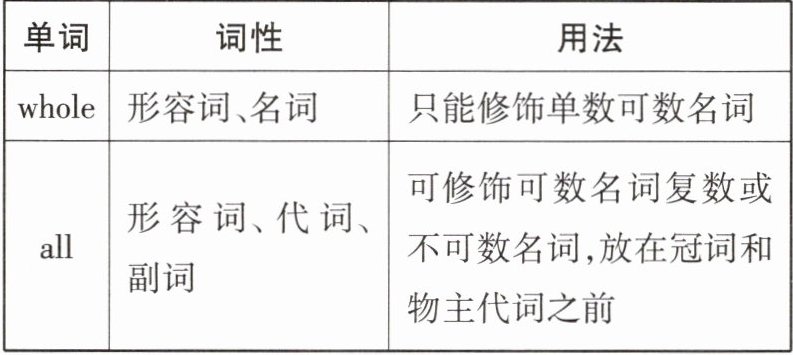
She spent the whole morning reading.
她花了整个上午读书。
All my friends came to my party.
我所有的朋友都来参加我的聚会了。
情境应用
1. —Did you spend afternoon finishing your homework?
—Yes, and I felt a little tired after that.
A. all the
B. whole the
C. the all
D. whole
2. The old man devoted to protecting the forests in Yunnan. (他的一生)
whole 作形容词,意为“所有的;完全的”,修饰单数可数名词,通常放在定冠词 the 或形容词性物主代词之后。
the whole day 一整天;my whole life 我的一生;the whole class 全班
【知识拓展】辨析 whole 与 all
She spent the whole morning reading.
她花了整个上午读书。
All my friends came to my party.
我所有的朋友都来参加我的聚会了。
情境应用
1. —Did you spend afternoon finishing your homework?
—Yes, and I felt a little tired after that.
A. all the
B. whole the
C. the all
D. whole
2. The old man devoted to protecting the forests in Yunnan. (他的一生)
答案
1. A
2. his whole life
2. his whole life
解析
1. 本题考查whole与all的用法辨析:all修饰名词时需放在定冠词、物主代词之前,all the afternoon意为“整个下午”;whole修饰单数可数名词时要放在定冠词the之后,正确表达应为the whole afternoon,选项B、C、D的排列均不符合用法规则,因此选A。
2. 本题考查whole的用法,按照规则whole要放在形容词性物主代词之后,对应“他的一生”的正确表达为his whole life。
2. 本题考查whole的用法,按照规则whole要放在形容词性物主代词之后,对应“他的一生”的正确表达为his whole life。
探究点2 leave behind 的用法
leave behind 意为“留下;遗留”,是“动词+副词”结构的短语,当宾语是名词时,名词放在leave和behind的中间或后面均可;当宾语是代词时,要把代词放在leave和behind的中间。
Don’t leave behind your bag.
=Don’t leave your bag behind.
不要落下你的包。
Don’t leave anything behind when you leave.
你离开时不要留下任何东西。
情境应用
1. The kind traveller some books and clothes for the kids last week.
A. agreed with B. left behind
C. thought of D. dealt with
2. The ancient town in Lijiang many old stone houses.(遗留)
答案
1. B
2. leaves behind
2. leaves behind
解析
1. 本题考查短语辨析:A选项agreed with意为“同意”,B选项left behind意为“留下、遗留”,C选项thought of意为“想起”,D选项dealt with意为“处理”。根据句意“这位好心的旅行者上周给孩子们留下了一些书和衣服”,结合表一般过去时的时间状语last week,只有B选项符合语境。
2. 本题考查leave behind的用法,根据中文提示“遗留”,主语The ancient town是单数名词,此处陈述客观事实,谓语动词用一般现在时的第三人称单数形式,宾语many old stone houses是名词,可放在leave和behind之后,因此填入对应形式即可。
2. 本题考查leave behind的用法,根据中文提示“遗留”,主语The ancient town是单数名词,此处陈述客观事实,谓语动词用一般现在时的第三人称单数形式,宾语many old stone houses是名词,可放在leave和behind之后,因此填入对应形式即可。
()1. We went to the to get some money and then visited the nearby flower market last Sunday.
A.bank
B.park
C.cinema
D.hospital
A.bank
B.park
C.cinema
D.hospital
答案
A
解析
根据句中"to get some money(取钱)"的提示,能办理取钱业务的场所是银行,选项A银行、B公园、C电影院、D医院,只有A符合语境逻辑。
()2. The community always the elderly free medical checks every spring.
A.compares ; with
B.provides ; with
C.mixes ; with
D.covers ; with
A.compares ; with
B.provides ; with
C.mixes ; with
D.covers ; with
答案
B
解析
辨析各选项短语含义:A. compare...with 把……和……作比较;B. provide sb. with sth. 为某人提供某物;C. mix...with 把……和……混合;D. cover...with 用……覆盖。根据句意“社区每年春天总是为老年人提供免费体检”,只有B项符合语境。
()3. Lei Feng Spirit will stay in our hearts
.
A.already
B.yet
C.never
D.forever
.
A.already
B.yet
C.never
D.forever
答案
D
解析
辨析各选项副词含义与用法:A.already表“已经”,多用于现在完成时肯定句;B.yet表“还”,多用于否定句、疑问句句末;C.never表“从不”,代入句子语义不通;D.forever表“永远”,契合“雷锋精神将永远留在我们心中”的句意,符合一般将来时语境。
Ⅱ.根据句意,用括号中所给词的适当形式填空
1. They collected old and repaired them for the elderly in the community. (radio)
2. We do in the forest to find
new plants. (explore)
3. We should use some ways to solve the problem. (science)
4. My friend has a of toy cars from all over the world. (collect)
1. They collected old and repaired them for the elderly in the community. (radio)
2. We do in the forest to find
new plants. (explore)
3. We should use some ways to solve the problem. (science)
4. My friend has a of toy cars from all over the world. (collect)
答案
1. radios
2. exploration
3. scientific
4. collection
2. exploration
3. scientific
4. collection
解析
1. 句中后文的them指代空格处的名词,radio是可数名词,此处指代多台旧收音机,需要使用复数形式,以o结尾的无生命可数名词变复数直接加s,所以填radios。
2. 动词do后需要接名词作宾语,动词explore对应的名词形式是exploration,do exploration意为“进行探索”,符合句意。
3. 空格后是名词ways,需要用形容词修饰该名词,名词science对应的形容词形式是scientific,意为“科学的”,scientific ways表示“科学的方法”。
4. 不定冠词a后需要接名词,动词collect对应的名词形式是collection,固定搭配a collection of表示“一批/收藏”,符合语境。
2. 动词do后需要接名词作宾语,动词explore对应的名词形式是exploration,do exploration意为“进行探索”,符合句意。
3. 空格后是名词ways,需要用形容词修饰该名词,名词science对应的形容词形式是scientific,意为“科学的”,scientific ways表示“科学的方法”。
4. 不定冠词a后需要接名词,动词collect对应的名词形式是collection,固定搭配a collection of表示“一批/收藏”,符合语境。
