

 登录
登录
B
阅读下面材料,从题中所给的A、B、C、D四个选项中选出一个最佳选项。
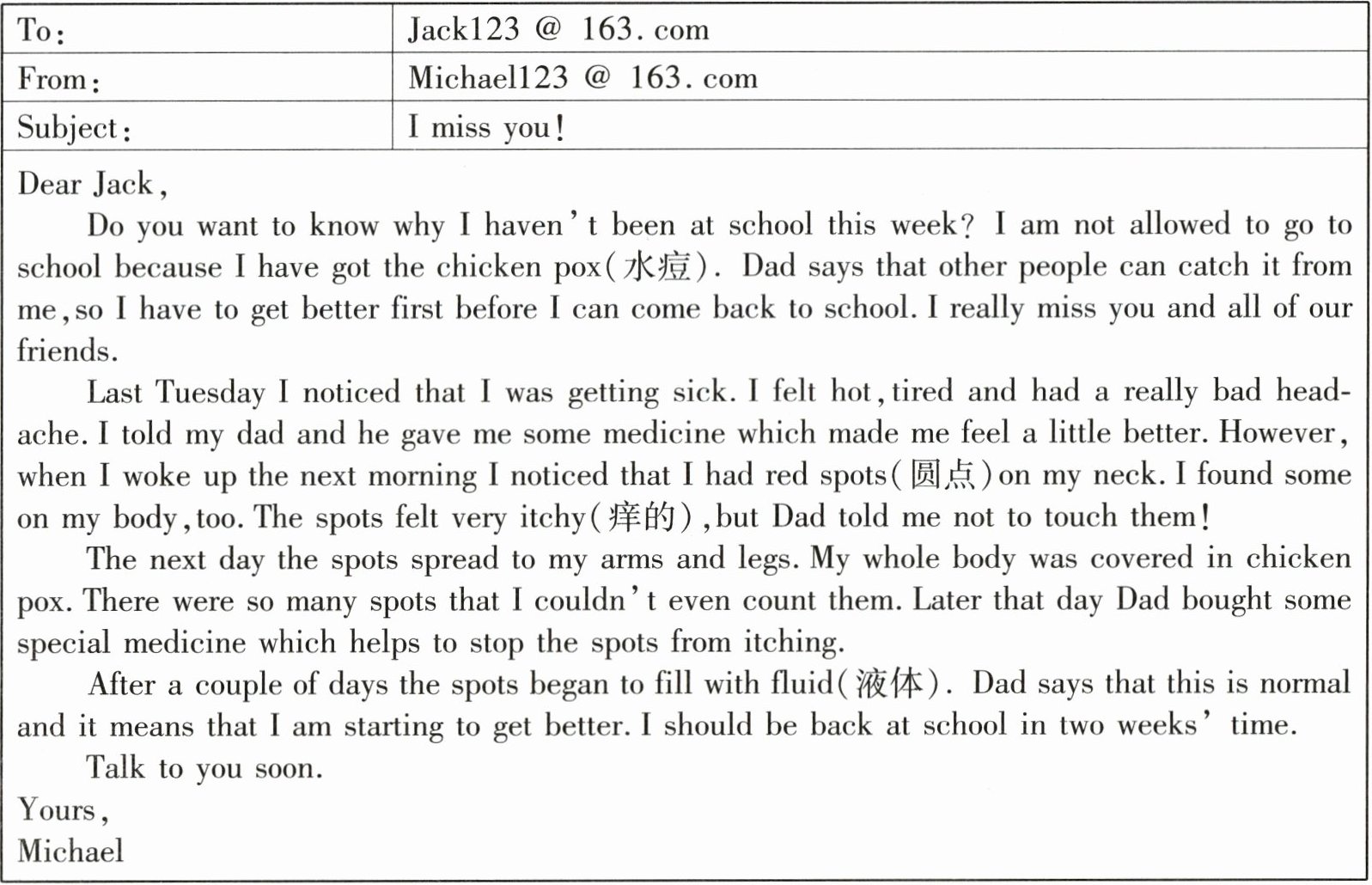
(
A. at school B. at home C. in the hospital D. in the library
(
A. they are on vacation now B. they have moved away with their parents
C. he cannot go to school now D. he is in a different school now
(
A. neck and body B. arms and legs C. neck and arms D. hands and legs
(
A. week B. two weeks C. month D. two months
(
A. only happens to children B. is a very dangerous illness
C. only happens in school D. can spread from one person to another
阅读下面材料,从题中所给的A、B、C、D四个选项中选出一个最佳选项。
(
B
)6. Michael wrote this email ______.A. at school B. at home C. in the hospital D. in the library
(
C
)7. Michael misses his friends because ______.A. they are on vacation now B. they have moved away with their parents
C. he cannot go to school now D. he is in a different school now
(
A
)8. Michael first found red spots on his ______.A. neck and body B. arms and legs C. neck and arms D. hands and legs
(
B
)9. It will take another ______ for Michael to get well again.A. week B. two weeks C. month D. two months
(
D
)10. We can learn from the passage that the chicken pox ______.A. only happens to children B. is a very dangerous illness
C. only happens in school D. can spread from one person to another
答案
6.B 7.C 8.A 9.B 10.D
解析
翻译:
B
阅读下面材料,从题中所给的A、B、C、D四个选项中选出一个最佳选项。
( )6. 迈克尔写这封电子邮件________。
A. 在学校 B. 在家 C. 在医院 D. 在图书馆
( )7. 迈克尔想念他的朋友们,因为________。
A. 他们现在在度假 B. 他们和父母搬走了
C. 他现在不能去上学 D. 他现在在一所不同的学校
( )8. 迈克尔首先在他的________上发现了红点。
A. 脖子和身体 B. 胳膊和腿 C. 脖子和胳膊 D. 手和腿
( )9. 迈克尔要再过________才能康复。
A. 一周 B. 两周 C. 一个月 D. 两个月
( )10. 我们从文章中可以了解到水痘________。
A. 只发生在孩子身上 B. 是一种非常危险的疾病
C. 只在学校发生 D. 可以在人与人之间传播
B
阅读下面材料,从题中所给的A、B、C、D四个选项中选出一个最佳选项。
( )6. 迈克尔写这封电子邮件________。
A. 在学校 B. 在家 C. 在医院 D. 在图书馆
( )7. 迈克尔想念他的朋友们,因为________。
A. 他们现在在度假 B. 他们和父母搬走了
C. 他现在不能去上学 D. 他现在在一所不同的学校
( )8. 迈克尔首先在他的________上发现了红点。
A. 脖子和身体 B. 胳膊和腿 C. 脖子和胳膊 D. 手和腿
( )9. 迈克尔要再过________才能康复。
A. 一周 B. 两周 C. 一个月 D. 两个月
( )10. 我们从文章中可以了解到水痘________。
A. 只发生在孩子身上 B. 是一种非常危险的疾病
C. 只在学校发生 D. 可以在人与人之间传播
C
阅读下面材料,从题中所给的A、B、C、D四个选项中选出一个最佳选项。
If you live in Shanghai, you might have taken a "lesson" in sorting (分类) garbage, as the city introduced new garbage-sorting regulations (规章) on July 1, 2019.
As China's first city to carry out strict regulations on garbage sorting and recycling, Shanghai requires its residents (居民) to sort garbage into four categories (类别), namely recyclable, harmful, dry and wet waste. If people fail to sort their garbage properly, they can be fined up to 200 yuan.
Since the regulation took effect, the amount of total daily waste in Shanghai has been reduced by an average of 15,500 tons, dropping 26 percent from the end of 2018, while the average daily weight of recyclables hits 4,500 tons, five times higher than the end of 2018, according to the Shanghai Landscaping and City Appearance Administrative Bureau.
The city also rebuilt 21,000 waste-sorting stations and more than 40,000 waste bins have been updated (更新). The city's waste collection and transportation system (运输系统) is complete, according to the bureau.
"Proper waste sorting protects the environment and saves natural resources," said Deng Jianping, director of the bureau. "Led by the central government, Shanghai is making efforts to develop long-term solutions to garbage management."
However, there have also been some problems. Some people complained that it is difficult to deal with wet garbage, as they are asked to remove wet garbage from its bag when dumping (倾倒). According to the sorting rules, the wet garbage must go in the wet waste bin and the bag must go in the dry waste bin.
This separation is necessary, as it ensures that the wet garbage will decompose (分解) properly and become useful organic (有机的) waste, the bureau said.
Plastic bags can affect this process. Some people in Shanghai are instead using paper bags that can biodegrade (生物降解) or plastic containers that can be washed and reused, according to Xinhua.
(
A. recyclable, dry, harmful and kitchen waste B. recyclable, kitchen, dry and "other" waste
C. harmful, recyclable, dry and "other" waste D. harmful, recyclable, dry and wet waste
(
A. The garbage-sorting regulation has already brought improvements. |
B. Recyclable waste comes out to two-thirds of the total daily waste. |
C. In 2019, people produced less waste than in 2018. |
D. Shanghai needs stricter rules to deal with waste. |
(
A. has added more than 40,000 waste bins B. has had problems with garbage management
C. will help other cities make garbage-sorting regulations D. is still looking for long-term solutions to deal with garbage
(
A. The process of sorting garbage. B. The process of dumping wet waste.
C. The process of decomposing wet waste. D. The separation of wet waste and dry waste.
(
A. why Shanghai must sort their garbage B. how Shanghai sorts their garbage
C. the new garbage-sorting regulation in Shanghai and some of its achievement D. how to protect our environment
阅读下面材料,从题中所给的A、B、C、D四个选项中选出一个最佳选项。
If you live in Shanghai, you might have taken a "lesson" in sorting (分类) garbage, as the city introduced new garbage-sorting regulations (规章) on July 1, 2019.
As China's first city to carry out strict regulations on garbage sorting and recycling, Shanghai requires its residents (居民) to sort garbage into four categories (类别), namely recyclable, harmful, dry and wet waste. If people fail to sort their garbage properly, they can be fined up to 200 yuan.
Since the regulation took effect, the amount of total daily waste in Shanghai has been reduced by an average of 15,500 tons, dropping 26 percent from the end of 2018, while the average daily weight of recyclables hits 4,500 tons, five times higher than the end of 2018, according to the Shanghai Landscaping and City Appearance Administrative Bureau.
The city also rebuilt 21,000 waste-sorting stations and more than 40,000 waste bins have been updated (更新). The city's waste collection and transportation system (运输系统) is complete, according to the bureau.
"Proper waste sorting protects the environment and saves natural resources," said Deng Jianping, director of the bureau. "Led by the central government, Shanghai is making efforts to develop long-term solutions to garbage management."
However, there have also been some problems. Some people complained that it is difficult to deal with wet garbage, as they are asked to remove wet garbage from its bag when dumping (倾倒). According to the sorting rules, the wet garbage must go in the wet waste bin and the bag must go in the dry waste bin.
This separation is necessary, as it ensures that the wet garbage will decompose (分解) properly and become useful organic (有机的) waste, the bureau said.
Plastic bags can affect this process. Some people in Shanghai are instead using paper bags that can biodegrade (生物降解) or plastic containers that can be washed and reused, according to Xinhua.
(
D
)11. People in Shanghai are asked to sort their garbage into the ______ categories.A. recyclable, dry, harmful and kitchen waste B. recyclable, kitchen, dry and "other" waste
C. harmful, recyclable, dry and "other" waste D. harmful, recyclable, dry and wet waste
(
A
)12. What does the third paragraph tell us?A. The garbage-sorting regulation has already brought improvements. |
B. Recyclable waste comes out to two-thirds of the total daily waste. |
C. In 2019, people produced less waste than in 2018. |
D. Shanghai needs stricter rules to deal with waste. |
(
D
)13. According to Deng Jianping, Shanghai ______.A. has added more than 40,000 waste bins B. has had problems with garbage management
C. will help other cities make garbage-sorting regulations D. is still looking for long-term solutions to deal with garbage
(
C
)14. What does "this process" in the last paragraph refer to?A. The process of sorting garbage. B. The process of dumping wet waste.
C. The process of decomposing wet waste. D. The separation of wet waste and dry waste.
(
C
)15. This article tells us ______.A. why Shanghai must sort their garbage B. how Shanghai sorts their garbage
C. the new garbage-sorting regulation in Shanghai and some of its achievement D. how to protect our environment
答案
11.D 12.A 13.D 14.C 15.C
解析
翻译:
### C
阅读下面材料,从题中所给的A、B、C、D四个选项中选出一个最佳选项。
如果你住在上海,你可能已经上了一堂垃圾分类的“课”,因为这座城市在2019年7月1日出台了新的垃圾分类规章。
作为中国第一个对垃圾分类和回收实施严格规章的城市,上海要求其居民将垃圾分为四类,即可回收物、有害垃圾、干垃圾和湿垃圾。如果人们没有正确地进行垃圾分类,他们可能会被处以最高200元的罚款。
据上海市绿化和市容管理局称,自该规章生效以来,上海的每日垃圾总量平均减少了15500吨,比2018年底下降了26%,而可回收物的平均日重量达到了4500吨,是2018年底的五倍。
该市还重建了21000个垃圾分类站,超过40000个垃圾桶得到了更新。据该局称,该市的垃圾收集和运输系统已经完善。
“正确的垃圾分类保护环境并节约自然资源,”该局局长邓建平说,“在中央政府的领导下,上海正在努力制定垃圾管理的长期解决方案。”
然而,也出现了一些问题。一些人抱怨处理湿垃圾很困难,因为他们被要求在倾倒湿垃圾时将其从袋子里拿出来。根据分类规则,湿垃圾必须放入湿垃圾桶,袋子必须放入干垃圾桶。
该局表示,这种分离是必要的,因为它确保湿垃圾能够正常分解并成为有用的有机垃圾。
塑料袋会影响这个过程。据新华社报道,上海的一些人转而使用可生物降解的纸袋或可清洗并重复使用的塑料容器。
( )11. 上海市民被要求将垃圾分为________类。
A. 可回收物、干垃圾、有害垃圾和厨余垃圾
B. 可回收物、厨余垃圾、干垃圾和“其他”垃圾
C. 有害垃圾、可回收物、干垃圾和“其他”垃圾
D. 有害垃圾、可回收物、干垃圾和湿垃圾
( )12. 第三段告诉我们什么?
A. 垃圾分类规章已经带来了改善。
B. 可回收垃圾占每日垃圾总量的三分之二。
C. 2019年,人们产生的垃圾比2018年少。
D. 上海需要更严格的规章来处理垃圾。
( )13. 据邓建平说,上海________。
A. 已经增加了超过40000个垃圾桶
B. 在垃圾管理方面存在问题
C. 将帮助其他城市制定垃圾分类规章
D. 仍在寻找处理垃圾的长期解决方案
( )14. 最后一段中的“这个过程”指的是什么?
A. 垃圾分类的过程。
B. 倾倒湿垃圾的过程。
C. 湿垃圾分解的过程。
D. 湿垃圾和干垃圾的分离。
( )15. 这篇文章告诉我们________。
A. 上海为什么必须进行垃圾分类
B. 上海如何进行垃圾分类
C. 上海新的垃圾分类规章及其一些成果
D. 如何保护我们的环境
### C
阅读下面材料,从题中所给的A、B、C、D四个选项中选出一个最佳选项。
如果你住在上海,你可能已经上了一堂垃圾分类的“课”,因为这座城市在2019年7月1日出台了新的垃圾分类规章。
作为中国第一个对垃圾分类和回收实施严格规章的城市,上海要求其居民将垃圾分为四类,即可回收物、有害垃圾、干垃圾和湿垃圾。如果人们没有正确地进行垃圾分类,他们可能会被处以最高200元的罚款。
据上海市绿化和市容管理局称,自该规章生效以来,上海的每日垃圾总量平均减少了15500吨,比2018年底下降了26%,而可回收物的平均日重量达到了4500吨,是2018年底的五倍。
该市还重建了21000个垃圾分类站,超过40000个垃圾桶得到了更新。据该局称,该市的垃圾收集和运输系统已经完善。
“正确的垃圾分类保护环境并节约自然资源,”该局局长邓建平说,“在中央政府的领导下,上海正在努力制定垃圾管理的长期解决方案。”
然而,也出现了一些问题。一些人抱怨处理湿垃圾很困难,因为他们被要求在倾倒湿垃圾时将其从袋子里拿出来。根据分类规则,湿垃圾必须放入湿垃圾桶,袋子必须放入干垃圾桶。
该局表示,这种分离是必要的,因为它确保湿垃圾能够正常分解并成为有用的有机垃圾。
塑料袋会影响这个过程。据新华社报道,上海的一些人转而使用可生物降解的纸袋或可清洗并重复使用的塑料容器。
( )11. 上海市民被要求将垃圾分为________类。
A. 可回收物、干垃圾、有害垃圾和厨余垃圾
B. 可回收物、厨余垃圾、干垃圾和“其他”垃圾
C. 有害垃圾、可回收物、干垃圾和“其他”垃圾
D. 有害垃圾、可回收物、干垃圾和湿垃圾
( )12. 第三段告诉我们什么?
A. 垃圾分类规章已经带来了改善。
B. 可回收垃圾占每日垃圾总量的三分之二。
C. 2019年,人们产生的垃圾比2018年少。
D. 上海需要更严格的规章来处理垃圾。
( )13. 据邓建平说,上海________。
A. 已经增加了超过40000个垃圾桶
B. 在垃圾管理方面存在问题
C. 将帮助其他城市制定垃圾分类规章
D. 仍在寻找处理垃圾的长期解决方案
( )14. 最后一段中的“这个过程”指的是什么?
A. 垃圾分类的过程。
B. 倾倒湿垃圾的过程。
C. 湿垃圾分解的过程。
D. 湿垃圾和干垃圾的分离。
( )15. 这篇文章告诉我们________。
A. 上海为什么必须进行垃圾分类
B. 上海如何进行垃圾分类
C. 上海新的垃圾分类规章及其一些成果
D. 如何保护我们的环境
