

 登录
登录
五、[2026合肥二模] 立德树人·热爱家乡补全对话(有两项多余)
A: How long have you lived in Hefei, Mr Hu?
B: All my life. 20.
A: How has it changed?
B: When I was young, there was no underground. 21.
A: Exactly! It’s an excellent way to get around!
B: I agree. The city is also much busier than before. 22.
A: Sounds great! Are there any other changes?
B: 23.
A: Good to hear that. 24.
A. Thanks for talking to me.
B. Now the government has built the Hefei Metro to improve transport for its citizens.
C. It has changed a lot over the years.
D. The government helped build many new parks in Hefei, like Luogang Park.
E. I don’t know where to go in the city now.
F. People don’t like living in the city any more.
G. There are more services and attractions now.
A: How long have you lived in Hefei, Mr Hu?
B: All my life. 20.
C
A: How has it changed?
B: When I was young, there was no underground. 21.
B
A: Exactly! It’s an excellent way to get around!
B: I agree. The city is also much busier than before. 22.
G
And tourism has become an important industry here.A: Sounds great! Are there any other changes?
B: 23.
D
They are great places for people to relax and have fun.A: Good to hear that. 24.
A
A. Thanks for talking to me.
B. Now the government has built the Hefei Metro to improve transport for its citizens.
C. It has changed a lot over the years.
D. The government helped
build many new parks in Hefei, like Luogang Park.E. I don’t know where to go in the city now.
F. People don’t like living in the city any more.
G. There are more services and attractions now.
答案
20. C 21. B 22. G 23. D 24. A
解析
【分析】本题为补全对话题,需结合上下文语境的问答逻辑,选择语义连贯、符合“合肥变化”这一对话主题的选项。先通读对话明确话题,再逐一分析每个空的前后句逻辑:20空承接“住了一辈子”引出“变化”话题;21空承接“没有地铁”对应地铁相关内容;22空承接“城市更忙”引出服务与景点;23空承接“其他变化”对应公园相关;24空为对话结尾的感谢语。
【解析】20. 前句B称住了一辈子,后句A问“它怎么变化的”,故20空需引出“变化”,选C;21空前句说“小时候没有地铁”,后句A夸赞地铁是好的出行方式,故21空需提到建地铁,选B;22空前句说“城市更忙”,后句提及旅游业成重要产业,故22空需提到服务和景点,选G;23空前句问“其他变化”,后句说“放松娱乐的地方”,故23空需提到公园,选D;24空为对话结尾,A应表达感谢,选A。
【答案】20.C 21.B 22.G 23.D 24.A
【知识点】补全对话、情景交际、语境理解
【点评】本题以合肥的变化为话题,考查学生对日常交际语境的逻辑理解能力,贴近学生生活,难度适中,能有效检测学生的情景运用能力。
【难度系数】0.6
【解析】20. 前句B称住了一辈子,后句A问“它怎么变化的”,故20空需引出“变化”,选C;21空前句说“小时候没有地铁”,后句A夸赞地铁是好的出行方式,故21空需提到建地铁,选B;22空前句说“城市更忙”,后句提及旅游业成重要产业,故22空需提到服务和景点,选G;23空前句问“其他变化”,后句说“放松娱乐的地方”,故23空需提到公园,选D;24空为对话结尾,A应表达感谢,选A。
【答案】20.C 21.B 22.G 23.D 24.A
【知识点】补全对话、情景交际、语境理解
【点评】本题以合肥的变化为话题,考查学生对日常交际语境的逻辑理解能力,贴近学生生活,难度适中,能有效检测学生的情景运用能力。
【难度系数】0.6
六、阅读理解
Three students share transport changes in their hometowns.
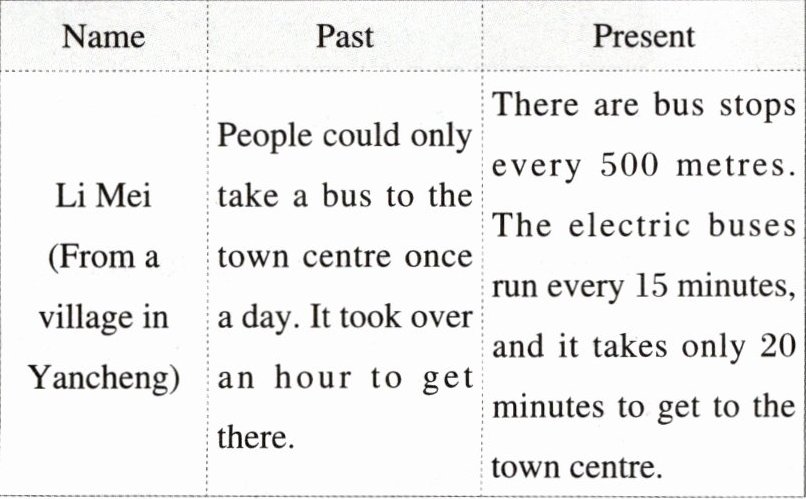
2 英语 九年级 上册 人教版
(续表)
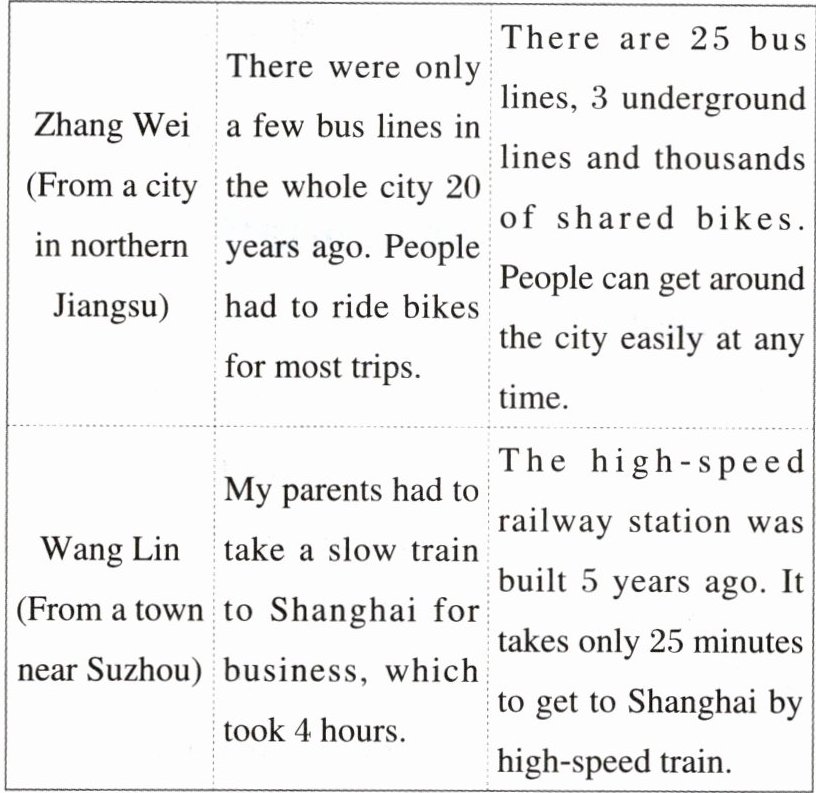
Zhang Wei (From a city in northern Jiangsu) | There were only a few bus lines in the whole city 20 years ago. People had to ride bikes for most trips. | There are 25 bus lines, 3 underground lines and thousands of shared bikes. People can get around the city easily at any time.
Wang Lin (From a town near Suzhou) | My parents had to take a slow train to Shanghai for business, which took 4 hours. | The high-speed railway station was built 5 years ago. It takes only 25 minutes to get to Shanghai by high-speed train.
(
A. Slow and crowded.
B. Fast and convenient.
C. Cheap but slow.
D. Expensive but fast.
(
A. A village has built a new road to connect with the nearby town.
B. A city has added 10 new flight routes to other countries.
C. A city has developed from one bus line to a complete public transport network.
D. The countryside has replaced all the old buses with new electric ones.
(
A. By slow train.
B. By bus.
C. By high-speed train.
D. By car.
Three students share transport changes in their hometowns.
2 英语 九年级 上册 人教版
(续表)
Zhang Wei (From a city in northern Jiangsu) | There were only a few bus lines in the whole city 20 years ago. People had to ride bikes for most trips. | There are 25 bus lines, 3 underground lines and thousands of shared bikes. People can get around the city easily at any time.
Wang Lin (From a town near Suzhou) | My parents had to take a slow train to Shanghai for business, which took 4 hours. | The high-speed railway station was built 5 years ago. It takes only 25 minutes to get to Shanghai by high-speed train.
(
B
)25. What does Li Mei think of the present transport in her hometown?A. Slow and crowded.
B. Fast and convenient.
C. Cheap but slow.
D. Expensive but fast.
(
C
)26. 能力训练点·信息提取与加工 Which of the following is the most similar to Zhang Wei’s hometown change?A. A village has built a new road to connect with the nearby town.
B. A city has added 10 new flight routes to other countries.
C. A city has developed from one bus line to a complete public transport network.
D. The countryside has replaced all the old buses with new electric ones.
(
C
)27. How do Wang Lin’s parents go to Shanghai for business now?A. By slow train.
B. By bus.
C. By high-speed train.
D. By car.
答案
25. B 26. C 27. C
解析
【分析】本题为英语阅读理解细节题,需根据题目要求定位原文对应信息作答。第25题需判断家乡当前交通特点,第26题需匹配张伟家乡的交通变化类型,第27题需提取王林父母现在去上海的交通方式,均需精准定位原文关键内容。
【解析】25题:定位原文中两人现在的交通描述:张伟现在有25条公交线、3条地铁线及大量共享单车,出行便捷;王林现在坐高铁去上海仅需25分钟,说明交通快且方便,对应选项B。26题:张伟家乡的变化是从仅有少量公交线发展为包含公交、地铁、共享单车的完整公共交通网络,与选项C“从一条公交线发展到完整的公共交通网络”最相似。27题:王林提到父母过去坐慢车去上海需4小时,现在当地建了高铁站,坐高铁仅需25分钟,故现在乘坐高铁,对应选项C。
【答案】25.B 26.C 27.C
【知识点】英语阅读理解细节理解、交通话题信息提取
【点评】本题围绕家乡交通变化展开,均为细节类题目,学生只需仔细定位原文对应信息即可解答,难度适中。
【难度系数】0.8
【解析】25题:定位原文中两人现在的交通描述:张伟现在有25条公交线、3条地铁线及大量共享单车,出行便捷;王林现在坐高铁去上海仅需25分钟,说明交通快且方便,对应选项B。26题:张伟家乡的变化是从仅有少量公交线发展为包含公交、地铁、共享单车的完整公共交通网络,与选项C“从一条公交线发展到完整的公共交通网络”最相似。27题:王林提到父母过去坐慢车去上海需4小时,现在当地建了高铁站,坐高铁仅需25分钟,故现在乘坐高铁,对应选项C。
【答案】25.B 26.C 27.C
【知识点】英语阅读理解细节理解、交通话题信息提取
【点评】本题围绕家乡交通变化展开,均为细节类题目,学生只需仔细定位原文对应信息即可解答,难度适中。
【难度系数】0.8
