

 登录
登录
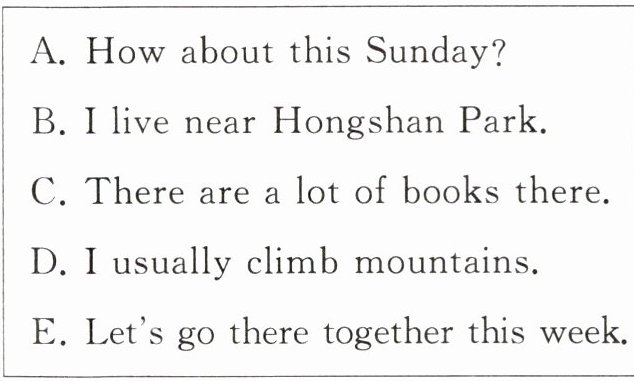
七、从方框中选择合适的句子完成对话,将序号写在横线上。
Su Hai:What do you do at weekends,Liu Yang?
Liu Yang:
Su Hai:Where do you live?
Liu Yang: And sometimes I go to the library near our school.
Su Hai:Me too.
Liu Yang:
Su Hai:Great! When?
Liu Yang:
Su Hai:OK.
A. How about this Sunday?
B. I live near Hongshan Park.
C. There are a lot of books there.
D. I usuallyclimb mountains.
E. Let's gothere together this week.
Su Hai:What do you do at weekends,Liu Yang?
Liu Yang:
Su Hai:Where do you live?
Liu Yang: And sometimes I go to the library near our school.
Su Hai:Me too.
Liu Yang:
Su Hai:Great! When?
Liu Yang:
Su Hai:OK.
A. How about this Sunday?
B. I live near Hongshan Park.
C. There are a lot of books there.
D. I usuallyclimb mountains.
E. Let's gothere together this week.
答案
第一空:D
第二空:B
第三空:E
第四空:A
第二空:B
第三空:E
第四空:A
解析
1. 第一空:上文问句“What do you do at weekends”询问周末的活动,应选描述周末活动的D选项。
2. 第二空:上文问句“Where do you live?”询问居住地点,应选回答居住地点的B选项。
3. 第三空:上文提到两人都去图书馆,此处Liu Yang发出一起去的提议,应选E选项。
4. 第四空:上文问句“When?”询问时间,应选提议时间的A选项。
2. 第二空:上文问句“Where do you live?”询问居住地点,应选回答居住地点的B选项。
3. 第三空:上文提到两人都去图书馆,此处Liu Yang发出一起去的提议,应选E选项。
4. 第四空:上文问句“When?”询问时间,应选提议时间的A选项。
八、按要求完成句子。
1.Liu Tao oftenwatches TV on Friday evenings.(改为一般疑问句)
Liu Tao often TV on Friday evenings?
2. Helendoesher homework in the evening.(改为否定句)
Helen her homework in the evening.
3. We usually draw pictures in the park.(对画线部分提问)
do you usuallypictures?
4. Tea is popular in China. Table tennis is popular in China.(合并为一句)
Tea and table tennispopularin China.
1.Liu Tao oftenwatches TV on Friday evenings.(改为一般疑问句)
Liu Tao often TV on Friday evenings?
2. Helendoesher homework in the evening.(改为否定句)
Helen her homework in the evening.
3. We usually draw pictures in the park.(对画线部分提问)
do you usuallypictures?
4. Tea is popular in China. Table tennis is popular in China.(合并为一句)
Tea and table tennispopularin China.
答案
1. Does; watch
2. doesn't; do
3. Where; draw
4. are; both
2. doesn't; do
3. Where; draw
4. are; both
解析
1. 原句为一般现在时,主语Liu Tao是第三人称单数,变一般疑问句需借助助动词Does置于句首,实义动词watches还原为原形watch。
2. 原句为一般现在时,主语Helen是第三人称单数,变否定句需借助助动词doesn't,实义动词does还原为原形do。
3. 画线部分in the park是地点,对地点提问用疑问词Where,助动词do后实义动词用原形draw。
4. 合并后主语Tea and table tennis是复数概念,be动词用are,both放在be动词后,用来表示“两者都”。
2. 原句为一般现在时,主语Helen是第三人称单数,变否定句需借助助动词doesn't,实义动词does还原为原形do。
3. 画线部分in the park是地点,对地点提问用疑问词Where,助动词do后实义动词用原形draw。
4. 合并后主语Tea and table tennis是复数概念,be动词用are,both放在be动词后,用来表示“两者都”。
九、根据中文提示完成句子。
1.我和我的朋友们有时候在周末打篮球。
I play basketballmy friends at weekends.
2. 今天下午我们去划船吧。
gothis afternoon.
3. 你喜欢和猫一起玩吗?
Do you likeyourcat?
4. ——你哥哥周末喜欢做什么? ——他喜欢在家看电视。
—Whatyour brother likeat weekends?
—HeTVat home.
1.我和我的朋友们有时候在周末打篮球。
I play basketballmy friends at weekends.
2. 今天下午我们去划船吧。
gothis afternoon.
3. 你喜欢和猫一起玩吗?
Do you likeyourcat?
4. ——你哥哥周末喜欢做什么? ——他喜欢在家看电视。
—Whatyour brother likeat weekends?
—HeTVat home.
答案
1. Sometimes; with
2. Let's; boating
3. playing with; /(或playing; with)
4. does; doing; likes watching; at
2. Let's; boating
3. playing with; /(或playing; with)
4. does; doing; likes watching; at
解析
1. 本题考查频率副词和介词的用法。中文里的“有时候”用频率副词sometimes表示,放在句首首字母大写;“和……一起”用介词with,用来连接共同做事情的对象。
2. 本题考查祈使句和固定短语。提出建议用Let's(Let us的缩写)引导祈使句;“去划船”是本单元的固定短语go boating。
3. 本题考查like的用法和固定搭配。“喜欢做某事”用like doing sth的结构,“和……一起玩”是固定搭配play with,完整句子为Do you like playing with your cat? 结合题目空格,第一空填playing with,第二空因排版问题无需填写,也可拆分填playing和with(注意正确语序为playing with your cat)。
4. 本题考查一般现在时的特殊疑问句和固定搭配。主语your brother是第三人称单数,特殊疑问句需借助助动词does;like后接动名词doing表示长期喜好。回答中主语He是第三人称单数,动词like变likes,“看电视”用watch TV,watch变watching;“在家”是固定短语at home。
2. 本题考查祈使句和固定短语。提出建议用Let's(Let us的缩写)引导祈使句;“去划船”是本单元的固定短语go boating。
3. 本题考查like的用法和固定搭配。“喜欢做某事”用like doing sth的结构,“和……一起玩”是固定搭配play with,完整句子为Do you like playing with your cat? 结合题目空格,第一空填playing with,第二空因排版问题无需填写,也可拆分填playing和with(注意正确语序为playing with your cat)。
4. 本题考查一般现在时的特殊疑问句和固定搭配。主语your brother是第三人称单数,特殊疑问句需借助助动词does;like后接动名词doing表示长期喜好。回答中主语He是第三人称单数,动词like变likes,“看电视”用watch TV,watch变watching;“在家”是固定短语at home。
