

 登录
登录
J Read and complete (根据表格完成短文)
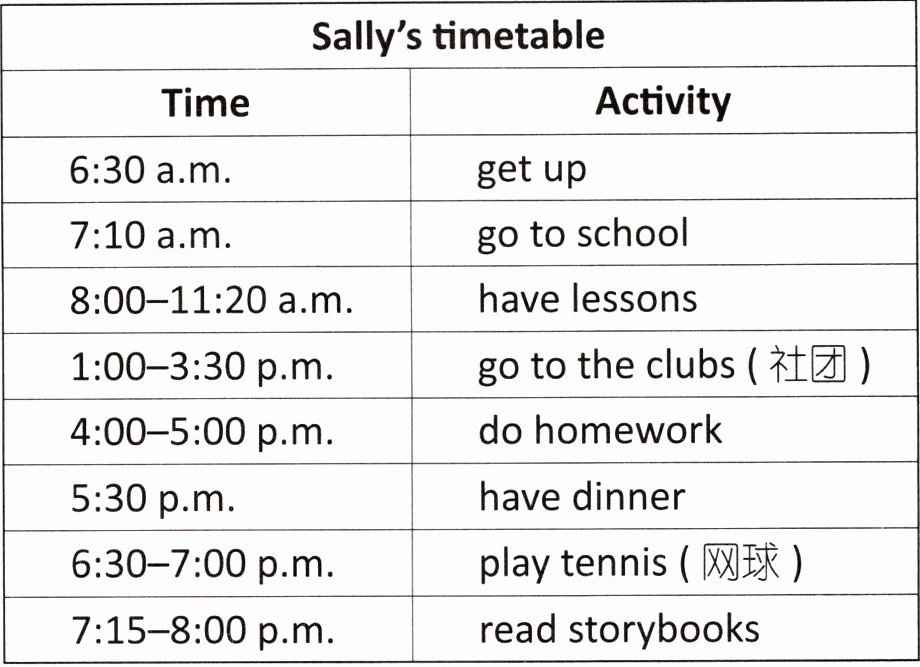
Sally is a primary (小学的) . She gets up and goes to school . She has four in the morning. She goes to the clubs in the . She does her from four to five. She at five thirty. dinner, she tennis with her father. Now it is seven fifty in the evening. Sally is stories. She likes reading very much.
Sally is a primary (小学的) . She gets up and goes to school . She has four in the morning. She goes to the clubs in the . She does her from four to five. She at five thirty. dinner, she tennis with her father. Now it is seven fifty in the evening. Sally is stories. She likes reading very much.
答案
student; early; lessons; afternoon; homework; has; dinner; After; plays; reading
解析
1. 根据“primary”可知填“student”(小学生)。
2. “gets up and goes to school”后接时间副词,表格中起床6:30、上学7:10,用“early”(早地)。
3. “four”后接名词复数,上午8:00-11:20是上课时间,填“lessons”(课)。
4. “in the”后接时间名词,社团时间1:00-3:30 p.m.是下午,填“afternoon”。
5. “does her”后接名词,4:00-5:00是做作业,填“homework”。
6. 5:30 p.m.的活动是“have dinner”,主语She是第三人称单数,填“has dinner”。
7. 打网球是在晚饭后,即After dinner,填“After”。
9. “tennis”前用动词,“play tennis”,主语She是第三人称单数,填“plays”。
10. “Now it is seven fifty”对应7:15-8:00的活动“read storybooks”,“is”后接现在分词,填“reading”。
2. “gets up and goes to school”后接时间副词,表格中起床6:30、上学7:10,用“early”(早地)。
3. “four”后接名词复数,上午8:00-11:20是上课时间,填“lessons”(课)。
4. “in the”后接时间名词,社团时间1:00-3:30 p.m.是下午,填“afternoon”。
5. “does her”后接名词,4:00-5:00是做作业,填“homework”。
6. 5:30 p.m.的活动是“have dinner”,主语She是第三人称单数,填“has dinner”。
7. 打网球是在晚饭后,即After dinner,填“After”。
9. “tennis”前用动词,“play tennis”,主语She是第三人称单数,填“plays”。
10. “Now it is seven fifty”对应7:15-8:00的活动“read storybooks”,“is”后接现在分词,填“reading”。
K Read and judge (阅读短文, 判断句子正误, 用T或F表示)
Table manners in China
In China, people love sitting together to eat and share yummy food. Here are some key points of table manners.
• Wait for the elders to sit down and eat first.
• Use chopsticks politely. Don't stick them upright in your bowl. And don't point them at other people.
• Use the serving chopsticks or spoons to get food from the shared dishes. This is clean and healthy.
• Try to eat all the food in your bowl. It tells the host, "This meal is yummy!"
() 1 Table manners in China show respect for the elders.
() 2 Sticking chopsticks in the rice bowl is polite.
() 3 "Serving chopsticks" mean "公筷" in Chinese.
() 4 It's not polite to eat all the food in your bowl.
() 5 These table manners are really about being kind to others.
Table manners in China
In China, people love sitting together to eat and share yummy food. Here are some key points of table manners.
• Wait for the elders to sit down and eat first.
• Use chopsticks politely. Don't stick them upright in your bowl. And don't point them at other people.
• Use the serving chopsticks or spoons to get food from the shared dishes. This is clean and healthy.
• Try to eat all the food in your bowl. It tells the host, "This meal is yummy!"
() 1 Table manners in China show respect for the elders.
() 2 Sticking chopsticks in the rice bowl is polite.
() 3 "Serving chopsticks" mean "公筷" in Chinese.
() 4 It's not polite to eat all the food in your bowl.
() 5 These table manners are really about being kind to others.
答案
TFTFT
解析
1. 短文第3行提到“Wait for the elders to sit down and eat first.”,表明中国餐桌礼仪体现对长辈的尊重,故1题T。
2. 文中第4行第2句话明确提到“Don't stick them upright in your bowl.”,所以2题F。
3. “serving chopsticks”对应中文“公筷”,3题T。
4. 短文倒数第1行明确指出“Try to eat all the food in your bowl.”,所以第4题F。
5. 这些礼仪如尊重长辈、使用公筷、吃完碗中食物等都是对他人友善的体现,5题T。
2. 文中第4行第2句话明确提到“Don't stick them upright in your bowl.”,所以2题F。
3. “serving chopsticks”对应中文“公筷”,3题T。
4. 短文倒数第1行明确指出“Try to eat all the food in your bowl.”,所以第4题F。
5. 这些礼仪如尊重长辈、使用公筷、吃完碗中食物等都是对他人友善的体现,5题T。
