

 登录
登录
一、根据中文意思完成句子。
1. —水在寒冷的冬天会变成冰。
—是的,你说得对。
—Water will
—Yes. You're right.
2. 李先生计划今年暑假乘船去武汉旅行。
Mr. Li plans to travel to Wuhan
3. 中国的许多河流自西向东流入大海。
Many rivers in China
4. 雨后,天气变得很凉爽。
After the rain, it
5. 早晨,树叶上有很多水珠。
In the morning, there are many
1. —水在寒冷的冬天会变成冰。
—是的,你说得对。
—Water will
turn
into
ice in cold winter.—Yes. You're right.
2. 李先生计划今年暑假乘船去武汉旅行。
Mr. Li plans to travel to Wuhan
by
water/ship
this summer holiday.3. 中国的许多河流自西向东流入大海。
Many rivers in China
go
into
the sea from west to east.4. 雨后,天气变得很凉爽。
After the rain, it
gets
very
cool
.5. 早晨,树叶上有很多水珠。
In the morning, there are many
water
drops
on the leaves.答案
一、1. turn into 2. by water/ship 3. go into 4. gets very cool 5. water drops
解析
【分析】
1. 第1题:中文意思是“变成”,需要找到对应的英语固定短语,turn into是常用的“变成”表达,且will后接动词原形,所以确定填turn into。
2. 第2题:中文“乘船”是表示出行方式,英语中用“by+交通工具”来表达,by ship和by water都可以表示乘船出行,符合题意。
3. 第3题:中文“流入”对应英语短语go into,主语Many rivers是复数形式,句子是一般现在时,所以动词用原形go into。
4. 第4题:中文“变得很凉爽”,“变得”用get来表达,主语it是第三人称单数,一般现在时中谓语动词要变为第三人称单数形式gets,“很凉爽”是very cool,所以组合起来是gets very cool。
5. 第5题:中文“水珠”是water drop,many后接可数名词复数,所以drop要变为复数形式drops,即water drops。
【解析】
1. 根据中文提示“变成”,结合will后接动词原形的语法规则,填入固定短语turn into。
2. 表示“乘船”的交通方式,用“by+交通工具”的结构,by ship或by water均符合要求,故填入by water/ship。
3. “流入”对应短语go into,主语Many rivers为复数,一般现在时中动词用原形,因此填入go into。
4. “变得”用get,主语it是第三人称单数,一般现在时谓语动词用gets,“很凉爽”译为very cool,所以填入gets very cool。
5. “水珠”是water drop,many修饰可数名词复数,drop的复数形式是drops,故填入water drops。
【答案】
一、1. turn into 2. by water/ship 3. go into 4. gets very cool 5. water drops
【知识点】
固定短语搭配、一般现在时用法、可数名词复数变化
【点评】
本题围绕日常场景考查英语基础知识点,涵盖固定短语、交通方式表达、时态运用及名词复数变形,注重对学生基础词汇和短语运用能力的考查,有助于巩固日常英语表达。
【难度系数】
0.8
1. 第1题:中文意思是“变成”,需要找到对应的英语固定短语,turn into是常用的“变成”表达,且will后接动词原形,所以确定填turn into。
2. 第2题:中文“乘船”是表示出行方式,英语中用“by+交通工具”来表达,by ship和by water都可以表示乘船出行,符合题意。
3. 第3题:中文“流入”对应英语短语go into,主语Many rivers是复数形式,句子是一般现在时,所以动词用原形go into。
4. 第4题:中文“变得很凉爽”,“变得”用get来表达,主语it是第三人称单数,一般现在时中谓语动词要变为第三人称单数形式gets,“很凉爽”是very cool,所以组合起来是gets very cool。
5. 第5题:中文“水珠”是water drop,many后接可数名词复数,所以drop要变为复数形式drops,即water drops。
【解析】
1. 根据中文提示“变成”,结合will后接动词原形的语法规则,填入固定短语turn into。
2. 表示“乘船”的交通方式,用“by+交通工具”的结构,by ship或by water均符合要求,故填入by water/ship。
3. “流入”对应短语go into,主语Many rivers为复数,一般现在时中动词用原形,因此填入go into。
4. “变得”用get,主语it是第三人称单数,一般现在时谓语动词用gets,“很凉爽”译为very cool,所以填入gets very cool。
5. “水珠”是water drop,many修饰可数名词复数,drop的复数形式是drops,故填入water drops。
【答案】
一、1. turn into 2. by water/ship 3. go into 4. gets very cool 5. water drops
【知识点】
固定短语搭配、一般现在时用法、可数名词复数变化
【点评】
本题围绕日常场景考查英语基础知识点,涵盖固定短语、交通方式表达、时态运用及名词复数变形,注重对学生基础词汇和短语运用能力的考查,有助于巩固日常英语表达。
【难度系数】
0.8
二、根据短文完成思维导图。
People use water to do lotsof things. On the farm, farmers (农民) use water to water vegetables and keep animals. In the factory, workers use water to make lots of products (产品).
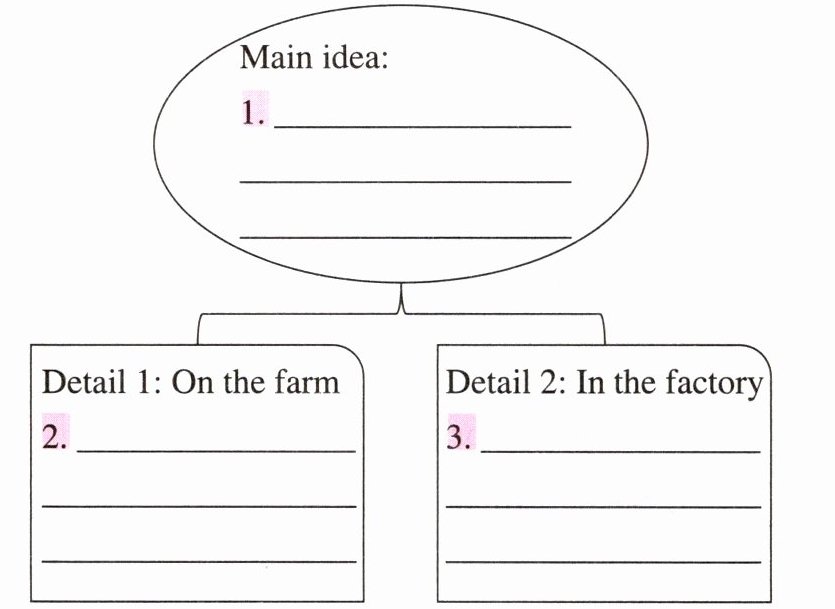
People use water to do lotsof things. On the farm, farmers (农民) use water to water vegetables and keep animals. In the factory, workers use water to make lots of products (产品).
答案
二、1. People use water to do lots of things.
2. Farmers use water to water vegetables and keep animals.
3. Workers use water to make lots of products.
2. Farmers use water to water vegetables and keep animals.
3. Workers use water to make lots of products.
解析
【分析】
首先,我们需要明确思维导图的结构:Main idea是对全文内容的概括,Detail 1和Detail 2是支撑主旨的具体细节。
1. 找主旨:短文开头第一句是总起句,概括了全文核心内容,可直接作为Main idea的答案。
2. 找农场的细节:根据“Detail 1: On the farm”,定位到短文中对应描述农场的内容,整理成完整句子即可。
3. 找工厂的细节:根据“Detail 2: In the factory”,定位到短文中对应描述工厂的内容,整理成完整句子即可。
【解析】
1. 提取主旨:短文开篇点明核心内容,直接摘取总起句“People use water to do lots of things.”作为Main idea。
2. 提取农场相关细节:在短文中找到对应“On the farm”的描述,整理为完整句子“Farmers use water to water vegetables and keep animals.”。
3. 提取工厂相关细节:在短文中找到对应“In the factory”的描述,整理为完整句子“Workers use water to make lots of products.”。
【答案】
1. People use water to do lots of things.
2. Farmers use water to water vegetables and keep animals.
3. Workers use water to make lots of products.
【知识点】
主旨大意提取、细节信息定位、英语文本梳理
【点评】
本题考查学生对英语短文主旨和细节信息的抓取能力,要求学生能快速定位不同场景下的关键内容,理清文本的总分结构,难度较低,适合巩固基础阅读能力。
【难度系数】
0.8
首先,我们需要明确思维导图的结构:Main idea是对全文内容的概括,Detail 1和Detail 2是支撑主旨的具体细节。
1. 找主旨:短文开头第一句是总起句,概括了全文核心内容,可直接作为Main idea的答案。
2. 找农场的细节:根据“Detail 1: On the farm”,定位到短文中对应描述农场的内容,整理成完整句子即可。
3. 找工厂的细节:根据“Detail 2: In the factory”,定位到短文中对应描述工厂的内容,整理成完整句子即可。
【解析】
1. 提取主旨:短文开篇点明核心内容,直接摘取总起句“People use water to do lots of things.”作为Main idea。
2. 提取农场相关细节:在短文中找到对应“On the farm”的描述,整理为完整句子“Farmers use water to water vegetables and keep animals.”。
3. 提取工厂相关细节:在短文中找到对应“In the factory”的描述,整理为完整句子“Workers use water to make lots of products.”。
【答案】
1. People use water to do lots of things.
2. Farmers use water to water vegetables and keep animals.
3. Workers use water to make lots of products.
【知识点】
主旨大意提取、细节信息定位、英语文本梳理
【点评】
本题考查学生对英语短文主旨和细节信息的抓取能力,要求学生能快速定位不同场景下的关键内容,理清文本的总分结构,难度较低,适合巩固基础阅读能力。
【难度系数】
0.8
三、阅读理解。
阅读下面语言材料,然后按文后要求做题。
It is in every living thing. It is in the air. It is under the ground. It runs through mountains and valleys (山谷). It forms lakes and oceans. What is it? It's water.
Nature has a great water system. Rain falls from the sky to the ground and the water finds its way to streams (小溪) and rivers. Rivers goes into the oceans. At the mouths of rivers, fresh water joins the salt water of the oceans. It brings rich nutrition (丰富的营养) for plants and animals to live on.
There are many important plants and animals at the mouth of a river. So we have to make our streams and rivers clean. Man has to work with nature — not against (反对) it.
根据材料内容选择最佳答案。
(
A. What water is.
B. How water forms.
C. Water is important.
D. Water is everywhere.
(
A. 系统
B. 作用
C. 价值
D. 规律
(
A. Rain.
B. Nature.
C. Valleys.
D. Oceans.
(
A. We can find water in everything.
B. We should learn to work with nature.
C. The mouth of a river is near the mountains.
D. There is no salt water at the mouths of the rivers.
(
A. On a poster about traveling.
B. In a book about sports.
C. In a science book.
D. In a history book.
阅读下面语言材料,然后按文后要求做题。
It is in every living thing. It is in the air. It is under the ground. It runs through mountains and valleys (山谷). It forms lakes and oceans. What is it? It's water.
Nature has a great water system. Rain falls from the sky to the ground and the water finds its way to streams (小溪) and rivers. Rivers goes into the oceans. At the mouths of rivers, fresh water joins the salt water of the oceans. It brings rich nutrition (丰富的营养) for plants and animals to live on.
There are many important plants and animals at the mouth of a river. So we have to make our streams and rivers clean. Man has to work with nature — not against (反对) it.
根据材料内容选择最佳答案。
(
D
) 1. What's the main idea of Paragraph 1?A. What water is.
B. How water forms.
C. Water is important.
D. Water is everywhere.
(
A
) 2. What does the underlined word "system" mean in Chinese?A. 系统
B. 作用
C. 价值
D. 规律
(
A
) 3. Where does the water in streams and rivers come from?A. Rain.
B. Nature.
C. Valleys.
D. Oceans.
(
B
) 4. What can we learn from the text?A. We can find water in everything.
B. We should learn to work with nature.
C. The mouth of a river is near the mountains.
D. There is no salt water at the mouths of the rivers.
(
C
) 5. Where can we probably read the text?A. On a poster about traveling.
B. In a book about sports.
C. In a science book.
D. In a history book.
答案
三、1. D 由第一段的描述可知,作者说的是水,并且表明了它无处不在。
2. A 由第二段的描述可知,雨水从天上落到地面,流进小溪和河流;河流流入大海。故推测 system 的意思是“系统”。
3. A 由第二段第二句可知,小溪以及河流中的水来自雨水。
4. B 由第三段最后一句可知,人类应该学会和自然和谐共生,而不是违反自然规律。
5. C 通读全文可知,本文是一篇关于水的科普短文,应该是来自科学方面的书籍。
2. A 由第二段的描述可知,雨水从天上落到地面,流进小溪和河流;河流流入大海。故推测 system 的意思是“系统”。
3. A 由第二段第二句可知,小溪以及河流中的水来自雨水。
4. B 由第三段最后一句可知,人类应该学会和自然和谐共生,而不是违反自然规律。
5. C 通读全文可知,本文是一篇关于水的科普短文,应该是来自科学方面的书籍。
解析
【分析】
1. 第1题:确定第一段主旨需梳理段落内容,第一段通过列举水存在于生物体内、空气中、地下,流经山川山谷、形成湖泊海洋等内容,核心是说明水分布范围广,无处不在,以此锁定答案。
2. 第2题:猜测词义要结合上下文语境,第二段描述了雨水落地后进入小溪、河流,再汇入海洋的完整循环过程,这是一个完整的体系,由此推测“system”的含义。
3. 第3题:属于细节查找题,直接定位第二段第二句,即可找到小溪和河流中水的来源。
4. 第4题:需从文中提取核心观点,重点关注最后一段最后一句,这是文章传递的重要启示。
5. 第5题:判断文章出处需结合文本类型,本文是介绍水的循环系统及相关知识的科普短文,据此判断其所属书籍类型。
【解析】
1. 第1题:第一段通过“in every living thing”“in the air”“under the ground”“runs through mountains and valleys”“forms lakes and oceans”等描述,全方位展现了水的广泛分布,主旨是水无处不在,故选D。
2. 第2题:第二段详细介绍了雨水从天空落到地面,流入小溪、河流,最终汇入海洋的完整过程,这是一个自然的水循环体系,因此“system”的中文意思是“系统”,故选A。
3. 第3题:根据第二段第二句“Rain falls from the sky to the ground and the water finds its way to streams (小溪) and rivers”可知,小溪和河流里的水来自雨水,故选A。
4. 第4题:由第三段最后一句“Man has to work with nature — not against (反对) it”可知,我们应该学会与自然和谐共处,故选B。
5. 第5题:本文是一篇介绍水的循环系统及相关知识的科普短文,这类内容通常会出现在科学书籍中,故选C。
【答案】
1. D;2. A;3. A;4. B;5. C
【知识点】
主旨大意题解法、词义猜测技巧、科普类文本阅读
【点评】
本文是一篇科普类短文,围绕水的分布、水循环系统展开介绍,同时传递了人与自然和谐共处的理念。题目涵盖主旨归纳、词义猜测、细节查找、文章出处判断等常见阅读题型,考查学生的阅读理解综合能力,有助于学生掌握科普类文本的阅读方法。
【难度系数】
0.7
1. 第1题:确定第一段主旨需梳理段落内容,第一段通过列举水存在于生物体内、空气中、地下,流经山川山谷、形成湖泊海洋等内容,核心是说明水分布范围广,无处不在,以此锁定答案。
2. 第2题:猜测词义要结合上下文语境,第二段描述了雨水落地后进入小溪、河流,再汇入海洋的完整循环过程,这是一个完整的体系,由此推测“system”的含义。
3. 第3题:属于细节查找题,直接定位第二段第二句,即可找到小溪和河流中水的来源。
4. 第4题:需从文中提取核心观点,重点关注最后一段最后一句,这是文章传递的重要启示。
5. 第5题:判断文章出处需结合文本类型,本文是介绍水的循环系统及相关知识的科普短文,据此判断其所属书籍类型。
【解析】
1. 第1题:第一段通过“in every living thing”“in the air”“under the ground”“runs through mountains and valleys”“forms lakes and oceans”等描述,全方位展现了水的广泛分布,主旨是水无处不在,故选D。
2. 第2题:第二段详细介绍了雨水从天空落到地面,流入小溪、河流,最终汇入海洋的完整过程,这是一个自然的水循环体系,因此“system”的中文意思是“系统”,故选A。
3. 第3题:根据第二段第二句“Rain falls from the sky to the ground and the water finds its way to streams (小溪) and rivers”可知,小溪和河流里的水来自雨水,故选A。
4. 第4题:由第三段最后一句“Man has to work with nature — not against (反对) it”可知,我们应该学会与自然和谐共处,故选B。
5. 第5题:本文是一篇介绍水的循环系统及相关知识的科普短文,这类内容通常会出现在科学书籍中,故选C。
【答案】
1. D;2. A;3. A;4. B;5. C
【知识点】
主旨大意题解法、词义猜测技巧、科普类文本阅读
【点评】
本文是一篇科普类短文,围绕水的分布、水循环系统展开介绍,同时传递了人与自然和谐共处的理念。题目涵盖主旨归纳、词义猜测、细节查找、文章出处判断等常见阅读题型,考查学生的阅读理解综合能力,有助于学生掌握科普类文本的阅读方法。
【难度系数】
0.7
