

 登录
登录
2. 选出下列每组单词中画线部分发音不同的一项。
() (1) A. mum
B. family
C. mango
() (2) A. am
B. aunt
C. new
() (3) A. cousin
B. afternoon
C. meet
() (4) A. not
B. time
C. seven
() (1) A. mum
B. family
C. mango
() (2) A. am
B. aunt
C. new
() (3) A. cousin
B. afternoon
C. meet
() (4) A. not
B. time
C. seven
答案
C A C B
解析
(1)A、B项画线部分发/m/,C项发/n/。(2)B、C项画线部分发/n/,A项发/m/。(3)A、B项画线部分发/n/,C项发/m/。(4)A、C项画线部分发/n/,B项发/m/。
1. 根据 Cartoon time 的内容,选择填空。
() (1) can do a magic trick.
A. Sam
B. Bobby
C. Billy
() (2) Sam wants to share the with Bobby.
A. oranges
B. mangoes
C. bananas
() (1) can do a magic trick.
A. Sam
B. Bobby
C. Billy
() (2) Sam wants to share the with Bobby.
A. oranges
B. mangoes
C. bananas
答案
(1)B (2)C
解析
(1)根据Cartoon time内容,会变魔术的是Bobby。(2)Sam想和Bobby分享的是香蕉。
2. 为下列句子选择相对应的中文意思。
() (1) Do you have a mango?
A.让我们一起分享芒果。
() (2) Let's share the mangoes.
B.我有两个芒果。
() (3) I have two mangoes.
C.我喜欢芒果。
() (4) I like mangoes.
D.你有一个芒果吗?
() (1) Do you have a mango?
A.让我们一起分享芒果。
() (2) Let's share the mangoes.
B.我有两个芒果。
() (3) I have two mangoes.
C.我喜欢芒果。
() (4) I like mangoes.
D.你有一个芒果吗?
答案
(1)D;(2)A;(3)B;(4)C
解析
本题可根据各句英文句子的含义,与所给的中文选项进行匹配。
(1)“Do you have a mango?”是一般疑问句,意思是“你有一个芒果吗?”,与D选项对应。
(2)“Let's share the mangoes.”中“Let's”表示“让我们”,“share”表示“分享”,整句意思是“让我们一起分享芒果。”,与A选项对应。
(3)“I have two mangoes.”中“I”是“我”,“have”是“有”,“two mangoes”是“两个芒果”,整句意思是“我有两个芒果。”,与B选项对应。
(4)“I like mangoes.”中“I”是“我”,“like”是“喜欢”,“mangoes”是“芒果”,整句意思是“我喜欢芒果。”,与C选项对应。
(1)“Do you have a mango?”是一般疑问句,意思是“你有一个芒果吗?”,与D选项对应。
(2)“Let's share the mangoes.”中“Let's”表示“让我们”,“share”表示“分享”,整句意思是“让我们一起分享芒果。”,与A选项对应。
(3)“I have two mangoes.”中“I”是“我”,“have”是“有”,“two mangoes”是“两个芒果”,整句意思是“我有两个芒果。”,与B选项对应。
(4)“I like mangoes.”中“I”是“我”,“like”是“喜欢”,“mangoes”是“芒果”,整句意思是“我喜欢芒果。”,与C选项对应。
1. 从Ⅱ栏中选出与Ⅰ栏相匹配的应答句。
Ⅰ Ⅱ
() (1) I have two apples.
A. No, I don't.
() (2) Let's share the bananas.
B. Me too!
() (3) Would you like a mango?
C. I'm sorry.
() (4) Do you have an orange?
D. Thank you!
() (5) Don't eat the grapes here.
E. Yes, please.
Ⅰ Ⅱ
() (1) I have two apples.
A. No, I don't.
() (2) Let's share the bananas.
B. Me too!
() (3) Would you like a mango?
C. I'm sorry.
() (4) Do you have an orange?
D. Thank you!
() (5) Don't eat the grapes here.
E. Yes, please.
答案
(1)B;(2)D;(3)E;(4)A;(5)C
解析
本题可根据每个句子的含义来选择合适的应答语。
(1) “I have two apples.”表示“我有两个苹果”,B选项“Me too!”(我也有)符合语境。
(2) “Let's share the bananas.”表示“让我们分享香蕉吧”,对于提议的回应,D选项“Thank you!”(谢谢你)合理。
(3) “Would you like a mango?”表示“你想要一个芒果吗”,其肯定回答常用“Yes, please.”,所以选E。
(4) “Do you have an orange?”是一般疑问句,询问“你有一个橙子吗”,A选项“No, I don't.”是合适的否定回答。
(5) “Don't eat the grapes here.”是祈使句,表示“不要在这里吃葡萄”,C选项“I'm sorry.”(对不起)是合适的回应。
(1) “I have two apples.”表示“我有两个苹果”,B选项“Me too!”(我也有)符合语境。
(2) “Let's share the bananas.”表示“让我们分享香蕉吧”,对于提议的回应,D选项“Thank you!”(谢谢你)合理。
(3) “Would you like a mango?”表示“你想要一个芒果吗”,其肯定回答常用“Yes, please.”,所以选E。
(4) “Do you have an orange?”是一般疑问句,询问“你有一个橙子吗”,A选项“No, I don't.”是合适的否定回答。
(5) “Don't eat the grapes here.”是祈使句,表示“不要在这里吃葡萄”,C选项“I'm sorry.”(对不起)是合适的回应。
2. 根据图片提示填空,完成句子或对话。
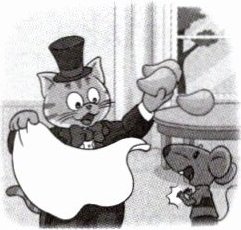
(1) Look, I have .
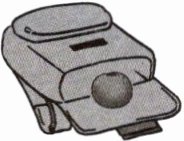
(2) —Bobby, what's that in your schoolbag?
—It's .
(3) —I like . They're sweet.
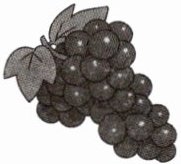
—Me .
(1) Look, I have .
(2) —Bobby, what's that in your schoolbag?
—It's .
(3) —I like . They're sweet.
—Me .
答案
(1) a cake (2) a sharpener (3) grapes; too
解析
(1) 图中是一只猫拿着一个蛋糕,“一个蛋糕”译为"a cake"。(2) 图中是一个卷笔刀,“一个卷笔刀”译为"a sharpener"。(3) 图中是葡萄,“葡萄”的复数形式是"grapes";“我也是”用"Me too"。
