

 登录
登录
探究点 1 crazy 的用法

I'm crazy about basketball. I play it every weekend.
我对篮球着迷。我每个周末都打篮球。
mermaid
graph TD
A[crazy adj. 疯狂的] --> B[be crazy about 对……着迷;热衷于……]
A --> C[You're crazy to go out in this cold weather without a coat.你在这么冷的天气不穿外套出去,真是疯了。]
A --> D[be crazy to do sth 做某事是疯狂的、不理智的]
A --> E[go crazy 发疯;变得疯狂;抓狂]
E --> F[When I heard the news, I almost went crazy. 当我听到这个消息时,我几乎要疯了。]
情境应用
1. They are c
2. My little brother is
A. relaxed
B. crazy
C. angry
D. happy
3. 当孩子们发现他们不能去游乐园时,他们抓狂了。
When the children found out they couldn't go to the amusement park, they
I'm crazy about basketball. I play it every weekend.
我对篮球着迷。我每个周末都打篮球。
mermaid
graph TD
A[crazy adj. 疯狂的] --> B[be crazy about 对……着迷;热衷于……]
A --> C[You're crazy to go out in this cold weather without a coat.你在这么冷的天气不穿外套出去,真是疯了。]
A --> D[be crazy to do sth 做某事是疯狂的、不理智的]
A --> E[go crazy 发疯;变得疯狂;抓狂]
E --> F[When I heard the news, I almost went crazy. 当我听到这个消息时,我几乎要疯了。]
情境应用
1. They are c
crazy
(疯狂的)to try to climb the mountain without any proper equipment.2. My little brother is
B
about dinosaurs. He has a lot of dinosaur toys.A. relaxed
B. crazy
C. angry
D. happy
3. 当孩子们发现他们不能去游乐园时,他们抓狂了。
When the children found out they couldn't go to the amusement park, they
went
crazy
.答案
1. crazy 2. B 3. went crazy
探究点 2 survive 的用法
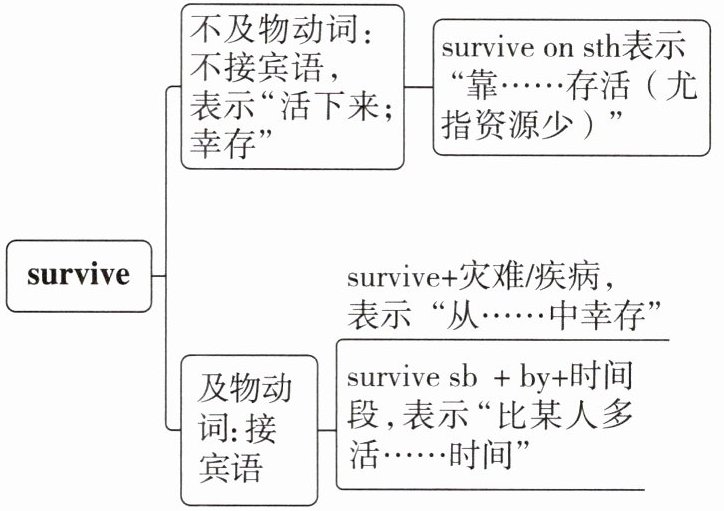
mermaid
graph TD
A[survive] --> B[不及物动词:不接宾语,表示“活下来;幸存”]
B --> C[survive on sth 表示“靠……存活(尤指资源少)”]
A --> D[及物动词:接宾语]
D --> E[survive + 灾难/疾病,表示“从……中幸存”]
D --> F[survive sb + by + 时间段,表示“比某人多活……时间”]
Only 3 of the 140 passengers survived.
140 名乘客中只有 3 人生还。
They survived on bread and water for a week.
他们靠面包和水活了一周。
If you don't have water, you can't survive for more than 3 days.
如果你没有水,你活不过 3 天。
She survived a serious heart attack last year.
她去年挺过了一场严重的心脏病发作。
His father survived his mother by 5 years.
他的父亲比母亲多活了 5 年。
情境应用
1. —How did they
—They ate wild fruits and drank river water.
A. survive
B. go
C. stay
D. keep
2. The rescue team found a little girl who was still
A. alive; survive in
B. living; survive
C. living; survive in
D. alive; survive
3. 这些野生动物靠很少的水就能生存。
These wild animals can
mermaid
graph TD
A[survive] --> B[不及物动词:不接宾语,表示“活下来;幸存”]
B --> C[survive on sth 表示“靠……存活(尤指资源少)”]
A --> D[及物动词:接宾语]
D --> E[survive + 灾难/疾病,表示“从……中幸存”]
D --> F[survive sb + by + 时间段,表示“比某人多活……时间”]
Only 3 of the 140 passengers survived.
140 名乘客中只有 3 人生还。
They survived on bread and water for a week.
他们靠面包和水活了一周。
If you don't have water, you can't survive for more than 3 days.
如果你没有水,你活不过 3 天。
She survived a serious heart attack last year.
她去年挺过了一场严重的心脏病发作。
His father survived his mother by 5 years.
他的父亲比母亲多活了 5 年。
情境应用
1. —How did they
A
in the forest without food for three days?—They ate wild fruits and drank river water.
A. survive
B. go
C. stay
D. keep
2. The rescue team found a little girl who was still
alive
under a building three days after the earthquake. They wondered how she was able to survive
the big earthquake.A. alive; survive in
B. living; survive
C. living; survive in
D. alive; survive
3. 这些野生动物靠很少的水就能生存。
These wild animals can
survive
on
very little water.答案
1. A 2. D 3. survive on
