

 登录
登录
Ⅴ. 根据对话内容填空。
Teng Fei:Hello,Bob!
Bob:Hi,Teng Fei.
Teng Fei:Bob,what(1)
Bob:I'm(3)
Teng Fei:I'm watching TV,too. Do you want to play(4)
Bob:That's sounds(5)
Teng Fei:Let's meet at sports park.
Bob:See you then.
Teng Fei:Hello,Bob!
Bob:Hi,Teng Fei.
Teng Fei:Bob,what(1)
are
you(2)doing
?Bob:I'm(3)
watching
TV. It's kind of boring. What about you?Teng Fei:I'm watching TV,too. Do you want to play(4)
tennis
?Bob:That's sounds(5)
good
.Teng Fei:Let's meet at sports park.
Bob:See you then.
答案
Ⅴ. (1)are (2)doing (3)watching
(4)tennis (5)good
(4)tennis (5)good
解析
【解析】
1. 第(1)(2)空:根据答语语境,是询问对方正在做什么,用现在进行时的特殊疑问句结构“what + be动词 + 主语 + doing”,主语是you,对应的be动词为are,故(1)填are,(2)填doing。
2. 第(3)空:现在进行时结构为“am/is/are + 动词现在分词”,结合“TV”可知是“看电视”,watch的现在分词是watching,故填watching。
3. 第(4)空:play后接球类运动,play tennis是固定搭配,意为“打网球”,符合语境,故填tennis。
4. 第(5)空:上文提出邀约,此处用“That sounds good.”回应表示赞同,这是常用交际用语,故填good。
【答案】
(1)are (2)doing (3)watching (4)tennis (5)good
【知识点】
现在进行时用法、动词短语搭配、日常交际用语
【点评】
本题考查现在进行时的问答及日常邀约交际,需掌握现在进行时结构,熟悉球类运动表达和日常交际回应用语,侧重基础语言运用。
【难度系数】
0.8
1. 第(1)(2)空:根据答语语境,是询问对方正在做什么,用现在进行时的特殊疑问句结构“what + be动词 + 主语 + doing”,主语是you,对应的be动词为are,故(1)填are,(2)填doing。
2. 第(3)空:现在进行时结构为“am/is/are + 动词现在分词”,结合“TV”可知是“看电视”,watch的现在分词是watching,故填watching。
3. 第(4)空:play后接球类运动,play tennis是固定搭配,意为“打网球”,符合语境,故填tennis。
4. 第(5)空:上文提出邀约,此处用“That sounds good.”回应表示赞同,这是常用交际用语,故填good。
【答案】
(1)are (2)doing (3)watching (4)tennis (5)good
【知识点】
现在进行时用法、动词短语搭配、日常交际用语
【点评】
本题考查现在进行时的问答及日常邀约交际,需掌握现在进行时结构,熟悉球类运动表达和日常交际回应用语,侧重基础语言运用。
【难度系数】
0.8
Ⅵ. 阅读下面短文,从方框内的选项中选出能填入空白处的最佳选项,使短文内容完整、通顺。
Mr Green is standing near the window. His wife,Mrs Green,is sitting behind him,
“Oh,”Mrs Green says,“
“He's cleaning the seat,”says Mr Green,“
Ms Green looks out of the window and then she says,“Ah,don't you know who he is? He is our son! You must wear glasses!”
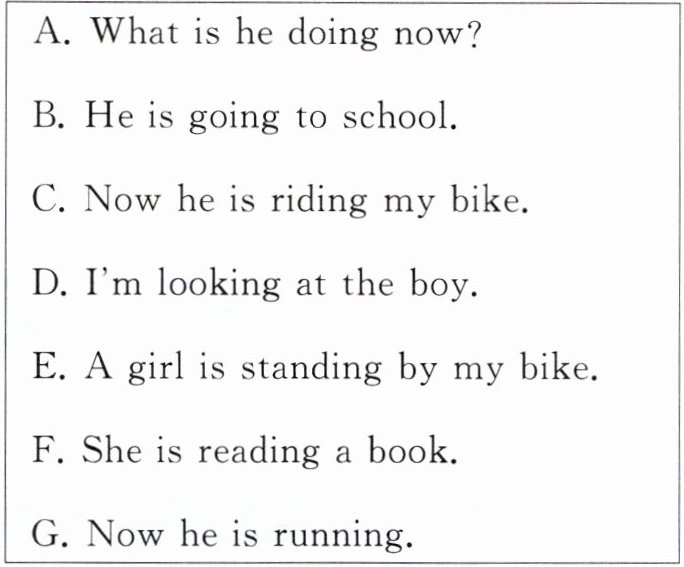
Mr Green is standing near the window. His wife,Mrs Green,is sitting behind him,
F
. She closes the book and asks her husband,“What are you looking at?”D
Mr Green answers,“He's under the tree near our house. He's standing by my bike”.“Oh,”Mrs Green says,“
A
”“He's cleaning the seat,”says Mr Green,“
C
”Ms Green looks out of the window and then she says,“Ah,don't you know who he is? He is our son! You must wear glasses!”
答案
Ⅵ. 1. F 2. D 3. A 4. C
解析
【解析】
1. 第一空:根据后文“She closes the book”的提示,可知格林夫人此前正在看书,故选F。
2. 第二空:根据妻子的问题“What are you looking at?”以及格林先生关于男孩的回答,可知此处应表明格林先生在看一个男孩,故选D。
3. 第三空:根据格林先生答语“He's cleaning the seat”,可知此处是妻子询问男孩正在做什么,故选A。
4. 第四空:结合语境,格林先生误将儿子认作陌生人,此处表述他看到的男孩的行为,C选项符合语境,故选C。
【答案】
1.F;2.D;3.A;4.C
【知识点】
情景交际、补全对话、现在进行时
【点评】
本题以夫妻对话为场景考查补全对话,需结合上下文关键信息,分析语境来选择合适选项,考查学生的语境理解与语言运用能力。
【难度系数】
0.6
1. 第一空:根据后文“She closes the book”的提示,可知格林夫人此前正在看书,故选F。
2. 第二空:根据妻子的问题“What are you looking at?”以及格林先生关于男孩的回答,可知此处应表明格林先生在看一个男孩,故选D。
3. 第三空:根据格林先生答语“He's cleaning the seat”,可知此处是妻子询问男孩正在做什么,故选A。
4. 第四空:结合语境,格林先生误将儿子认作陌生人,此处表述他看到的男孩的行为,C选项符合语境,故选C。
【答案】
1.F;2.D;3.A;4.C
【知识点】
情景交际、补全对话、现在进行时
【点评】
本题以夫妻对话为场景考查补全对话,需结合上下文关键信息,分析语境来选择合适选项,考查学生的语境理解与语言运用能力。
【难度系数】
0.6
Ⅰ. 根据单词首字母提示完成句子。
1. My parents are busy making zongzi for the D
2. The r
3. Listen! S
4. —It's great to hear your v
—Yours, too!
5. —I'm sorry, c
—Sure.
1. My parents are busy making zongzi for the D
ragon
Boat Festival
. It's a traditional day in China.2. The r
ace
itself is very exciting.3. Listen! S
omebody
is beating(敲)at the door.4. —It's great to hear your v
oice
.—Yours, too!
5. —I'm sorry, c
ould
you repeat(重复)that?—Sure.
答案
Ⅰ. 1. Dragon; Festival 2. race
3. Somebody 4. voice 5. could
3. Somebody 4. voice 5. could
解析
【解析】
1. 根据“making zongzi(包粽子)”及首字母提示,可知是中国传统节日端午节,英文为Dragon Boat Festival,故填Dragon; Festival。
2. 结合语境“本身非常令人兴奋”和首字母r,race(赛事,比赛)符合语义,故填race。
3. 由“Listen!(听!)”和“beating at the door(敲门)”可知是某人在敲门,首字母为S,Somebody(某人)符合,故填Somebody。
4. “hear your...”表示“听到你的……”,首字母v,voice(嗓音)符合语境,故填voice。
5. 此处是委婉请求对方重复话语,could用于委婉请求,首字母c,故填could。
【答案】
Ⅰ. 1. Dragon; Festival 2. race
3. Somebody 4. voice 5. could
【知识点】
节日相关词汇;日常交际用语;不定代词用法
【点评】
本题考查根据首字母提示及语境补全单词,涵盖中国传统节日词汇、日常交际表达等内容,要求学生结合语境理解语义并掌握常见基础词汇。
【难度系数】
0.8
1. 根据“making zongzi(包粽子)”及首字母提示,可知是中国传统节日端午节,英文为Dragon Boat Festival,故填Dragon; Festival。
2. 结合语境“本身非常令人兴奋”和首字母r,race(赛事,比赛)符合语义,故填race。
3. 由“Listen!(听!)”和“beating at the door(敲门)”可知是某人在敲门,首字母为S,Somebody(某人)符合,故填Somebody。
4. “hear your...”表示“听到你的……”,首字母v,voice(嗓音)符合语境,故填voice。
5. 此处是委婉请求对方重复话语,could用于委婉请求,首字母c,故填could。
【答案】
Ⅰ. 1. Dragon; Festival 2. race
3. Somebody 4. voice 5. could
【知识点】
节日相关词汇;日常交际用语;不定代词用法
【点评】
本题考查根据首字母提示及语境补全单词,涵盖中国传统节日词汇、日常交际表达等内容,要求学生结合语境理解语义并掌握常见基础词汇。
【难度系数】
0.8
Ⅱ. 根据对话内容填空。
A:Hello! This is Lily speaking.(1)
B:Sorry, Tom isn't here right now.(2)
A:Oh, that's too bad. Well, please tell him I'm having a party this weekend and I hope he can come.
B:Sure. I will(将会)give him the message.(3)
(After a few seconds...)
OK, Anything(4)
A:No, that's all. Thank you very much.
B:(5)
A:Bye!
A:Hello! This is Lily speaking.(1)
May I speak to Tom please?
?B:Sorry, Tom isn't here right now.(2)
Can I take a message?
?A:Oh, that's too bad. Well, please tell him I'm having a party this weekend and I hope he can come.
B:Sure. I will(将会)give him the message.(3)
Hold on
, please. Let me write it down.(After a few seconds...)
OK, Anything(4)
else
?A:No, that's all. Thank you very much.
B:(5)
You're welcome
. Bye!A:Bye!
答案
Ⅱ. 1. May I speak to Tom please?
2. Can I take a message?
3. Hold on
4. else
5. You're welcome
2. Can I take a message?
3. Hold on
4. else
5. You're welcome
解析
【解析】
这是一段电话交际场景的对话,需结合语境填写合适的表达:
1. 根据下文“Sorry, Tom isn't here right now.”可知A要找Tom,电话用语中表达“我可以和汤姆通话吗?”用“May I speak to Tom please?”;
2. 前文表明Tom不在,结合下文A要留口信,此处B询问是否需要捎口信,用“Can I take a message?”;
3. 根据后文“Let me write it down.”可知B让A稍等,电话用语中“稍等”用“Hold on”;
4. 此处询问是否还有其他事情,“anything else”是固定表达,意为“还有别的吗”,故填“else”;
5. 上文A表达感谢,回应感谢常用“You're welcome.”。
【答案】
1. May I speak to Tom please?
2. Can I take a message?
3. Hold on
4. else
5. You're welcome
【知识点】
电话交际用语、情景对话固定表达
【点评】
本题考查电话场景下的日常英语交际用语,需结合对话语境和电话交际的常用句式作答,侧重对日常情景对话积累与运用能力的考查。
【难度系数】
0.8
这是一段电话交际场景的对话,需结合语境填写合适的表达:
1. 根据下文“Sorry, Tom isn't here right now.”可知A要找Tom,电话用语中表达“我可以和汤姆通话吗?”用“May I speak to Tom please?”;
2. 前文表明Tom不在,结合下文A要留口信,此处B询问是否需要捎口信,用“Can I take a message?”;
3. 根据后文“Let me write it down.”可知B让A稍等,电话用语中“稍等”用“Hold on”;
4. 此处询问是否还有其他事情,“anything else”是固定表达,意为“还有别的吗”,故填“else”;
5. 上文A表达感谢,回应感谢常用“You're welcome.”。
【答案】
1. May I speak to Tom please?
2. Can I take a message?
3. Hold on
4. else
5. You're welcome
【知识点】
电话交际用语、情景对话固定表达
【点评】
本题考查电话场景下的日常英语交际用语,需结合对话语境和电话交际的常用句式作答,侧重对日常情景对话积累与运用能力的考查。
【难度系数】
0.8
