

 登录
登录
C Read the article about how to have good manners online and complete it using enough and too. Rewrite the underlined sentences using the structures in brackets.
Most of us know how to behave when we meet people face to face, but we often forget our good manners when we go online. Below are some rules to help you behave properly online.
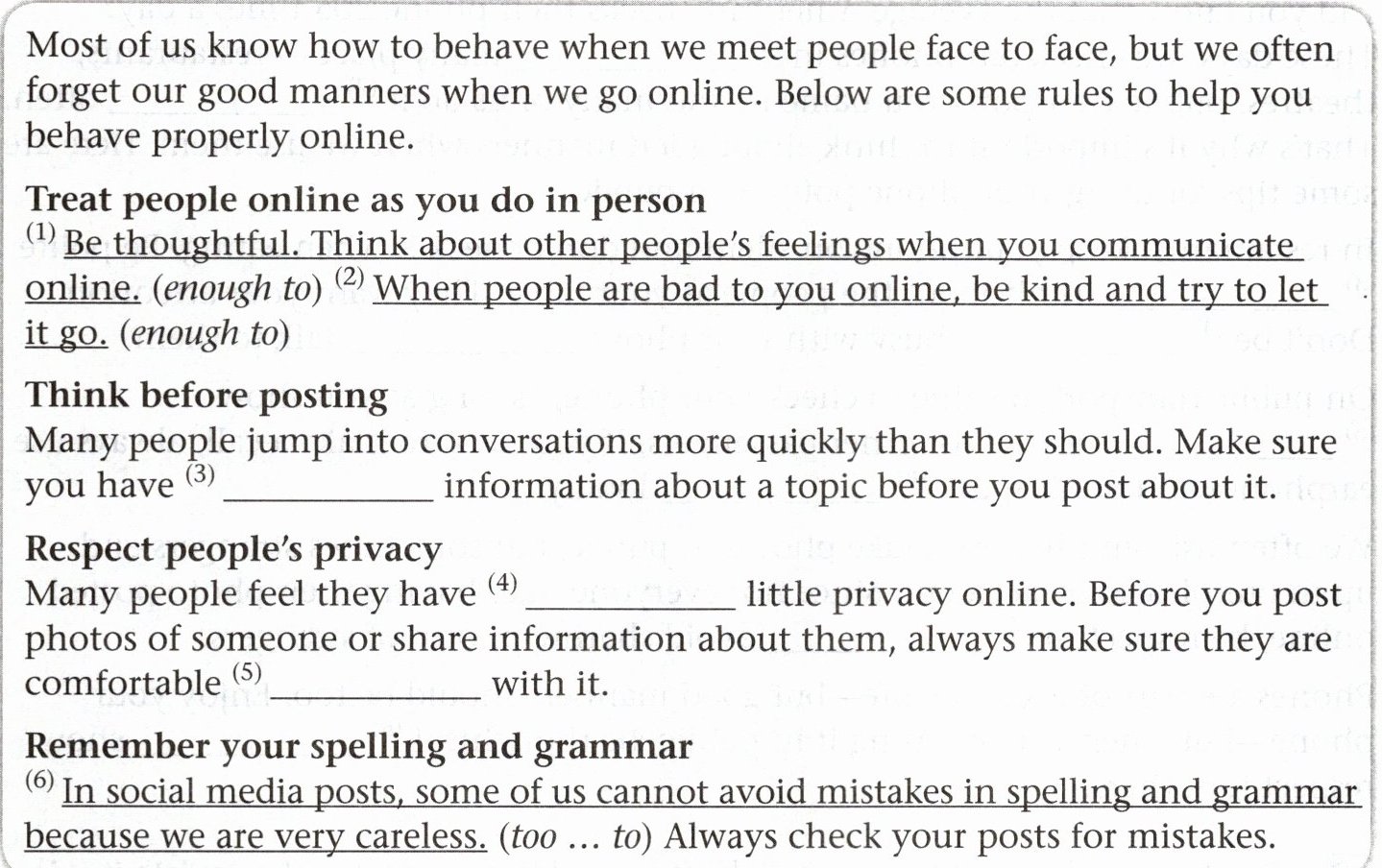
(1)
(2)
(6)
Most of us know how to behave when we meet people face to face, but we often forget our good manners when we go online. Below are some rules to help you behave properly online.
(1)
Be thoughtful enough to think about other people's feelings when you communicate online.
(2)
When people are bad to you online, be kind enough to try to let it go.
(6)
In social media posts, some of us are too careless to avoid mistakes in spelling and grammar.
答案
(1) Be thoughtful enough to think about other people's feelings when you communicate online.
(2) When people are bad to you online, be kind enough to try to let it go.
(3) enough
(4) too
(5) enough
(6) In social media posts, some of us are too careless to avoid mistakes in spelling and grammar.
(2) When people are bad to you online, be kind enough to try to let it go.
(3) enough
(4) too
(5) enough
(6) In social media posts, some of us are too careless to avoid mistakes in spelling and grammar.
解析
【分析】
这道题考查enough和too的用法,以及enough to与too...to结构的改写。解题思路分为两步:
1. 对于改写句子的题目((1)(2)(6)):先明确enough to(足够……去做某事)和too...to(太……而不能做某事)的结构特点。enough修饰形容词时放在形容词后,再接to do;too后接形容词,再接to do,且too...to本身含否定含义,改写时要注意原句的语义转换。
2. 对于填空部分((3)(4)(5)):结合语境判断语义,enough修饰名词可放名词前,修饰形容词/副词放其后;too+形容词/副词(或too+形容词+不可数名词/可数名词复数)表示“太……”,结合“足够的信息”“太少隐私”“足够舒服”的语境选择合适的词。
【解析】
1. (1) 原句表达“要体贴,在线交流时考虑他人感受”,用enough to结构,将形容词thoughtful后加enough,再接不定式to think about...,完成改写。
2. (2) 原句表达“当别人在线对你不好时,要友善并试着释怀”,用enough to结构,在形容词kind后加enough,再接不定式to try to let it go,完成改写。
3. (3) 空格后是名词information,结合语境“发帖前确保有足够的信息”,enough修饰名词放前面,故填enough。
4. (4) 空格后是little,结合语境“很多人觉得在线隐私太少”,too little表示“太少,过于少”,符合语义,故填too。
5. (5) 空格前是形容词comfortable,结合语境“确保他们对此足够舒服”,enough修饰形容词放其后,故填enough。
6. (6) 原句表达“因为太粗心,所以不能避免拼写语法错误”,用too...to结构,将原因“very careless”转换为too careless,再接不定式to avoid...,同时去掉原句的否定和because从句,完成改写。
【答案】
(1) Be thoughtful enough to think about other people's feelings when you communicate online.
(2) When people are bad to you online, be kind enough to try to let it go.
(3) enough
(4) too
(5) enough
(6) In social media posts, some of us are too careless to avoid mistakes in spelling and grammar.
【知识点】
1. enough的用法
2. too...to结构
3. 句型改写
【点评】
本题围绕网络礼仪主题,考查enough和too的核心用法以及句型转换,既要求掌握词汇搭配,又需要结合语境理解语义,能有效检测学生对形容词短语和否定结构的运用能力。
【难度系数】
0.6
这道题考查enough和too的用法,以及enough to与too...to结构的改写。解题思路分为两步:
1. 对于改写句子的题目((1)(2)(6)):先明确enough to(足够……去做某事)和too...to(太……而不能做某事)的结构特点。enough修饰形容词时放在形容词后,再接to do;too后接形容词,再接to do,且too...to本身含否定含义,改写时要注意原句的语义转换。
2. 对于填空部分((3)(4)(5)):结合语境判断语义,enough修饰名词可放名词前,修饰形容词/副词放其后;too+形容词/副词(或too+形容词+不可数名词/可数名词复数)表示“太……”,结合“足够的信息”“太少隐私”“足够舒服”的语境选择合适的词。
【解析】
1. (1) 原句表达“要体贴,在线交流时考虑他人感受”,用enough to结构,将形容词thoughtful后加enough,再接不定式to think about...,完成改写。
2. (2) 原句表达“当别人在线对你不好时,要友善并试着释怀”,用enough to结构,在形容词kind后加enough,再接不定式to try to let it go,完成改写。
3. (3) 空格后是名词information,结合语境“发帖前确保有足够的信息”,enough修饰名词放前面,故填enough。
4. (4) 空格后是little,结合语境“很多人觉得在线隐私太少”,too little表示“太少,过于少”,符合语义,故填too。
5. (5) 空格前是形容词comfortable,结合语境“确保他们对此足够舒服”,enough修饰形容词放其后,故填enough。
6. (6) 原句表达“因为太粗心,所以不能避免拼写语法错误”,用too...to结构,将原因“very careless”转换为too careless,再接不定式to avoid...,同时去掉原句的否定和because从句,完成改写。
【答案】
(1) Be thoughtful enough to think about other people's feelings when you communicate online.
(2) When people are bad to you online, be kind enough to try to let it go.
(3) enough
(4) too
(5) enough
(6) In social media posts, some of us are too careless to avoid mistakes in spelling and grammar.
【知识点】
1. enough的用法
2. too...to结构
3. 句型改写
【点评】
本题围绕网络礼仪主题,考查enough和too的核心用法以及句型转换,既要求掌握词汇搭配,又需要结合语境理解语义,能有效检测学生对形容词短语和否定结构的运用能力。
【难度系数】
0.6
Writing
A lesson in manners
A Kitty is writing an article about a personal experience with manners. Read her article and learn how to write about your personal experience with good or bad manners.
Use time expressions to
help readers understand the
sequence of events.
Adjectives can add detail
and help readers imagine the
scene more clearly.
My manners mistake
My best friend’s birthday was last month. She had a lovely party at her house. When she brought a beautiful birthday cake out, I was one of the first people to get a piece.
Use a pronoun to avoid
repeating a noun.
Use the time expression to
show when the choke
happened.
Dialogue can help bring a
scene to life.
It looked tasty, so I started eating it right away—before everyone else had theirs. While I was eating the cake, I was also chatting and laughing with some friends, so I wasn’t really paying attention to how I was eating.
I ended up eating with my mouth open. This isn’t very polite. Then, in the middle of laughing, I suddenly choked on a piece of cake and started coughing loudly. I noticed some people looking at me unhappily. Luckily, one of my friends stepped in to help. She gave me a glass of water and kindly said, “The cake must be very delicious if you have to eat it before everyone else gets a piece.”
At that moment, I realized I was completely forgetting my table manners. At first, I felt so uncomfortable, but my friend offered me a warm smile and said, “It’s all right. We all forget our manners sometimes.” That may be true, but I decided right then to make more of an effort to mind my manners in the future.
A few weeks later, another friend had a birthday. This time, I waited politely for everyone to get their food before I started eating. I also remembered to eat with my mouth closed!
Use the simple present tense
to talk about what you’ve
learnt from the experience.
Good manners are a sign of respect for others. That’s why we all need to have good manners whether we are with friends or strangers.
◆ Structure of the article ◆
Beginning: Set the scene. Introduce when and where the experience took place.
Main body { Describe how you showed good/bad manners.
Explain how you felt about the experience.
Ending: Conclude by summarizing what you’ve learnt from the experience.
B Think about a time when you showed good or bad manners. What have you learnt from the experience? Write an article about it.
A lesson in manners
A Kitty is writing an article about a personal experience with manners. Read her article and learn how to write about your personal experience with good or bad manners.
Use time expressions to
help readers understand the
sequence of events.
Adjectives can add detail
and help readers imagine the
scene more clearly.
My manners mistake
My best friend’s birthday was last month. She had a lovely party at her house. When she brought a beautiful birthday cake out, I was one of the first people to get a piece.
Use a pronoun to avoid
repeating a noun.
Use the time expression to
show when the choke
happened.
Dialogue can help bring a
scene to life.
It looked tasty, so I started eating it right away—before everyone else had theirs. While I was eating the cake, I was also chatting and laughing with some friends, so I wasn’t really paying attention to how I was eating.
I ended up eating with my mouth open. This isn’t very polite. Then, in the middle of laughing, I suddenly choked on a piece of cake and started coughing loudly. I noticed some people looking at me unhappily. Luckily, one of my friends stepped in to help. She gave me a glass of water and kindly said, “The cake must be very delicious if you have to eat it before everyone else gets a piece.”
At that moment, I realized I was completely forgetting my table manners. At first, I felt so uncomfortable, but my friend offered me a warm smile and said, “It’s all right. We all forget our manners sometimes.” That may be true, but I decided right then to make more of an effort to mind my manners in the future.
A few weeks later, another friend had a birthday. This time, I waited politely for everyone to get their food before I started eating. I also remembered to eat with my mouth closed!
Use the simple present tense
to talk about what you’ve
learnt from the experience.
Good manners are a sign of respect for others. That’s why we all need to have good manners whether we are with friends or strangers.
◆ Structure of the article ◆
Beginning: Set the scene. Introduce when and where the experience took place.
Main body { Describe how you showed good/bad manners.
Explain how you felt about the experience.
Ending: Conclude by summarizing what you’ve learnt from the experience.
B Think about a time when you showed good or bad manners. What have you learnt from the experience? Write an article about it.
答案
My noisy mistake
Last Saturday evening, my friends and I went to a new restaurant near our school to celebrate the end of exams. The restaurant was crowded but cozy, with soft music playing in the background.
When we sat down at our table, we were all so excited that we started talking and laughing loudly. We told jokes and shared stories, not noticing how noisy we were. Then, I saw an old couple at the next table looking at us with皱眉 (frowning) faces. I felt a little uncomfortable but kept talking.
At that time, a kind waiter came over. He smiled and said gently, “Excuse me, could you please keep your voice down a bit? Other guests are trying to enjoy their meals.” My face turned red immediately. I apologized quickly and told my friends to be quiet. We all felt so embarrassed.
Now, I always remember that good manners are important in public places. Being noisy not only disturbs others but also shows a lack of respect. I’ve learnt to control my voice and think about others’ feelings. After all, respecting others is the best way to make everyone feel comfortable.
Last Saturday evening, my friends and I went to a new restaurant near our school to celebrate the end of exams. The restaurant was crowded but cozy, with soft music playing in the background.
When we sat down at our table, we were all so excited that we started talking and laughing loudly. We told jokes and shared stories, not noticing how noisy we were. Then, I saw an old couple at the next table looking at us with皱眉 (frowning) faces. I felt a little uncomfortable but kept talking.
At that time, a kind waiter came over. He smiled and said gently, “Excuse me, could you please keep your voice down a bit? Other guests are trying to enjoy their meals.” My face turned red immediately. I apologized quickly and told my friends to be quiet. We all felt so embarrassed.
Now, I always remember that good manners are important in public places. Being noisy not only disturbs others but also shows a lack of respect. I’ve learnt to control my voice and think about others’ feelings. After all, respecting others is the best way to make everyone feel comfortable.
解析
1. 确定主题:选择一次个人礼仪经历(好/坏),此处以“在餐厅大声喧哗”的坏礼仪为例。
2. 结构安排:
开头:交代时间(Last Saturday)、地点(a new restaurant)、事件(和朋友聚餐)。
主体:描述行为(大声说笑)、他人反应(邻桌皱眉、服务员提醒)、自身感受(尴尬)。
结尾:总结教训(公共场合需注意礼仪,尊重他人)。
3. 语言要点:用时间表达(When, Then, At that time);加入形容词(noisy, embarrassed, quiet);使用对话(服务员提醒);代词避免重复(we, they, I);结尾用一般现在时总结。
2. 结构安排:
开头:交代时间(Last Saturday)、地点(a new restaurant)、事件(和朋友聚餐)。
主体:描述行为(大声说笑)、他人反应(邻桌皱眉、服务员提醒)、自身感受(尴尬)。
结尾:总结教训(公共场合需注意礼仪,尊重他人)。
3. 语言要点:用时间表达(When, Then, At that time);加入形容词(noisy, embarrassed, quiet);使用对话(服务员提醒);代词避免重复(we, they, I);结尾用一般现在时总结。
