

 登录
登录
2. 同学们在收音机前参与节目,读一读,选择恰当的句子,完成对话。
A. People will live in space too.
B. But the robots may not be like the ones we see in the movies.
C. Thank you for coming, Professor Mary.
D. First of all, we probably won’t use money as we do today.
E. Where will people live?
Ted: This is Ted. Welcome to our radio show. Professor Mary, can you tell us some predictions(预测)for the future?
Mary: ① We will all use a voice card to pay.
Ted: Let’s see what our audience(听众)want to talk about. Here’s Caller 1.
Caller 1: Will we have robots?
Mary: Yes. ②
Ted: Great! I can’t wait to see those robots. Let’s go on to our next caller.
Caller 2: ③
Mary: We may build our cities under the ground or on the mountains. ④ ...
Ted: That’s all we have for today. ⑤
A. People will live in space too.
B. But the robots may not be like the ones we see in the movies.
C. Thank you for coming, Professor Mary.
D. First of all, we probably won’t use money as we do today.
E. Where will people live?
Ted: This is Ted. Welcome to our radio show. Professor Mary, can you tell us some predictions(预测)for the future?
Mary: ① We will all use a voice card to pay.
Ted: Let’s see what our audience(听众)want to talk about. Here’s Caller 1.
Caller 1: Will we have robots?
Mary: Yes. ②
Ted: Great! I can’t wait to see those robots. Let’s go on to our next caller.
Caller 2: ③
Mary: We may build our cities under the ground or on the mountains. ④ ...
Ted: That’s all we have for today. ⑤
答案
①D
②B
③E
④A
⑤C
②B
③E
④A
⑤C
解析
本题可根据对话的上下文逻辑关系来选择恰当的句子。
对于①处,上文Ted询问能否告知一些对未来的预测,下文提到将用语音卡支付,所以此处应该是关于未来预测的具体内容,C选项是欢迎教授到来,不符合逻辑,D选项“首先,我们可能不会像今天这样使用货币”符合语境,引出下文支付方式的改变。
对于②处,上文Caller 1询问是否会有机器人,下文应该围绕机器人展开,B选项“但机器人可能不像我们在电影中看到的那样”符合语境。
对于③处,下文Mary回答我们可能在地下或山上建造城市,还提到住在太空,所以此处应该是询问人们将住在哪里,E选项符合语境。
对于④处,上文提到在地下或山上建造城市,A选项“人们也将住在太空”进一步补充人们居住的地方,符合语境。
对于⑤处,对话结束,Ted应该对教授的到来表示感谢,C选项符合语境。
对于①处,上文Ted询问能否告知一些对未来的预测,下文提到将用语音卡支付,所以此处应该是关于未来预测的具体内容,C选项是欢迎教授到来,不符合逻辑,D选项“首先,我们可能不会像今天这样使用货币”符合语境,引出下文支付方式的改变。
对于②处,上文Caller 1询问是否会有机器人,下文应该围绕机器人展开,B选项“但机器人可能不像我们在电影中看到的那样”符合语境。
对于③处,下文Mary回答我们可能在地下或山上建造城市,还提到住在太空,所以此处应该是询问人们将住在哪里,E选项符合语境。
对于④处,上文提到在地下或山上建造城市,A选项“人们也将住在太空”进一步补充人们居住的地方,符合语境。
对于⑤处,对话结束,Ted应该对教授的到来表示感谢,C选项符合语境。
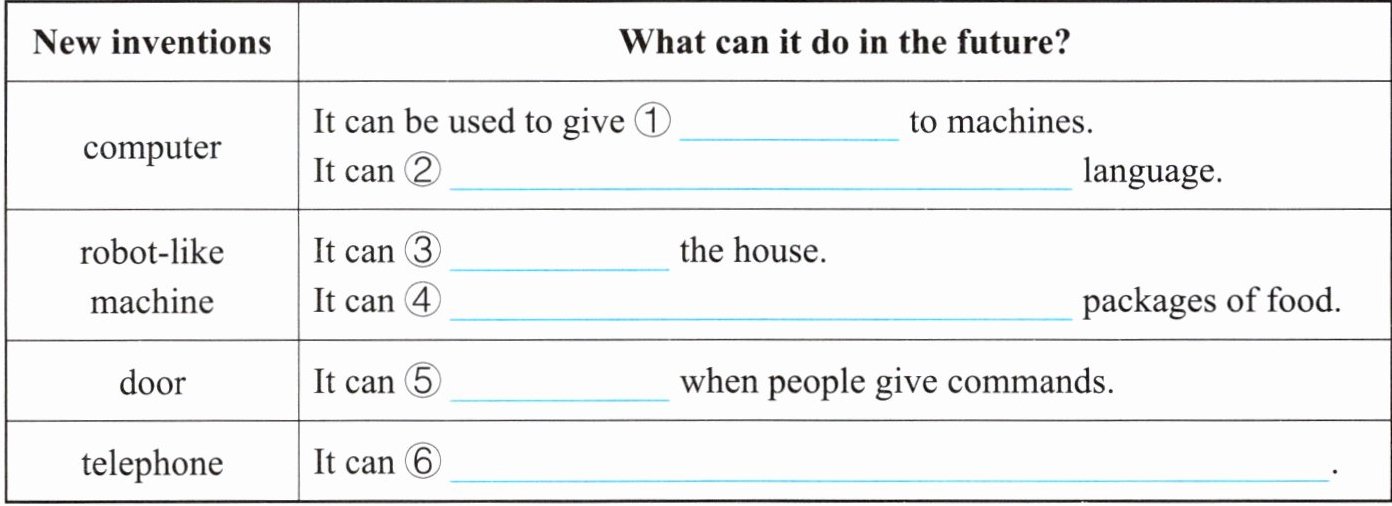
3. 许多新的发明会让未来生活更加便捷。读一读,完成下面的表格。
Many new inventions will make life easier in the future. People may use one computer to give directions to a large number of machines in the house. The machines may do all the chores. Robot - like machines may clean the house. Food might be in packages. People or robots might heat up the packages. People won’t need any keys or code to open the door. Doors will open when people give commands. Computers will understand spoken language so that people won’t need to type letters. And telephones might translate from one language into another!
Many new inventions will make life easier in the future. People may use one computer to give directions to a large number of machines in the house. The machines may do all the chores. Robot - like machines may clean the house. Food might be in packages. People or robots might heat up the packages. People won’t need any keys or code to open the door. Doors will open when people give commands. Computers will understand spoken language so that people won’t need to type letters. And telephones might translate from one language into another!
答案
① directions ② understand spoken ③ clean ④ heat up ⑤ open ⑥ translate from one language into another
解析
1. 根据"People may use one computer to give directions to a large number of machines in the house."可知填directions;2. 根据"Computers will understand spoken language"可知填understand spoken;3. 根据"Robot - like machines may clean the house."可知填clean;4. 根据"People or robots might heat up the packages."可知填heat up;5. 根据"Doors will open when people give commands."可知填open;6. 根据"And telephones might translate from one language into another!"可知填translate from one language into another。
