

 登录
登录
A3 Simon and Amy are chatting online. Complete their conversation with the correct tenses of the verbs in brackets.
Simon, Amy
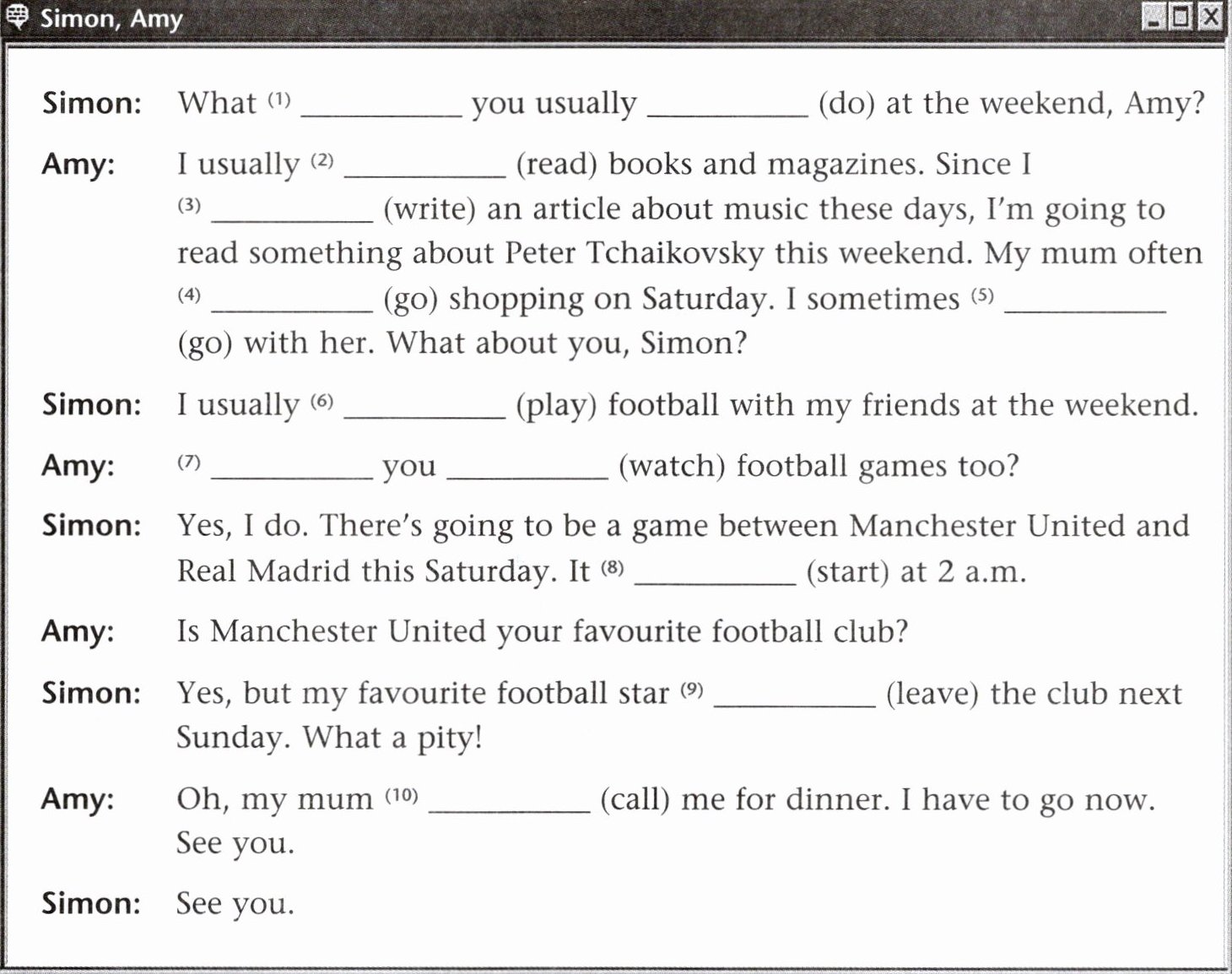
Simon: What ⁽¹⁾ you usually (do) at the weekend, Amy?
Amy: I usually ⁽²⁾ (read) books and magazines. Since I
⁽³⁾ (write) an article about music these days, I'm going to
read something about Peter Tchaikovsky this weekend. My mum often
⁽⁴⁾ (go) shopping on Saturday. I sometimes ⁽⁵⁾
(go) with her. What about you, Simon?
Simon: I usually ⁽⁶⁾ (play) football with my friends at the weekend.
Amy: ⁽⁷⁾ you (watch) football games too?
Simon: Yes, I do. There's going to be a game between Manchester United and
Real Madrid this Saturday. It ⁽⁸⁾ (start) at 2 a.m.
Amy: Is Manchester United your favourite football club?
Simon: Yes, but my favourite football star ⁽⁹⁾ (leave) the club next
Sunday. What a pity!
Amy: Oh, my mum ⁽¹⁰⁾ (call) me for dinner. I have to go now.
See you.
Simon: See you.
Simon, Amy
Simon: What ⁽¹⁾ you usually (do) at the weekend, Amy?
Amy: I usually ⁽²⁾ (read) books and magazines. Since I
⁽³⁾ (write) an article about music these days, I'm going to
read something about Peter Tchaikovsky this weekend. My mum often
⁽⁴⁾ (go) shopping on Saturday. I sometimes ⁽⁵⁾
(go) with her. What about you, Simon?
Simon: I usually ⁽⁶⁾ (play) football with my friends at the weekend.
Amy: ⁽⁷⁾ you (watch) football games too?
Simon: Yes, I do. There's going to be a game between Manchester United and
Real Madrid this Saturday. It ⁽⁸⁾ (start) at 2 a.m.
Amy: Is Manchester United your favourite football club?
Simon: Yes, but my favourite football star ⁽⁹⁾ (leave) the club next
Sunday. What a pity!
Amy: Oh, my mum ⁽¹⁰⁾ (call) me for dinner. I have to go now.
See you.
Simon: See you.
答案
(1) do; do
(2) read
(3) am writing
(4) goes
(5) go
(6) play
(7) Do; watch
(8) will start
(9) will leave
(10) is calling
(2) read
(3) am writing
(4) goes
(5) go
(6) play
(7) Do; watch
(8) will start
(9) will leave
(10) is calling
解析
本题需根据时间标志词和语境判断动词时态,具体如下:
1. (1) 句中usually是一般现在时标志,主语为you,特殊疑问句需借助助动词do,实义动词用原形do。
2. (2) usually是一般现在时标志,主语为I,谓语动词用原形read。
3. (3) these days表示现阶段正在进行的动作,用现在进行时,主语为I,故填am writing。
4. (4) often是一般现在时标志,主语my mum是第三人称单数,谓语动词用第三人称单数形式goes。
5. (5) sometimes是一般现在时标志,主语为I,谓语动词用原形go。
6. (6) usually是一般现在时标志,主语为I,谓语动词用原形play。
7. (7) 句为一般疑问句,询问经常性动作,用一般现在时,主语为you,借助助动词Do,实义动词用原形watch。
8. (8) 句中this Saturday表示将来时间,用一般将来时will start。
9. (9) next Sunday表示将来时间,用一般将来时will leave。
10. (10) 语境表示此刻正在发生的动作,用现在进行时is calling。
1. (1) 句中usually是一般现在时标志,主语为you,特殊疑问句需借助助动词do,实义动词用原形do。
2. (2) usually是一般现在时标志,主语为I,谓语动词用原形read。
3. (3) these days表示现阶段正在进行的动作,用现在进行时,主语为I,故填am writing。
4. (4) often是一般现在时标志,主语my mum是第三人称单数,谓语动词用第三人称单数形式goes。
5. (5) sometimes是一般现在时标志,主语为I,谓语动词用原形go。
6. (6) usually是一般现在时标志,主语为I,谓语动词用原形play。
7. (7) 句为一般疑问句,询问经常性动作,用一般现在时,主语为you,借助助动词Do,实义动词用原形watch。
8. (8) 句中this Saturday表示将来时间,用一般将来时will start。
9. (9) next Sunday表示将来时间,用一般将来时will leave。
10. (10) 语境表示此刻正在发生的动作,用现在进行时is calling。
B1 Choose the correct words in brackets to complete the sentences below.
1 Daniel (fixed/was fixing) his computer from 6:30 p.m. to
8:30 p.m. yesterday.
2 Mr Chen (put/was putting) his coat on, (took/was
taking) an umbrella and (went/was going) out.
3 *Chang'e 4* (landed/was landing) on the far side of the Moon in
2019.
4 He (washed/was washing) his car at this time last Wednesday.
5 The cinema (was built/was being built) in 1965.
6 We (worked/were working) on this history project from last
Thursday to this Tuesday.
1 Daniel (fixed/was fixing) his computer from 6:30 p.m. to
8:30 p.m. yesterday.
2 Mr Chen (put/was putting) his coat on, (took/was
taking) an umbrella and (went/was going) out.
3 *Chang'e 4* (landed/was landing) on the far side of the Moon in
2019.
4 He (washed/was washing) his car at this time last Wednesday.
5 The cinema (was built/was being built) in 1965.
6 We (worked/were working) on this history project from last
Thursday to this Tuesday.
答案
1. was fixing
2. put; took; went
3. landed
4. was washing
5. was built
6. were working
2. put; took; went
3. landed
4. was washing
5. was built
6. were working
解析
1. 句中时间状语"from 6:30 p.m. to 8:30 p.m. yesterday"表示过去的一段持续时间,强调该时间段内正在进行的动作,需用过去进行时,故填was fixing。
2. 本句描述一系列连贯的过去短暂性动作,动作先后发生,需用一般过去时,故依次填put, took, went。
3. 时间状语"in 2019"是过去具体时间点,"着陆"是短暂性动作,需用一般过去时,故填landed。
4. 时间状语"at this time last Wednesday"表示过去的具体时刻,强调当时正在进行的动作,需用过去进行时,故填was washing。
5. 时间状语"in 1965"是过去时间,本句表示电影院在1965年被建成,是过去完成的被动动作,需用一般过去时的被动语态was built。
6. 时间状语"from last Thursday to this Tuesday"表示过去的一段持续时间,强调该时间段内持续进行的动作,主语为we,需用过去进行时were working。
2. 本句描述一系列连贯的过去短暂性动作,动作先后发生,需用一般过去时,故依次填put, took, went。
3. 时间状语"in 2019"是过去具体时间点,"着陆"是短暂性动作,需用一般过去时,故填landed。
4. 时间状语"at this time last Wednesday"表示过去的具体时刻,强调当时正在进行的动作,需用过去进行时,故填was washing。
5. 时间状语"in 1965"是过去时间,本句表示电影院在1965年被建成,是过去完成的被动动作,需用一般过去时的被动语态was built。
6. 时间状语"from last Thursday to this Tuesday"表示过去的一段持续时间,强调该时间段内持续进行的动作,主语为we,需用过去进行时were working。
