

 登录
登录
三、阅读理解(共15小题;每小题2分,满分30分)
A
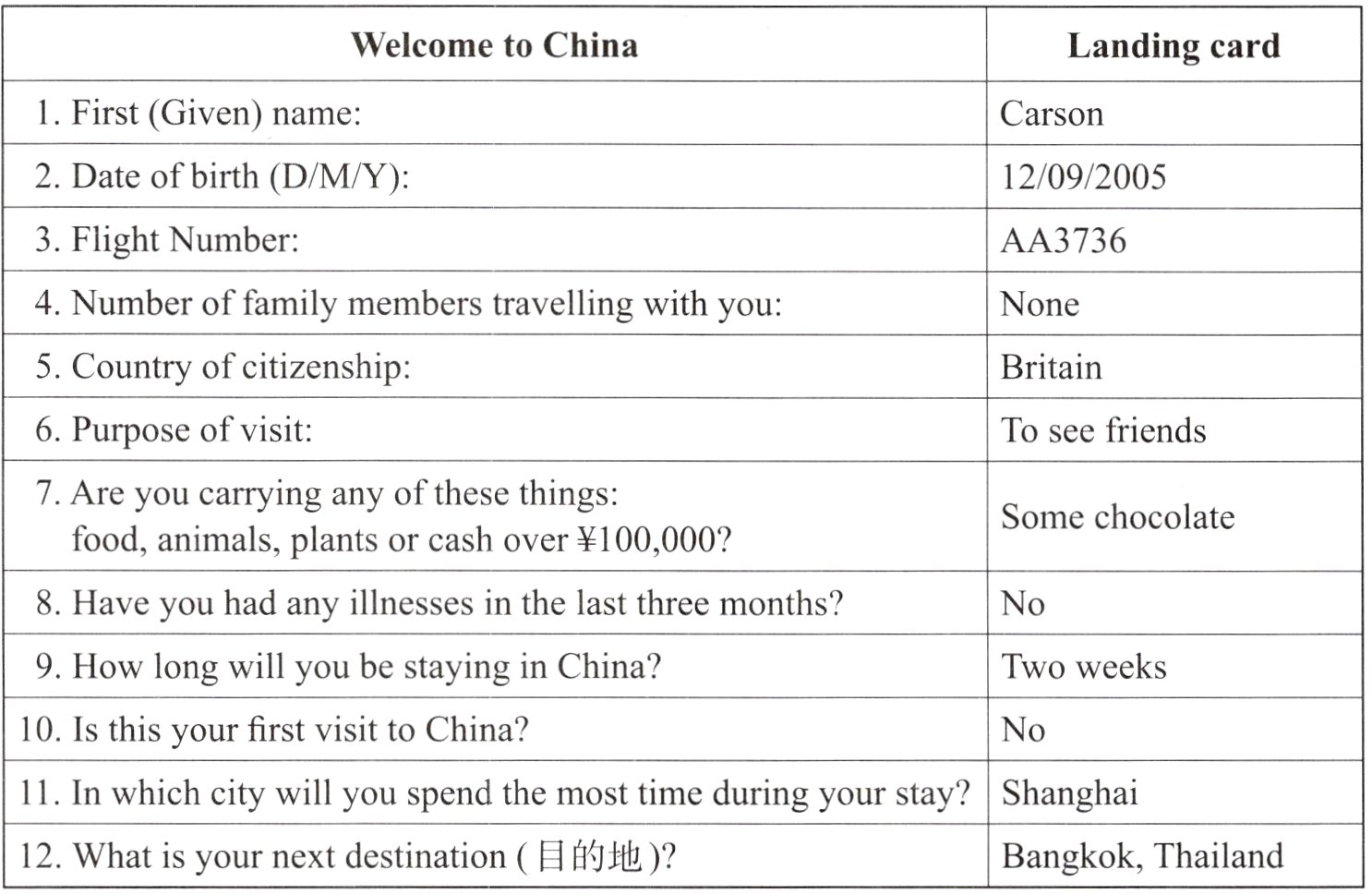
( ) 31. When is Carson's birthday?
A. December 9. B. September 12. C. September 5. D. May 9.
( ) 32. Where did Carson most probably write the card?
A. At school. B. In the hospital.
C. At the bus stop. D. In the airplane.
( ) 33. Which of the following is true?
A. This is Carson's first trip to Shanghai.
B. Carson will stay in China for two weeks.
C. Carson visits China to buy some chocolate.
D. Carson will visit China with his wife.
B
Honesty is a good thing, but does Mother Nature agree? Animals can't talk, but can they lie in other ways?
Animal experts may not call it lying, but they do agree that many animals, from birds to chimpanzees (黑猩猩), behave dishonestly to fool other animals. Why? Dishonesty often helps them survive.
Many kinds of birds are very successful at fooling other animals. For example, a bird called the plover sometimes pretends (假装) to be hurt in order to protect its young. When a predator (猎食动物) gets close to its nest, the plover leads the predator away from the nest. How? It pretends to have a broken wing. The predator follows the “hurt” adult, leaving the baby birds safe in the nest.
Another kind of bird, the scrub jay, hides its food so it always has something to eat. Scrub jays are also thieves. They watch where others hide their food and steal it. But clever scrub jays seem to know that a thief is watching them. So they go back later, dig the food, and hide it again somewhere else.
Chimpanzees, or chimps, can also be sneaky. After a fight, the losing chimp will give its hand to the other. When the winning chimp puts out its hand, too, the chimps are friendly again. But an animal expert once saw a losing chimp take the winner's hand and start fighting again.
Chimps are sneaky in other ways, too. When chimps find food that they love, such as bananas, it is natural for them to cry out. Then other chimps come running. But some clever chimps learn to cry very softly when they find food. That way, other chimps don't hear them, and they don't need to share their food.
As children, many of us learn the saying “You can't fool Mother Nature.” But maybe you can't trust her, either.
( ) 34. A plover protects its young from a predator by __________.
A. getting closer to its young B. driving away the adult predator
C. leaving its young in another nest D. pretending to be hurt
( ) 35. By “Chimpanzees, or chimps, can also be sneaky.”, the writer means __________.
A. chimps are ready to attack others B. chimps are sometimes dishonest
C. chimps envy the winners of the fight D. chimps can also be selfish
( ) 36. Which of the following is true according to the passage?
A. All the animals survive by fooling other animals.
B. Some clever scrub jays often steal their food back.
C. Some chimps lower their cry to keep food away from others.
D. The losing chimp won the fight by taking the winner's hand.
( ) 37. Which of the following might be the best title of the passage?
A. Do animals lie?
B. Does Mother Nature fool animals?
C. How do animals learn to lie?
D. How does honesty help animals survive?
C
“Wanted: Violin. Can't pay much. Call ...”
Why did I notice that? I wondered, since I seldom look at such ads.
I put the paper on my lap and closed my eyes, remembering what had happened many years before, when my family struggled to make a living on our farm. I, too, had wanted a violin, but we didn't have the money.
When my arms grew long enough, how I wanted one! But I knew it was out of the question.
It was not a good year. At harvest the crops did not bring as much as we had hoped. Yet even though times were hard, I couldn't wait any longer to ask, “Daddy, may I have a violin of my own?”
Daddy looked sad. That night, and many following nights, I heard him pray in our family devotions, “... Mary wants her own violin.”
One evening we all sat around the table. Daddy wrote a letter to his friend, Mr Finkle, a fine violinist.
When Daddy received a letter from Columbus a few weeks later, he announced, “We'll be driving to Columbus.”
The day finally arrived. After we got there, Mr Finkle, a tall man, older than Daddy, opened the door. “Come in!” he and Daddy heartily shook hands, both talking at once.
He picked up a case, opened it, lifted out a violin and started to play. The melody surged and spoke like waterfalls. Oh, to play like him, I thought.
“Carl, I found it in a pawn shop for seven dollars. It's a good violin. Mary should be able to make beautiful music with it.” Then he handed the violin to me.
I noticed the tears in Daddy's eyes as I finally comprehended. It was mine! I stroked the violin gently. The wood was a golden brown that seemed to warm in the light. “It's beautiful.” I said, barely breathing.
The day I carried my violin to school for my first lesson no one could imagine the bursting feeling in my heart. Over the months I practised daily, feeling the warm wood fit under my chin like an extension of myself.
When I was ready to join the school orchestra (管弦乐队), I trembled with excitement. I sat in the third row of violins and wore my white orchestra jacket like a royal robe. My heart beat wildly at my first public performance, a school operetta. I felt sure everyone in the audience was watching me. Daddy and Mother smiled proudly at their little girl. And soon I found myself in the first - violin chair.
I thought of Daddy, who did all he could to fill my needs and desires when I was a little girl. I wonder if I had ever thanked him.
At last I picked up the newspaper, walked to the phone and dialed the number. Later in the day, a man in his 30s knocked on the door. “My daughter wants a violin so badly,” he said. “How much are you asking?” Any music store, I knew, would offer me a nice sum. But now I heard my voice answer, “Seven dollars.”
“Are you sure?” he asked, reminding so much of Daddy.
Later, I saw his wife and children waiting in an old car. The door suddenly opened and a young girl ran to him. She hugged the violin case against her, then dropped to her knees and snapped open the case. She touched the violin lightly as it caught the glow of the late - afternoon sun, then turned and threw her arms around her smiling father.
( ) 38. Which of the following is true according to the passage?
A. Carl wrote a letter to thank Mr Finkle for giving him a violin.
B. Mary's family lived a harder life because of the poor harvest.
C. Mary was in the first - violin chair at her first school performance.
D. Mary was sure she would be a great violinist like Mr Finkle.
( ) 39. What does the underlined phrase “out of the question” mean?
A. Doubtful. B. Impossible. C. Natural. D. Certain.
( ) 40. What can we infer (推断) from the passage?
A. Mary passed her love to others in the way Mr Finkle did.
B. Mary never said thanks to her father who had passed away.
C. The young man's family had no money to pay for the violin.
D. Mary knew why her father took her to Columbus before going.
( ) 41. What can be the best title for the passage?
A. A violinist and a farmer B. A little girl and her father
C. The violin in the setting sun D. A violin in an advertisement
D
When I was young, I lived in Scotland with my parents. I had a good time there.
One morning, I ran to the garden, and said to the old Scotsman who worked there, “Today I am going up the mountain for berries.”
“No, no, Missey, not today,” he said. “It will rain.”
“No, it will not rain,” I said. “The Sun is up. The cook says it will be fine. The glass in the hall does not say rain.”
“Tuts, tuts,” said the old man. “I care for no suns, or cooks, or glasses. The pimpernel (海绿) says it will rain, and so it will rain. Flowers, Missey, always tell the truth. When they say rain, go and get your umbrella.”
Sure enough, by noon the rain was pouring down. After that, I looked with great respect at the tiny flower, sometimes brick red, sometimes blue, which could tell about the weather. But the pimpernel is not the only plant that is a weather teller.
If you go into the garden, and find the African marigolds shut after seven o'clock in the morning, you may be pretty sure that there will be a rainy day. There is a little single marigold which shuts up in a hurry if the sky becomes clouded. It is called the “rainy - marigold”.
Most plants which we call “weather tellers” shut up for rain, but some plants open for rain. The cause of the opening and closing is probably the difference in light. Most likely these plants shut their flowers because there is too little light.
But you know there are some plants which become smaller in a strong light and love the shade. You will find that most shade - loving plants, as the verbenas, do not close for rain.
Lilies, tulips and other flowers that love the Sun shut for rain. Tulips are careful not to open their cups very wide in the morning if it is likely to rain. The roses make no change. They seem not to fear wet.
On the whole, you may be pretty sure, if you go into your garden, and find many flowers—as tulips, marigolds and morning glories—shut, it will be a stormy day, unfit for picnics or long walks.
( ) 42. The plants which are “weather tellers” __________.
A. become smaller in a strong light B. tell about the weather
C. open for rain and fear light D. love shade and wet
( ) 43. You can go out for a picnic when __________.
A. the morning glories and lilies do not shut
B. the African marigolds shut after 7:00 a.m.
C. the pimpernels open wide in the daytime
D. the roses and tulips shut in the sunshine
( ) 44. What do we know from the passage?
A. The flowers have four ways to help people to get information about weather.
B. The glass in the hall has magic for the writer's family to know about weather.
C. We can know about weather by keeping many roses at home or in the garden.
D. Missey will probably know about weather by watching flowers from now on.
( ) 45. The passage is mainly about __________.
A. watching flowers carefully before going out
B. learning to watch flowers from the old Scotsman
C. the importance of growing flowers in the garden
D. the relationship between some flowers and weather
A
( ) 31. When is Carson's birthday?
A. December 9. B. September 12. C. September 5. D. May 9.
( ) 32. Where did Carson most probably write the card?
A. At school. B. In the hospital.
C. At the bus stop. D. In the airplane.
( ) 33. Which of the following is true?
A. This is Carson's first trip to Shanghai.
B. Carson will stay in China for two weeks.
C. Carson visits China to buy some chocolate.
D. Carson will visit China with his wife.
B
Honesty is a good thing, but does Mother Nature agree? Animals can't talk, but can they lie in other ways?
Animal experts may not call it lying, but they do agree that many animals, from birds to chimpanzees (黑猩猩), behave dishonestly to fool other animals. Why? Dishonesty often helps them survive.
Many kinds of birds are very successful at fooling other animals. For example, a bird called the plover sometimes pretends (假装) to be hurt in order to protect its young. When a predator (猎食动物) gets close to its nest, the plover leads the predator away from the nest. How? It pretends to have a broken wing. The predator follows the “hurt” adult, leaving the baby birds safe in the nest.
Another kind of bird, the scrub jay, hides its food so it always has something to eat. Scrub jays are also thieves. They watch where others hide their food and steal it. But clever scrub jays seem to know that a thief is watching them. So they go back later, dig the food, and hide it again somewhere else.
Chimpanzees, or chimps, can also be sneaky. After a fight, the losing chimp will give its hand to the other. When the winning chimp puts out its hand, too, the chimps are friendly again. But an animal expert once saw a losing chimp take the winner's hand and start fighting again.
Chimps are sneaky in other ways, too. When chimps find food that they love, such as bananas, it is natural for them to cry out. Then other chimps come running. But some clever chimps learn to cry very softly when they find food. That way, other chimps don't hear them, and they don't need to share their food.
As children, many of us learn the saying “You can't fool Mother Nature.” But maybe you can't trust her, either.
( ) 34. A plover protects its young from a predator by __________.
A. getting closer to its young B. driving away the adult predator
C. leaving its young in another nest D. pretending to be hurt
( ) 35. By “Chimpanzees, or chimps, can also be sneaky.”, the writer means __________.
A. chimps are ready to attack others B. chimps are sometimes dishonest
C. chimps envy the winners of the fight D. chimps can also be selfish
( ) 36. Which of the following is true according to the passage?
A. All the animals survive by fooling other animals.
B. Some clever scrub jays often steal their food back.
C. Some chimps lower their cry to keep food away from others.
D. The losing chimp won the fight by taking the winner's hand.
( ) 37. Which of the following might be the best title of the passage?
A. Do animals lie?
B. Does Mother Nature fool animals?
C. How do animals learn to lie?
D. How does honesty help animals survive?
C
“Wanted: Violin. Can't pay much. Call ...”
Why did I notice that? I wondered, since I seldom look at such ads.
I put the paper on my lap and closed my eyes, remembering what had happened many years before, when my family struggled to make a living on our farm. I, too, had wanted a violin, but we didn't have the money.
When my arms grew long enough, how I wanted one! But I knew it was out of the question.
It was not a good year. At harvest the crops did not bring as much as we had hoped. Yet even though times were hard, I couldn't wait any longer to ask, “Daddy, may I have a violin of my own?”
Daddy looked sad. That night, and many following nights, I heard him pray in our family devotions, “... Mary wants her own violin.”
One evening we all sat around the table. Daddy wrote a letter to his friend, Mr Finkle, a fine violinist.
When Daddy received a letter from Columbus a few weeks later, he announced, “We'll be driving to Columbus.”
The day finally arrived. After we got there, Mr Finkle, a tall man, older than Daddy, opened the door. “Come in!” he and Daddy heartily shook hands, both talking at once.
He picked up a case, opened it, lifted out a violin and started to play. The melody surged and spoke like waterfalls. Oh, to play like him, I thought.
“Carl, I found it in a pawn shop for seven dollars. It's a good violin. Mary should be able to make beautiful music with it.” Then he handed the violin to me.
I noticed the tears in Daddy's eyes as I finally comprehended. It was mine! I stroked the violin gently. The wood was a golden brown that seemed to warm in the light. “It's beautiful.” I said, barely breathing.
The day I carried my violin to school for my first lesson no one could imagine the bursting feeling in my heart. Over the months I practised daily, feeling the warm wood fit under my chin like an extension of myself.
When I was ready to join the school orchestra (管弦乐队), I trembled with excitement. I sat in the third row of violins and wore my white orchestra jacket like a royal robe. My heart beat wildly at my first public performance, a school operetta. I felt sure everyone in the audience was watching me. Daddy and Mother smiled proudly at their little girl. And soon I found myself in the first - violin chair.
I thought of Daddy, who did all he could to fill my needs and desires when I was a little girl. I wonder if I had ever thanked him.
At last I picked up the newspaper, walked to the phone and dialed the number. Later in the day, a man in his 30s knocked on the door. “My daughter wants a violin so badly,” he said. “How much are you asking?” Any music store, I knew, would offer me a nice sum. But now I heard my voice answer, “Seven dollars.”
“Are you sure?” he asked, reminding so much of Daddy.
Later, I saw his wife and children waiting in an old car. The door suddenly opened and a young girl ran to him. She hugged the violin case against her, then dropped to her knees and snapped open the case. She touched the violin lightly as it caught the glow of the late - afternoon sun, then turned and threw her arms around her smiling father.
( ) 38. Which of the following is true according to the passage?
A. Carl wrote a letter to thank Mr Finkle for giving him a violin.
B. Mary's family lived a harder life because of the poor harvest.
C. Mary was in the first - violin chair at her first school performance.
D. Mary was sure she would be a great violinist like Mr Finkle.
( ) 39. What does the underlined phrase “out of the question” mean?
A. Doubtful. B. Impossible. C. Natural. D. Certain.
( ) 40. What can we infer (推断) from the passage?
A. Mary passed her love to others in the way Mr Finkle did.
B. Mary never said thanks to her father who had passed away.
C. The young man's family had no money to pay for the violin.
D. Mary knew why her father took her to Columbus before going.
( ) 41. What can be the best title for the passage?
A. A violinist and a farmer B. A little girl and her father
C. The violin in the setting sun D. A violin in an advertisement
D
When I was young, I lived in Scotland with my parents. I had a good time there.
One morning, I ran to the garden, and said to the old Scotsman who worked there, “Today I am going up the mountain for berries.”
“No, no, Missey, not today,” he said. “It will rain.”
“No, it will not rain,” I said. “The Sun is up. The cook says it will be fine. The glass in the hall does not say rain.”
“Tuts, tuts,” said the old man. “I care for no suns, or cooks, or glasses. The pimpernel (海绿) says it will rain, and so it will rain. Flowers, Missey, always tell the truth. When they say rain, go and get your umbrella.”
Sure enough, by noon the rain was pouring down. After that, I looked with great respect at the tiny flower, sometimes brick red, sometimes blue, which could tell about the weather. But the pimpernel is not the only plant that is a weather teller.
If you go into the garden, and find the African marigolds shut after seven o'clock in the morning, you may be pretty sure that there will be a rainy day. There is a little single marigold which shuts up in a hurry if the sky becomes clouded. It is called the “rainy - marigold”.
Most plants which we call “weather tellers” shut up for rain, but some plants open for rain. The cause of the opening and closing is probably the difference in light. Most likely these plants shut their flowers because there is too little light.
But you know there are some plants which become smaller in a strong light and love the shade. You will find that most shade - loving plants, as the verbenas, do not close for rain.
Lilies, tulips and other flowers that love the Sun shut for rain. Tulips are careful not to open their cups very wide in the morning if it is likely to rain. The roses make no change. They seem not to fear wet.
On the whole, you may be pretty sure, if you go into your garden, and find many flowers—as tulips, marigolds and morning glories—shut, it will be a stormy day, unfit for picnics or long walks.
( ) 42. The plants which are “weather tellers” __________.
A. become smaller in a strong light B. tell about the weather
C. open for rain and fear light D. love shade and wet
( ) 43. You can go out for a picnic when __________.
A. the morning glories and lilies do not shut
B. the African marigolds shut after 7:00 a.m.
C. the pimpernels open wide in the daytime
D. the roses and tulips shut in the sunshine
( ) 44. What do we know from the passage?
A. The flowers have four ways to help people to get information about weather.
B. The glass in the hall has magic for the writer's family to know about weather.
C. We can know about weather by keeping many roses at home or in the garden.
D. Missey will probably know about weather by watching flowers from now on.
( ) 45. The passage is mainly about __________.
A. watching flowers carefully before going out
B. learning to watch flowers from the old Scotsman
C. the importance of growing flowers in the garden
D. the relationship between some flowers and weather
答案
31—33 BDB 34—37 DBCA 38—41 BBAC 42—45 BADD
