

 登录
登录
Ⅳ. 阅读下面短文,根据短文内容按要求完成任务。
Life in the Future
What will our world look like in 2050? Scientists predict many exciting changes.
Smart Homes & Technology
Homes will become more intelligent. Lights, heating, and security systems will work automatically(自动地) using AI. Robots might help with cooking and cleaning. Virtual reality (VR) glasses could let people “travel” to digital museums or forests without leaving home.
Transportation
Self-driving electric cars will replace normal cars. They will use clean energy and reduce air pollution. For long trips, “hyperloop” trains might carry passengers at 1,000 km/h! Flying taxis could also become common in big cities.
Environment
Cities will use more renewable energy. Solar panels(太阳能电池板) on buildings and wind farms in the sea will provide power. To protect nature, people might live in “vertical forests”—tall buildings covered with trees and plants. Recycling will be easier with smart bins that sort waste automatically.
Education & Work
Students may study online using VR classrooms. They could attend lessons with classmates from different countries. Offices might disappear as more people work remotely(远程地). However, jobs like AI engineers and space tour guides will grow.
Health
Doctors will use AI to find diseases faster. 3D printers could create artificial organs(器官) for patients. Wearable devices like smart watches will check our health daily and warn us about problems.
Will life be perfect? No. Climate change and AI safety will still be challenges. But with creativity and teamwork, humans can build a better future.
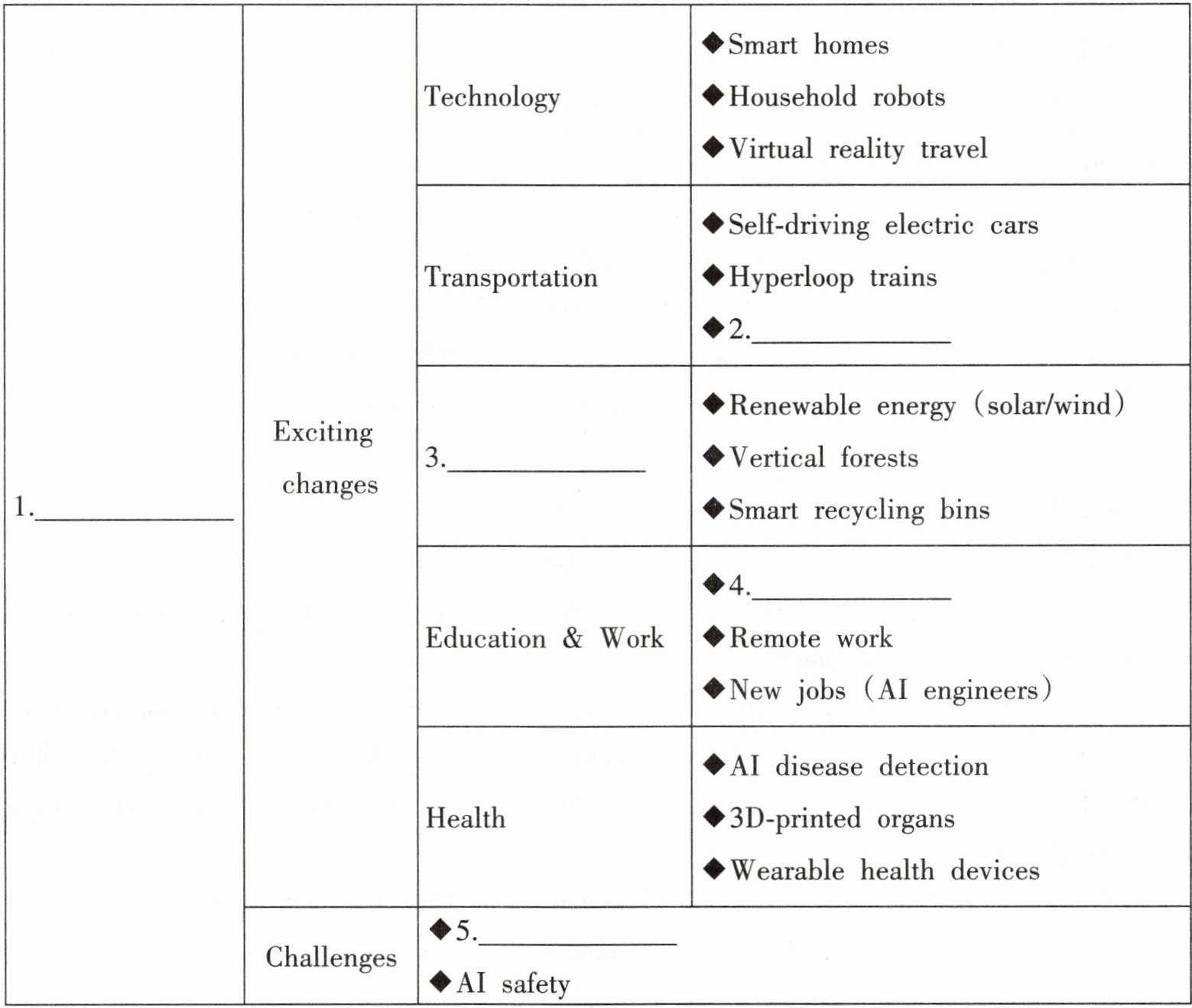
任务一:根据短文内容,完成下表。每个空格不超过3个单词。
任务二:根据短文内容,回答以下问题。
6. Who will turn on or off the lights in a smart home in the future?
7. How can students attend lessons with classmates from different countries?
8. Do you like the 3D printers in the part of “Health”? Why or why not?
Life in the Future
What will our world look like in 2050? Scientists predict many exciting changes.
Smart Homes & Technology
Homes will become more intelligent. Lights, heating, and security systems will work automatically(自动地) using AI. Robots might help with cooking and cleaning. Virtual reality (VR) glasses could let people “travel” to digital museums or forests without leaving home.
Transportation
Self-driving electric cars will replace normal cars. They will use clean energy and reduce air pollution. For long trips, “hyperloop” trains might carry passengers at 1,000 km/h! Flying taxis could also become common in big cities.
Environment
Cities will use more renewable energy. Solar panels(太阳能电池板) on buildings and wind farms in the sea will provide power. To protect nature, people might live in “vertical forests”—tall buildings covered with trees and plants. Recycling will be easier with smart bins that sort waste automatically.
Education & Work
Students may study online using VR classrooms. They could attend lessons with classmates from different countries. Offices might disappear as more people work remotely(远程地). However, jobs like AI engineers and space tour guides will grow.
Health
Doctors will use AI to find diseases faster. 3D printers could create artificial organs(器官) for patients. Wearable devices like smart watches will check our health daily and warn us about problems.
Will life be perfect? No. Climate change and AI safety will still be challenges. But with creativity and teamwork, humans can build a better future.
任务一:根据短文内容,完成下表。每个空格不超过3个单词。
任务二:根据短文内容,回答以下问题。
6. Who will turn on or off the lights in a smart home in the future?
AI.
7. How can students attend lessons with classmates from different countries?
Students can study online using VR classrooms.
8. Do you like the 3D printers in the part of “Health”? Why or why not?
Yes, I do.
Because they can create artificial organs for patients.
答案
1. Future life 2. Flying taxis 3. Environment 4. VR classrooms 5. Climate change
6. AI. 7. Students can study online using VR classrooms.
8. Yes, I do. Because they can create artificial organs for patients.
6. AI. 7. Students can study online using VR classrooms.
8. Yes, I do. Because they can create artificial organs for patients.
解析
【分析】
本题分为任务一(信息匹配填空)和任务二(细节理解+开放回答)。解题思路:任务一需根据短文内容,对应表格中各分类的原文信息,找到每个空格的匹配内容;任务二的6、7题是细节题,需定位原文对应句子,8题是开放题,结合Health部分的3D打印机作用作答。
【解析】
任务一:
1. 短文标题为《Life in the Future》,对应表格中“Exciting changes”和“Challenges”的大项,故1填Future life;
2. Transportation部分提到“Self-driving electric cars”“Hyperloop trains”,还提到“Flying taxis”,故2填Flying taxis;
3. 对应“Renewable energy”“Vertical forests”等内容的分类是Environment,故3填Environment;
4. Education & Work部分提到“Students may study online using VR classrooms”,故4填VR classrooms;
5. Challenges部分提到“Climate change and AI safety”,故5填Climate change。
任务二:
6. 定位Smart Homes部分,找到“Lights... will work automatically using AI”,可知答案是AI;
7. 定位Education部分,找到“Students may study online using VR classrooms”,整理为答案;
8. 开放题,结合Health部分“3D printers could create artificial organs for patients”,给出肯定回答及原因。
【答案】
1. Future life 2. Flying taxis 3. Environment 4. VR classrooms 5. Climate change
6. AI.
7. Students can study online using VR classrooms.
8. Yes, I do. Because they can create artificial organs for patients.
【知识点】
英语阅读理解、细节理解、信息匹配
【点评】
本题围绕“未来生活”主题,考查学生快速定位原文信息的能力,包含信息匹配、细节问答和开放表达,题型全面,难度适中,能有效考查学生的阅读水平。
【难度系数】
0.6
本题分为任务一(信息匹配填空)和任务二(细节理解+开放回答)。解题思路:任务一需根据短文内容,对应表格中各分类的原文信息,找到每个空格的匹配内容;任务二的6、7题是细节题,需定位原文对应句子,8题是开放题,结合Health部分的3D打印机作用作答。
【解析】
任务一:
1. 短文标题为《Life in the Future》,对应表格中“Exciting changes”和“Challenges”的大项,故1填Future life;
2. Transportation部分提到“Self-driving electric cars”“Hyperloop trains”,还提到“Flying taxis”,故2填Flying taxis;
3. 对应“Renewable energy”“Vertical forests”等内容的分类是Environment,故3填Environment;
4. Education & Work部分提到“Students may study online using VR classrooms”,故4填VR classrooms;
5. Challenges部分提到“Climate change and AI safety”,故5填Climate change。
任务二:
6. 定位Smart Homes部分,找到“Lights... will work automatically using AI”,可知答案是AI;
7. 定位Education部分,找到“Students may study online using VR classrooms”,整理为答案;
8. 开放题,结合Health部分“3D printers could create artificial organs for patients”,给出肯定回答及原因。
【答案】
1. Future life 2. Flying taxis 3. Environment 4. VR classrooms 5. Climate change
6. AI.
7. Students can study online using VR classrooms.
8. Yes, I do. Because they can create artificial organs for patients.
【知识点】
英语阅读理解、细节理解、信息匹配
【点评】
本题围绕“未来生活”主题,考查学生快速定位原文信息的能力,包含信息匹配、细节问答和开放表达,题型全面,难度适中,能有效考查学生的阅读水平。
【难度系数】
0.6
