

 登录
登录
Ⅵ. 书面表达。
★ 谈论周末作息
完成课本第63页3d的调查表,然后写一份调查报告,简单描述你的partner(小伙伴)的周末活动。(30词左右)
This is my partner, 's weekend routine.
★ 谈论周末作息
完成课本第63页3d的调查表,然后写一份调查报告,简单描述你的partner(小伙伴)的周末活动。(30词左右)
This is my partner, 's weekend routine.
答案
示例:
This is my partner, Li Ming's weekend routine. He gets up at 8 on weekends. He does his homework on Saturday, and he plays sports with his friends on Sunday.
This is my partner, Li Ming's weekend routine. He gets up at 8 on weekends. He does his homework on Saturday, and he plays sports with his friends on Sunday.
解析
【分析】
本题为英语书面表达题,要求围绕伙伴的周末作息展开描述,需先确定伙伴名字,再用一般现在时简单说明周末的起床时间、具体活动,控制词数在30左右,符合题目要求。
【解析】
先填写伙伴名字,接着依次描述周末的起床时间、周六的活动、周日的活动,使用简单的一般现在时句式,确保内容贴合周末作息主题,语言简洁通顺。
【答案】
This is my partner, Li Ming's weekend routine. He gets up at 8 on weekends. He does his homework on Saturday, and he plays sports with his friends on Sunday.
【知识点】
英语书面表达 一般现在时 周末作息描述
【点评】
本题考查学生对周末作息话题的英语基础表达能力,要求简洁明了,符合日常交际用语规范,难度适中。
【难度系数】
0.7
本题为英语书面表达题,要求围绕伙伴的周末作息展开描述,需先确定伙伴名字,再用一般现在时简单说明周末的起床时间、具体活动,控制词数在30左右,符合题目要求。
【解析】
先填写伙伴名字,接着依次描述周末的起床时间、周六的活动、周日的活动,使用简单的一般现在时句式,确保内容贴合周末作息主题,语言简洁通顺。
【答案】
This is my partner, Li Ming's weekend routine. He gets up at 8 on weekends. He does his homework on Saturday, and he plays sports with his friends on Sunday.
【知识点】
英语书面表达 一般现在时 周末作息描述
【点评】
本题考查学生对周末作息话题的英语基础表达能力,要求简洁明了,符合日常交际用语规范,难度适中。
【难度系数】
0.7
Ⅰ. 先将括号中描述日常活动的短语翻译成汉语,再用其适当形式完成句子。
例句: Tom usually gets up(get up) at 6:30. (起床)
1. Tina
2. John
3. I
4. They
5. The girl often
6. The students usually
7. Teng Fei
8. My brother
9. Han Lin usually
10. The boy
例句: Tom usually gets up(get up) at 6:30. (起床)
1. Tina
brushes teeth
(brush teeth) twice a day. (刷牙
)2. John
eats breakfast
(eat breakfast) at home at 6:40 in the morning. (吃早餐
)3. I
go to school
(go to school)at 7:20 a.m. (上学
)4. They
have classes
(have class) at 8 a.m. (上学
)5. The girl often
plays sports
(play sports) after school. (做运动
)6. The students usually
have lunch
(have lunch) at school. (吃午饭
)7. Teng Fei
has dinner
(have dinner) with his family. (吃晚饭
)8. My brother
does his homework
(do his homework) after dinner. (做作业
)9. Han Lin usually
takes a shower
(take a shower) at night. (淋浴
)10. The boy
goes to bed
(go to bed) at half past nine at night. (睡觉
)答案
1. brushes teeth(刷牙) 2. eats breakfast(吃早餐) 3. go to school(上学)
4. have classes(上学) 5. plays sports(做运动) 6. have lunch(吃午饭)
7. has dinner(吃晚饭) 8. does his homework(做作业)
9. takes a shower(淋浴) 10. goes to bed(睡觉)
4. have classes(上学) 5. plays sports(做运动) 6. have lunch(吃午饭)
7. has dinner(吃晚饭) 8. does his homework(做作业)
9. takes a shower(淋浴) 10. goes to bed(睡觉)
解析
【分析】
本题需完成两项任务:一是将括号内描述日常活动的短语翻译成汉语,二是用短语的适当形式补全句子。解题思路:① 先准确翻译括号内的短语,对应日常活动的中文表达;② 结合句中usually、twice a day、often等频率副词,确定句子时态为一般现在时;③ 根据主语的人称和数判断动词形式:主语为第三人称单数(如Tina、John等)时,谓语动词用第三人称单数形式;主语为第一人称、复数(如I、They等)时,谓语动词用原形,据此变形短语完成句子。
【解析】
1. 括号内短语brush teeth译为“刷牙”,主语Tina是第三人称单数,一般现在时中动词需用第三人称单数形式,故填brushes teeth(刷牙);
2. 短语eat breakfast译为“吃早餐”,主语John是第三人称单数,动词变第三人称单数形式,填eats breakfast(吃早餐);
3. 短语go to school译为“上学”,主语是第一人称I,动词用原形,填go to school(上学);
4. 短语have class译为“上课”,主语They是复数,动词用原形,此处class常用复数形式,故填have classes(上学);
5. 短语play sports译为“做运动”,主语The girl是第三人称单数,动词变plays,填plays sports(做运动);
6. 短语have lunch译为“吃午饭”,主语The students是复数,动词用原形,填have lunch(吃午饭);
7. 短语have dinner译为“吃晚饭”,主语Teng Fei是第三人称单数,动词变has,填has dinner(吃晚饭);
8. 短语do his homework译为“做作业”,主语My brother是第三人称单数,动词变does,填does his homework(做作业);
9. 短语take a shower译为“淋浴”,主语Han Lin是第三人称单数,动词变takes,填takes a shower(淋浴);
10. 短语go to bed译为“睡觉”,主语The boy是第三人称单数,动词变goes,填goes to bed(睡觉);
【答案】
1. brushes teeth(刷牙) 2. eats breakfast(吃早餐) 3. go to school(上学) 4. have classes(上学) 5. plays sports(做运动) 6. have lunch(吃午饭) 7. has dinner(吃晚饭) 8. does his homework(做作业) 9. takes a shower(淋浴) 10. goes to bed(睡觉)
【知识点】
一般现在时,动词第三人称单数,短语翻译
【点评】
本题考查日常活动短语翻译及一般现在时的动词形式变化,属于基础语法题,需掌握一般现在时中主语与谓语动词的一致规则,难度较低,是初中英语的基础练习内容。
【难度系数】
0.8
本题需完成两项任务:一是将括号内描述日常活动的短语翻译成汉语,二是用短语的适当形式补全句子。解题思路:① 先准确翻译括号内的短语,对应日常活动的中文表达;② 结合句中usually、twice a day、often等频率副词,确定句子时态为一般现在时;③ 根据主语的人称和数判断动词形式:主语为第三人称单数(如Tina、John等)时,谓语动词用第三人称单数形式;主语为第一人称、复数(如I、They等)时,谓语动词用原形,据此变形短语完成句子。
【解析】
1. 括号内短语brush teeth译为“刷牙”,主语Tina是第三人称单数,一般现在时中动词需用第三人称单数形式,故填brushes teeth(刷牙);
2. 短语eat breakfast译为“吃早餐”,主语John是第三人称单数,动词变第三人称单数形式,填eats breakfast(吃早餐);
3. 短语go to school译为“上学”,主语是第一人称I,动词用原形,填go to school(上学);
4. 短语have class译为“上课”,主语They是复数,动词用原形,此处class常用复数形式,故填have classes(上学);
5. 短语play sports译为“做运动”,主语The girl是第三人称单数,动词变plays,填plays sports(做运动);
6. 短语have lunch译为“吃午饭”,主语The students是复数,动词用原形,填have lunch(吃午饭);
7. 短语have dinner译为“吃晚饭”,主语Teng Fei是第三人称单数,动词变has,填has dinner(吃晚饭);
8. 短语do his homework译为“做作业”,主语My brother是第三人称单数,动词变does,填does his homework(做作业);
9. 短语take a shower译为“淋浴”,主语Han Lin是第三人称单数,动词变takes,填takes a shower(淋浴);
10. 短语go to bed译为“睡觉”,主语The boy是第三人称单数,动词变goes,填goes to bed(睡觉);
【答案】
1. brushes teeth(刷牙) 2. eats breakfast(吃早餐) 3. go to school(上学) 4. have classes(上学) 5. plays sports(做运动) 6. have lunch(吃午饭) 7. has dinner(吃晚饭) 8. does his homework(做作业) 9. takes a shower(淋浴) 10. goes to bed(睡觉)
【知识点】
一般现在时,动词第三人称单数,短语翻译
【点评】
本题考查日常活动短语翻译及一般现在时的动词形式变化,属于基础语法题,需掌握一般现在时中主语与谓语动词的一致规则,难度较低,是初中英语的基础练习内容。
【难度系数】
0.8
Ⅱ. 用方框中适当的句子补全对话。(其中有一项为多余选项)
Tim: Hi! I'm Tim, a school reporter. What's your name, please?
Li Ming: Li Ming.
Tim: So Li Ming, what time do you get up on school days?
Li Ming: I get up at 6:30 a.m. Then I wash my face, brush my teeth, and have breakfast.
Tim:
Li Ming: I leave home at 7:20 a.m. I walk to school with my friend.
Tim:
Li Ming: My first class starts at 8:00 a.m.
Tim:
Li Ming: I have four classes in the morning.
Tim:
Li Ming: I have lunch at school. I eat with my classmates.
Tim: What time do you go home?
Li Ming: I get home at about 4:30 p.m.
Tim:
Li Ming: I do my homework first. Then I have dinner with my family. After dinner, I do my homework and read some books. Sometimes I watch TV for a little while.
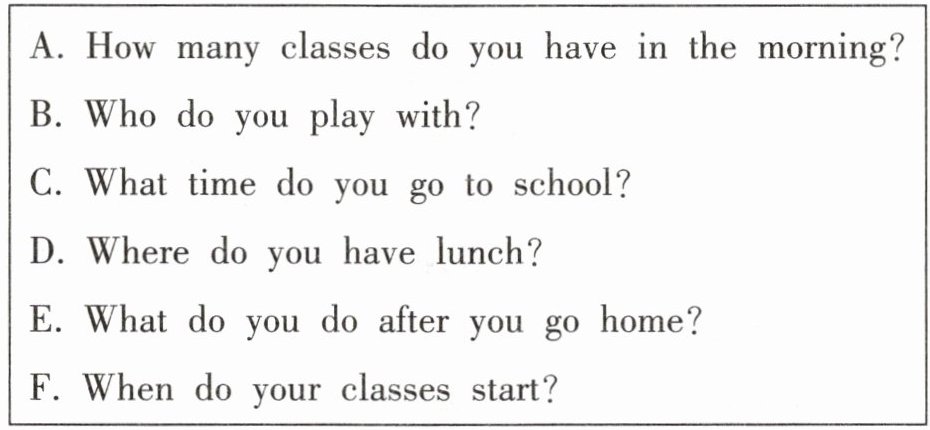
1.
2.
3.
4.
5.
Tim: Hi! I'm Tim, a school reporter. What's your name, please?
Li Ming: Li Ming.
Tim: So Li Ming, what time do you get up on school days?
Li Ming: I get up at 6:30 a.m. Then I wash my face, brush my teeth, and have breakfast.
Tim:
C
1Li Ming: I leave home at 7:20 a.m. I walk to school with my friend.
Tim:
F
2Li Ming: My first class starts at 8:00 a.m.
Tim:
A
3Li Ming: I have four classes in the morning.
Tim:
D
4Li Ming: I have lunch at school. I eat with my classmates.
Tim: What time do you go home?
Li Ming: I get home at about 4:30 p.m.
Tim:
E
5Li Ming: I do my homework first. Then I have dinner with my family. After dinner, I do my homework and read some books. Sometimes I watch TV for a little while.
1.
C
2.
F
3.
A
4.
D
5.
E
答案
1.C 2.F 3.A 4.D 5.E
解析
【分析】
补全对话需结合每个空的答句内容,匹配对应的特殊疑问句:先明确每个答句的核心信息(时间、数量、地点、事件等),再对应方框中问句的疑问词和内容,同时排除未用到的多余选项。
【解析】
1. 答句提到“离开家上学的时间”,对应询问上学时间的C选项;
2. 答句提到“课程开始时间”,对应询问课程开始时间的F选项;
3. 答句提到“上午的课数量”,对应询问课数量的A选项;
4. 答句提到“吃午饭的地点”,对应询问午饭地点的D选项;
5. 答句提到“回家后做的事”,对应询问回家后做什么的E选项;多余选项B未使用,符合要求。
【答案】
1.C 2.F 3.A 4.D 5.E
【知识点】
补全对话、特殊疑问句运用
【点评】
本题考查日常校园生活情景的对话补全,需结合上下文问答逻辑匹配对应问句,是基础英语交际题,难度适中。
【难度系数】
0.6
补全对话需结合每个空的答句内容,匹配对应的特殊疑问句:先明确每个答句的核心信息(时间、数量、地点、事件等),再对应方框中问句的疑问词和内容,同时排除未用到的多余选项。
【解析】
1. 答句提到“离开家上学的时间”,对应询问上学时间的C选项;
2. 答句提到“课程开始时间”,对应询问课程开始时间的F选项;
3. 答句提到“上午的课数量”,对应询问课数量的A选项;
4. 答句提到“吃午饭的地点”,对应询问午饭地点的D选项;
5. 答句提到“回家后做的事”,对应询问回家后做什么的E选项;多余选项B未使用,符合要求。
【答案】
1.C 2.F 3.A 4.D 5.E
【知识点】
补全对话、特殊疑问句运用
【点评】
本题考查日常校园生活情景的对话补全,需结合上下文问答逻辑匹配对应问句,是基础英语交际题,难度适中。
【难度系数】
0.6
