

 登录
登录
七、信息还原。
阅读下面短文,从短文后的选项中选出可以填入空白处的最佳选项。选项中有两项为多余选项。
Bamboo is a wonderful plant for many people around the world.
One of the world's oldest building materials is bamboo. Like today, people in the past used it because it was very strong. They used it to build houses, boats, and bridges. The Chinese made a bamboo bridge over the Minjiang River in Sichuan, China, almost 1,000 years ago.
As a part of history, bamboo is very important. The great scientist Thomas Edison did not invent the light bulb(灯泡), but he made it perfect. He wanted the material inside to burn for a long period of time. He tried over 1,000 different types of materials.
1.
阅读下面短文,从短文后的选项中选出可以填入空白处的最佳选项。选项中有两项为多余选项。
Bamboo is a wonderful plant for many people around the world.
B
1 People make tables, clothes, medicine, and musical instruments with it. Pandas eat bamboo every day, and people can also eat it.F
2 Some bamboo grows so quickly that people say they can watch it grow. The speed of growth depends on the type of bamboo, the earth and the season. Normal bamboo grows 3-10 cm a day. It usually grows in tropical(热带的) areas. E
3 Bamboo plants are found in Asia, Australia, parts of Africa, and South America.One of the world's oldest building materials is bamboo. Like today, people in the past used it because it was very strong. They used it to build houses, boats, and bridges. The Chinese made a bamboo bridge over the Minjiang River in Sichuan, China, almost 1,000 years ago.
A
4 Also, bamboo is still used to make houses today, especially in China and the Philippines.As a part of history, bamboo is very important. The great scientist Thomas Edison did not invent the light bulb(灯泡), but he made it perfect. He wanted the material inside to burn for a long period of time. He tried over 1,000 different types of materials.
C
5 One day, he tried to use a piece of bamboo and the light bulb lasted for over a thousand hours. This invention helped other scientists to make the modern light bulb we use today.1.
B
2. F
3. E
4. A
5. C
答案
1. B 2. F 3. E 4. A 5. C
解析
【分析】
本题为英语信息还原题,解题思路是:先通读全文,明确文章围绕竹子的多方面内容(用途、生长、建筑应用、历史关联等)展开;接着逐个分析每个空白处前后句的语义和逻辑关系,结合选项的话题匹配度、衔接性,排除多余选项,选出最符合语境的答案。
【解析】
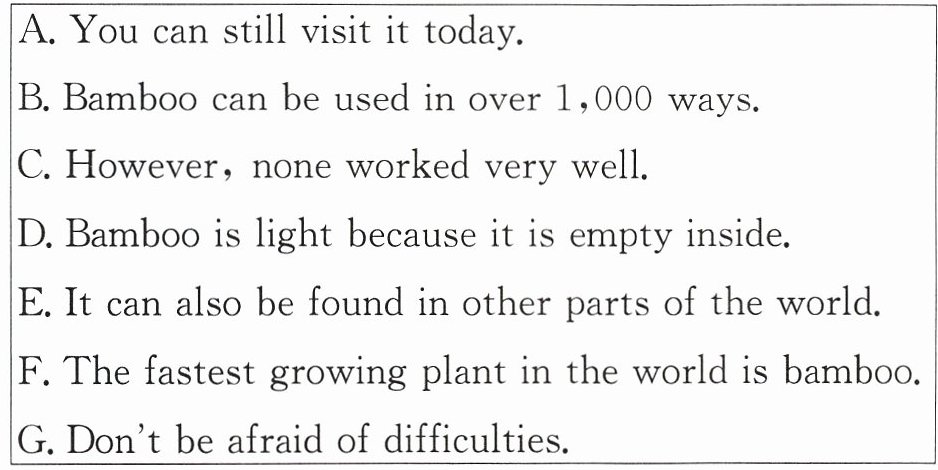
1. 第1空后提到人们用竹子制作桌子、衣服、药品等,说明竹子用途广泛,选项B“Bamboo can be used in over 1,000 ways.”(竹子有超过1000种用途)与后文衔接,符合语境,故选B。
2. 第2空后讲述竹子生长速度快的特点,选项F“The fastest growing plant in the world is bamboo.”(世界上生长最快的植物是竹子)引出该话题,与后文内容呼应,故选F。
3. 第3空前说明竹子通常生长在热带地区,后提到竹子分布在亚洲、澳大利亚等其他地区,选项E“It can also be found in other parts of the world.”(它也能在世界其他地方找到)承接前后,说明分布范围,故选E。
4. 第4空前提到1000年前中国人在岷江建了竹桥,后说现在竹子仍用于建房,选项A“You can still visit it today.”(你今天仍然可以参观它)指代前文的竹桥,衔接自然,故选A。
5. 第5空前说爱迪生尝试了1000多种材料,后提到用竹子成功,选项C“However, none worked very well.”(然而,没有一种效果很好)承接前文的多次尝试,引出后续用竹子的成功,故选C。
【答案】
1.B 2.F 3.E 4.A 5.C
【知识点】
语篇衔接、阅读理解、信息还原
【点评】
本题围绕竹子的用途、生长特性、建筑应用及历史关联展开,考查学生对上下文逻辑关系和语境的理解能力,需结合话题一致性与语义衔接解题,是初中英语常见的信息还原题型。
【难度系数】
0.4
本题为英语信息还原题,解题思路是:先通读全文,明确文章围绕竹子的多方面内容(用途、生长、建筑应用、历史关联等)展开;接着逐个分析每个空白处前后句的语义和逻辑关系,结合选项的话题匹配度、衔接性,排除多余选项,选出最符合语境的答案。
【解析】
1. 第1空后提到人们用竹子制作桌子、衣服、药品等,说明竹子用途广泛,选项B“Bamboo can be used in over 1,000 ways.”(竹子有超过1000种用途)与后文衔接,符合语境,故选B。
2. 第2空后讲述竹子生长速度快的特点,选项F“The fastest growing plant in the world is bamboo.”(世界上生长最快的植物是竹子)引出该话题,与后文内容呼应,故选F。
3. 第3空前说明竹子通常生长在热带地区,后提到竹子分布在亚洲、澳大利亚等其他地区,选项E“It can also be found in other parts of the world.”(它也能在世界其他地方找到)承接前后,说明分布范围,故选E。
4. 第4空前提到1000年前中国人在岷江建了竹桥,后说现在竹子仍用于建房,选项A“You can still visit it today.”(你今天仍然可以参观它)指代前文的竹桥,衔接自然,故选A。
5. 第5空前说爱迪生尝试了1000多种材料,后提到用竹子成功,选项C“However, none worked very well.”(然而,没有一种效果很好)承接前文的多次尝试,引出后续用竹子的成功,故选C。
【答案】
1.B 2.F 3.E 4.A 5.C
【知识点】
语篇衔接、阅读理解、信息还原
【点评】
本题围绕竹子的用途、生长特性、建筑应用及历史关联展开,考查学生对上下文逻辑关系和语境的理解能力,需结合话题一致性与语义衔接解题,是初中英语常见的信息还原题型。
【难度系数】
0.4
