

 登录
登录
Robots Are Now Teaching English!
Get ready. Robots are going to come into our classroom. From South Korea to Japan to the United States, schools are putting English speaking robots in front of their students. The young students say that the robots are fun. But are these children really learning anything? Different students have different ideas.
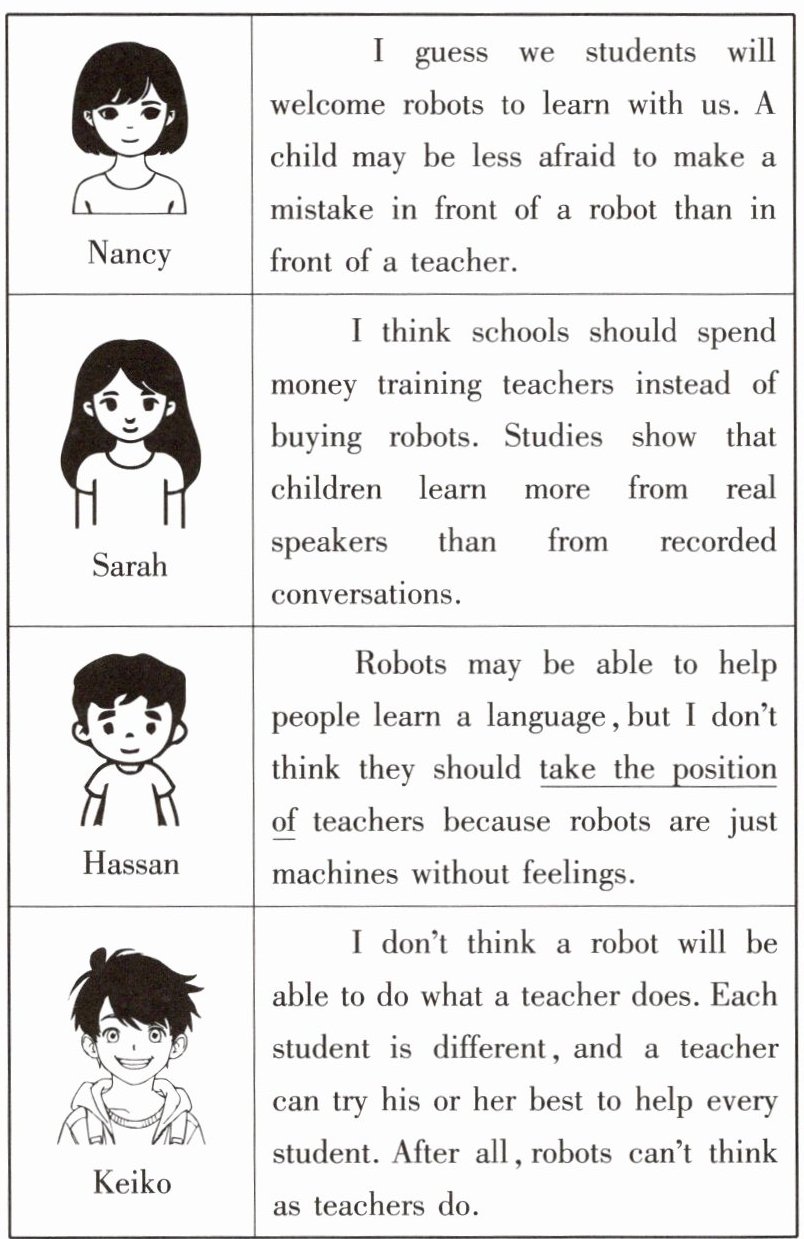 ||Nancy|I guess we students will welcome robots to learn with us. A child may be less afraid to make a mistake in front of a robot than in front of a teacher.|
||Sarah|I think schools should spend money training teachers instead of buying robots. Studies show that children learn more from real speakers than from recorded conversations.|
||Hassan|Robots may be able to help people learn a language, but I don't think they should take the position of teachers because robots are just machines without feelings.|
||Keiko|I don't think a robot will be able to do what a teacher does. Each student is different, and a teacher can try his or her best to help every student. After all, robots can't think as teachers do.|
(
A. Popular.
B. Serious.
C. Special.
D. Boring.
(
A. robots
B. machines
C. teachers
D. recorded conversations
(
A. 影响.
B. 帮助.
C. 惩罚.
D. 代替.
(
A. It can make mistakes.
B. It can only speak English.
C. It can't train teachers.
D. It can't know the needs of each student.
(
A. Sports.
B. Science.
C. Health.
D. Nature.
Get ready. Robots are going to come into our classroom. From South Korea to Japan to the United States, schools are putting English speaking robots in front of their students. The young students say that the robots are fun. But are these children really learning anything? Different students have different ideas.
||Nancy|I guess we students will welcome robots to learn with us. A child may be less afraid to make a mistake in front of a robot than in front of a teacher.|||Sarah|I think schools should spend money training teachers instead of buying robots. Studies show that children learn more from real speakers than from recorded conversations.|
||Hassan|Robots may be able to help people learn a language, but I don't think they should take the position of teachers because robots are just machines without feelings.|
||Keiko|I don't think a robot will be able to do what a teacher does. Each student is different, and a teacher can try his or her best to help every student. After all, robots can't think as teachers do.|
(
A
) 1. What does Nancy think of robots?A. Popular.
B. Serious.
C. Special.
D. Boring.
(
C
) 2. Sarah thinks students can learn better from ______.A. robots
B. machines
C. teachers
D. recorded conversations
(
D
) 3. What does the underlined phrase “take the position of” mean in Chinese?A. 影响.
B. 帮助.
C. 惩罚.
D. 代替.
(
D
) 4. Why can't a robot do better than a teacher according to Keiko?A. It can make mistakes.
B. It can only speak English.
C. It can't train teachers.
D. It can't know the needs of each student.
(
B
) 5. In which section of the newspaper can we read the passage?A. Sports.
B. Science.
C. Health.
D. Nature.
答案
1. A
2. C
3. D
4. D
5. B
2. C
3. D
4. D
5. B
解析
1.问题问:“Nancy对机器人有什么看法?”
Nancy的陈述中提到学生可能会欢迎机器人来一起学习,认为在机器人面前犯错会比在老师面前犯错更不让人害怕。因此Nancy认为机器人会受到欢迎,即“Popular”。
因此,答案是A。
2.问题问:“Sarah认为学生可以从哪里学得更好?”
Sarah的陈述中提到学校应该花钱培训老师而不是购买机器人,研究表明学生从真实的讲话者那里学得更多,而不是录音对话。因此Sarah认为学生可以从教师那里学得更好。
因此,答案是C。
3.问题问:“下划线短语‘take the position of’在中文中是什么意思?”
Hassan的陈述中提到机器人可以帮助人们学习语言,但不认为它们应该代替老师,因为机器人只是没有感情的机器。根据上下文,短语“take the position of”的意思是“代替”。
因此,答案是D。
4.问题问:“根据Keiko,为什么机器人不能比老师做得更好?”
Keiko的陈述中提到每个学生都是不同的,老师可以尽力帮助每个学生,而机器人不能像老师那样思考。因此,机器人不能了解每个学生的需求。
因此,答案是D。
5.问题问:“我们可以在报纸的哪个部分读到这篇文章?”
文章讨论的是机器人在教育中的应用,这属于科学技术相关的内容。
因此,答案是B。
Nancy的陈述中提到学生可能会欢迎机器人来一起学习,认为在机器人面前犯错会比在老师面前犯错更不让人害怕。因此Nancy认为机器人会受到欢迎,即“Popular”。
因此,答案是A。
2.问题问:“Sarah认为学生可以从哪里学得更好?”
Sarah的陈述中提到学校应该花钱培训老师而不是购买机器人,研究表明学生从真实的讲话者那里学得更多,而不是录音对话。因此Sarah认为学生可以从教师那里学得更好。
因此,答案是C。
3.问题问:“下划线短语‘take the position of’在中文中是什么意思?”
Hassan的陈述中提到机器人可以帮助人们学习语言,但不认为它们应该代替老师,因为机器人只是没有感情的机器。根据上下文,短语“take the position of”的意思是“代替”。
因此,答案是D。
4.问题问:“根据Keiko,为什么机器人不能比老师做得更好?”
Keiko的陈述中提到每个学生都是不同的,老师可以尽力帮助每个学生,而机器人不能像老师那样思考。因此,机器人不能了解每个学生的需求。
因此,答案是D。
5.问题问:“我们可以在报纸的哪个部分读到这篇文章?”
文章讨论的是机器人在教育中的应用,这属于科学技术相关的内容。
因此,答案是B。
