

 登录
探究点 happen to 的用法
| 用法 | 例句 |
| --- | --- |
| sth+happen(s) to + sb/sth
某事发生在某人/某物身上 | An accident happened to his father last week.
他的爸爸上周出了一场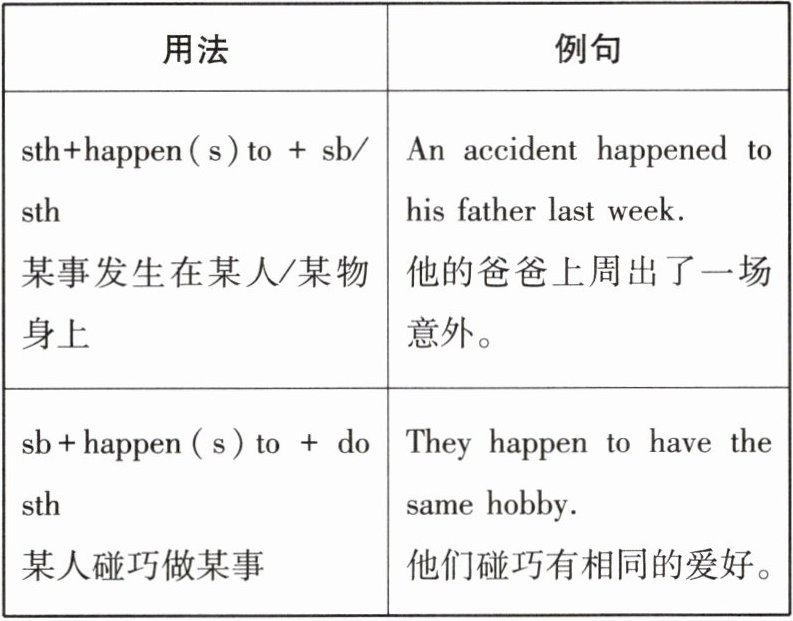 意外。 |
| sb+happen(s) to + do sth
某人碰巧做某事 | They happen to have the same hobby.
他们碰巧有相同的爱好。 |
情境应用
1. Luckily, nothing bad them during the storm.
A. took to B. happened to
C. got to D. ran to
2. I to meet my old friend at the supermarket yesterday. (happen)
3. He happened the answer to the question. (know)
4. Something bad his cat yesterday. (发生在)
| 用法 | 例句 |
| --- | --- |
| sth+happen(s) to + sb/sth
某事发生在某人/某物身上 | An accident happened to his father last week.
他的爸爸上周出了一场
意外。 || sb+happen(s) to + do sth
某人碰巧做某事 | They happen to have the same hobby.
他们碰巧有相同的爱好。 |
情境应用
1. Luckily, nothing bad them during the storm.
A. took to B. happened to
C. got to D. ran to
2. I to meet my old friend at the supermarket yesterday. (happen)
3. He happened the answer to the question. (know)
4. Something bad his cat yesterday. (发生在)
答案
1. B
2. happened
3. to know
4. happened to
2. happened
3. to know
4. happened to
解析
1. 本题考查happen to的用法,根据“sth+happen(s) to + sb 某事发生在某人身上”的规则,结合句意“幸运的是,暴风雨期间没有任何坏事发生在他们身上”,A.took to意为“喜欢、开始从事”,C.got to意为“到达”,D.ran to意为“跑向”,只有B选项符合语义和用法要求。
2. 本题考查happen to的时态,根据“sb+happen(s) to + do sth 某人碰巧做某事”的规则,句中时间状语yesterday表示过去,谓语动词要用happen的过去式happened。
3. 本题考查happen to的固定搭配结构,根据“sb+happen(s) to + do sth”的规则,happen后要接动词不定式,因此填to know。
4. 本题考查happen to的时态和语义,根据“sth+happen(s) to + sth 某事发生在某物身上”的规则,时间状语yesterday表示过去,happen的过去式为happened,因此填happened to。
()1. —Look! The old man is walking with a boy closely. Who is the boy to him?
—The boy is his , his son’s lovely little boy.
A.cousin
B.sister
C.grandson
D.classmate
—The boy is his , his son’s lovely little boy.
A.cousin
B.sister
C.grandson
D.classmate
答案
C
解析
根据句中提示"his son’s lovely little boy",可知这个男孩是老人儿子的儿子,也就是孙子。A选项cousin意为堂/表亲,B选项sister意为姐妹,是女性,不符合boy的描述,D选项classmate意为同学,均不符合语境,grandson意为孙子,符合语义。
()2. your case, you can ask the teacher for help when you meet study problems.
A.At
B.In
C.On
D.For
A.At
B.In
C.On
D.For
答案
B
解析
本题考查固定短语搭配,固定表达in one's case意为“在某人的情况下”,其余选项的介词均无法和your case构成符合句意的正确搭配,由此确定答案。
()3. —Why do you look so sad these days?
You seem a little about the coming English test.
—Because I'm not good at listening and reading.
A.bored
B.tired
C.worried
D.excited
You seem a little about the coming English test.
—Because I'm not good at listening and reading.
A.bored
B.tired
C.worried
D.excited
答案
C
解析
根据前句“你这些天看起来很难过”以及答句“我不擅长听力和阅读”的语境,结合固定搭配be worried about(为……担心),A选项bored意为无聊的,B选项tired意为疲惫的,D选项excited意为兴奋的,均不符合语境,只有C项符合语义。
()4. —When will your family Kun-
ming by high-speed train this week-
end?
—We'll get there at about 4 o'clock in
the afternoon.
A.come
B.arrive
C.get
D.reach
ming by high-speed train this week-
end?
—We'll get there at about 4 o'clock in
the afternoon.
A.come
B.arrive
C.get
D.reach
答案
D
解析
本题考查“到达”相关动词的用法辨析:1. A选项come为不及物动词,后接地点名词时需要加介词to;2. B选项arrive为不及物动词,后接地点名词时需搭配介词in(大地点)或at(小地点);3. C选项get表示“到达”时为不及物动词,后接地点名词时需要加介词to;4. D选项reach是及物动词,可直接接地点名词。本题空格后直接跟地点名词Kunming,只有reach符合语法要求。
Ⅱ. 根据句意,用括号中所给词的适当形式填空
1. My friend and I to the new water park next Saturday. (go)
2. She keeps to English songs to improve her listening skills. (listen)
3. I an interesting book when the phone suddenly rang last night. (read)
4. Your body will get much after you do some exercise. (strong)
5. We should tell him not up when he meets problems. (give)
答案
1. will go/are going
2. listening
3. was reading
4. stronger
5. to give
2. listening
3. was reading
4. stronger
5. to give
解析
1. 句中时间状语next Saturday表示将来的时间,句子要用一般将来时,主语My friend and I是复数,所以填will go或者are going。
2. 固定搭配keep doing sth. 表示“持续做某事”,后面要接动词的动名词形式,因此listen变为listening。
3. 此处是过去进行时的常用结构be doing sth. when...,表示过去某个动作发生时另一个动作正在进行,时间last night说明是过去,主语是I,be动词用was,所以填was reading。
4. 副词much可以用来修饰形容词的比较级,表达“……得多”的含义,strong的比较级是stronger。
5. 固定搭配tell sb. not to do sth. 意思是“告诉某人不要做某事”,后面接动词不定式,因此填to give。
2. 固定搭配keep doing sth. 表示“持续做某事”,后面要接动词的动名词形式,因此listen变为listening。
3. 此处是过去进行时的常用结构be doing sth. when...,表示过去某个动作发生时另一个动作正在进行,时间last night说明是过去,主语是I,be动词用was,所以填was reading。
4. 副词much可以用来修饰形容词的比较级,表达“……得多”的含义,strong的比较级是stronger。
5. 固定搭配tell sb. not to do sth. 意思是“告诉某人不要做某事”,后面接动词不定式,因此填to give。
Ⅲ.将下列句子中汉语部分译成英语,注意使用适当的形式
1. Seeing colourful birds flying freely in the sky is a for him.(好兆头)
2. What our classroom window?(发生于)
3. She all the letters to find the one from her pen pal.(仔细察看)
4. that we will have an English competition tomorrow.(记住)
5. ,I usually finish homework before dinner.(就我而言)
1. Seeing colourful birds flying freely in the sky is a for him.(好兆头)
2. What our classroom window?(发生于)
3. She all the letters to find the one from her pen pal.(仔细察看)
4. that we will have an English competition tomorrow.(记住)
5. ,I usually finish homework before dinner.(就我而言)
答案
1. good sign
2. happened to
3. looked through
4. Remember
5. As for me
2. happened to
3. looked through
4. Remember
5. As for me
解析
1. 本题考查固定短语,“好兆头”的对应英文表达为good sign,空前有不定冠词a,使用名词单数形式即可。
2. 本题考查固定搭配与时态,“发生于/发生在……之上”用固定短语happen to,此处询问已经发生的事件,时态用一般过去时。
3. 本题考查固定短语与时态,“仔细察看(信件、文件类物品)”用固定短语look through,此处描述过去发生的动作,时态用一般过去时。
4. 本题考查祈使句用法,此处为提醒语气的祈使句,句首用动词原形,“记住”译为Remember,首字母大写后接宾语从句。
5. 本题考查固定短语,初中阶段“就我而言”的标准常用表达为As for me,放在句首作状语符合语境。
2. 本题考查固定搭配与时态,“发生于/发生在……之上”用固定短语happen to,此处询问已经发生的事件,时态用一般过去时。
3. 本题考查固定短语与时态,“仔细察看(信件、文件类物品)”用固定短语look through,此处描述过去发生的动作,时态用一般过去时。
4. 本题考查祈使句用法,此处为提醒语气的祈使句,句首用动词原形,“记住”译为Remember,首字母大写后接宾语从句。
5. 本题考查固定短语,初中阶段“就我而言”的标准常用表达为As for me,放在句首作状语符合语境。
