

 登录
登录
一、看图,写单词。
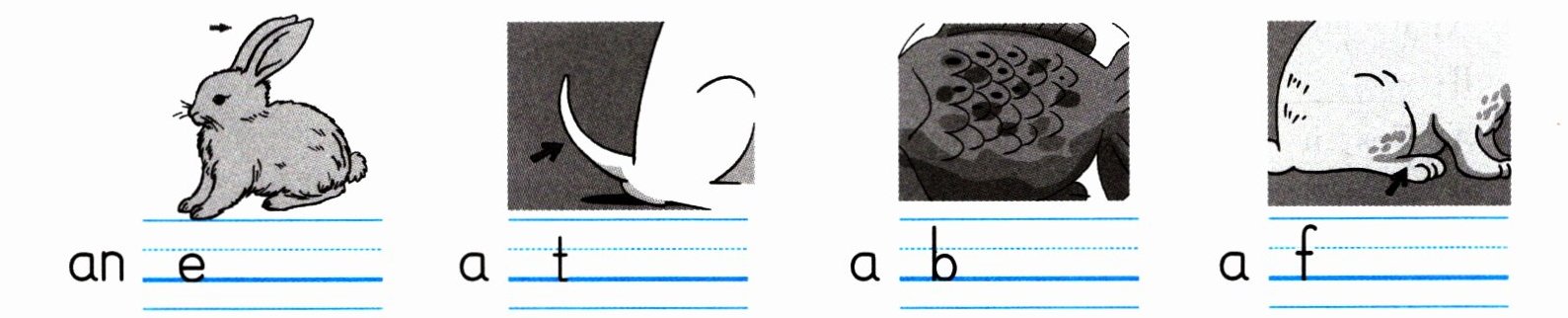
答案
1. ear
2. tail
3. body
4. foot
2. tail
3. body
4. foot
二、根据句意和中文提示完成句子,或写出画线部分的中文意思。
1. The crab has a hard body. ( )
2. The parrot can fly and talk. ( )
3. Who has ______ (两条长腿)?
4. She has ______ (大眼睛).
1. The crab has a hard body. ( )
2. The parrot can fly and talk. ( )
3. Who has ______ (两条长腿)?
4. She has ______ (大眼睛).
答案
一个坚硬的身体
会飞和说话
two long legs
big eyes
会飞和说话
two long legs
big eyes
三、从方框中选择合适的选项填空,将序号填在横线上。
A. have B. has C. don't have D. doesn't E. Does F. Do G. don't H. There is
1. A cat ______ a long tail and four legs.
2. — ______ your father ______ a car? — No, he ______.
3. I ______ a ruler. Can I borrow yours, Su Hai?
4. — ______ you have an umbrella, Sam? — No, I ______.
A. have B. has C. don't have D. doesn't E. Does F. Do G. don't H. There is
1. A cat ______ a long tail and four legs.
2. — ______ your father ______ a car? — No, he ______.
3. I ______ a ruler. Can I borrow yours, Su Hai?
4. — ______ you have an umbrella, Sam? — No, I ______.
答案
1.B
2.E A D
3.C F
4.G
2.E A D
3.C F
4.G
( )1.— How many legs does a duck have? — ______
A.Two.
B.There are two.
C.There are four.
A.Two.
B.There are two.
C.There are four.
答案
A
解析
问句询问鸭子有多少条腿,根据常识鸭子有两条腿。A选项“Two.”直接回答数量,符合“How many...?”的简洁回答方式;B选项“There are two.”虽语法正确,但日常回答此类问题常用简略形式;C选项“four”与事实不符。
( )2.It's time ______ PE lesson.
A.to
B.four
C.for
A.to
B.four
C.for
答案
C
解析
本题主要考查“It's time...”的固定搭配用法。“It's time for + 名词”表示“是做某事的时间了”,“It's time to + 动词原形”也表示“是做某事的时间了”。在本题中“PE lesson”是名词短语,所以应该用“for”。选项A“to”后面要接动词原形,不符合本题结构;选项B“four”是数词,与本题语境无关。
( )3.— Do you like English? — ______. It's fun.
A.No, I don't
B.Yes, I do
C.I like PE
A.No, I don't
B.Yes, I do
C.I like PE
答案
B
解析
问句为Do you开头的一般疑问句,回答应用Yes, I do或No, I don't。根据答语“It's fun.”可知是肯定回答,所以应选Yes, I do。
( )4.______ a book on the desk?
A.Are there
B.Is there
C.Is
A.Are there
B.Is there
C.Is
答案
B
解析
该句为there be句型的一般疑问句,主语"a book"是单数,be动词用is,句首首字母大写,所以用"Is there"。
( )5.I can run. What ______ you ______?
A.can; do
B.do; can
C.are; doing
A.can; do
B.do; can
C.are; doing
答案
A
解析
前句用can表示能力,后句询问对方能力,也用can,结构为What can you do? 选项A符合。
( )6.How ______ lessons do you have on Monday?
A.about
B.much
C.many
A.about
B.much
C.many
答案
C
解析
本题考查疑问词组的用法。A选项“about”意为“关于”,不符合语境;B选项“much”修饰不可数名词,而“lessons”是可数名词复数,故不选;C选项“many”用于修饰可数名词复数,符合“lessons”的语境。因此,正确疑问词组应为“how many”,用于询问数量。
( )7.______ it ______ wings?
A.Does; have
B.Do; have
C.Does; has
A.Does; have
B.Do; have
C.Does; has
答案
A
解析
本题考查一般现在时的一般疑问句结构。主语it是第三人称单数,一般现在时的一般疑问句要借助助动词does,且助动词后动词用原形have。选项B中do用于主语不是第三人称单数的情况;选项C中助动词does后不能用动词第三人称单数形式has。所以正确答案是A。
( )8.— What do we have this morning? — ______
A.We have a PE lesson.
B.We has a PE lesson.
C.Yes, we do.
A.We have a PE lesson.
B.We has a PE lesson.
C.Yes, we do.
答案
A
解析
问句“What do we have this morning?”是特殊疑问句,询问今天上午有什么课,回答应该是具体课程。B选项“We has a PE lesson.”存在语法错误,主语we是复数,动词应该用have而不是has;C选项“Yes, we do.”是一般疑问句的肯定回答,而此题是特殊疑问句,该回答不适用。A选项“We have a PE lesson.”符合语法且回答了课程情况。
