

 登录
4. do exercises
【感知】
» All the students go there and do exercises together in the morning.(教材第 40 页)所有学生在早上去那里一起做体操。
» I often do exercise with my friends after school. 我放学后经常和朋友一起锻炼。
» We exercise about one hour at school every day. 我们每天在学校大约锻炼一个小时。
【探究】
(1) exercise 作
(2) exercise 作
(3) exercise 作动词,意为“
【应用】
(1)完成句子
①做眼保健操是保护我们视力的一种好方法。
Doing
②他的爸爸有时候在家附近的公园做锻炼。
His father sometimes
(2)用所给单词的适当形式填空
My grandfather often
【感知】
» All the students go there and do exercises together in the morning.(教材第 40 页)所有学生在早上去那里一起做体操。
» I often do exercise with my friends after school. 我放学后经常和朋友一起锻炼。
» We exercise about one hour at school every day. 我们每天在学校大约锻炼一个小时。
【探究】
(1) exercise 作
可数
(可数/不可数)名词,表示“一套动作,练习”。(2) exercise 作
不可数
(可数/不可数)名词,表示“活动,锻炼”,常和 take、do、get 等连用。(3) exercise 作动词,意为“
锻炼
”。【应用】
(1)完成句子
①做眼保健操是保护我们视力的一种好方法。
Doing
eye
exercises
is a good way to protect our eyesight.②他的爸爸有时候在家附近的公园做锻炼。
His father sometimes
does
some exercise
in the park near his home.(2)用所给单词的适当形式填空
My grandfather often
exercises
(exercise) in the morning.答案
4. [探究](1) 可数 (2) 不可数
(3) 锻炼
[应用](1)① eye exercises
② does; exercise
(2) exercises
解析
【分析】
本题考查核心词汇exercise的词性、可数性及固定搭配用法。解题思路:先结合题目给出的例句,区分exercise作名词时不同含义对应的可数性,再确定其动词含义;应用部分需结合固定搭配、主谓一致规则完成填空。
【解析】
探究部分:
(1) 由例句“do exercises together”可知,exercise表示“一套动作、练习”时为可数名词,常用复数形式。
(2) 由例句“do exercise”可知,exercise表示“活动、锻炼”时为不可数名词,常与do、take等动词连用。
(3) 由例句“We exercise about one hour”可知,exercise作动词时意为“锻炼”。
应用部分:
(1) ①“眼保健操”的固定表达为eye exercises,此处exercise表“一套动作”,用复数。
② 主语His father为第三人称单数,一般现在时中动词do需变does;“做锻炼”为固定搭配do exercise,exercise表“锻炼”时为不可数名词,用原形。
(2) 主语My grandfather为第三人称单数,一般现在时中动词exercise需用第三人称单数形式exercises。
【答案】
4. [探究](1) 可数 (2) 不可数 (3) 锻炼
[应用](1)① eye exercises ② does; exercise (2) exercises
【知识点】
名词的可数性、动词的用法、固定搭配
【点评】
本题围绕exercise的多词性、可数性及固定搭配展开,结合语境和例句分析,属于初中英语基础词汇考查题,需准确区分不同用法。
【难度系数】
0.6
5. amazing
【感知】
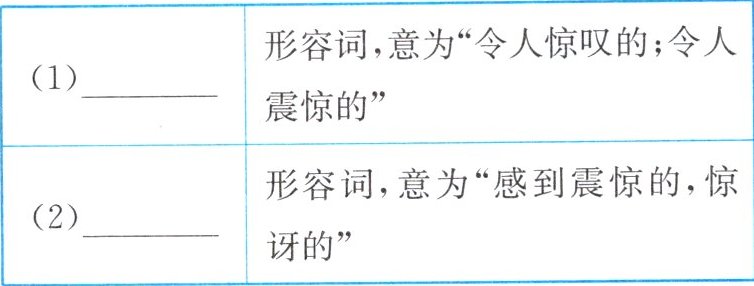
» It's amazing!(教材第40页)令人震惊!
» He is amazed at the news. 他对这个消息感到震惊。
【探究】
【应用】
用所给单词的适当形式填空
①She is
②What an
【感知】
» It's amazing!(教材第40页)令人震惊!
» He is amazed at the news. 他对这个消息感到震惊。
【探究】
【应用】
用所给单词的适当形式填空
①She is
amazed
(amaze) at the changes.②What an
amazing
(amaze) girl she is!答案
5. [探究](1) amazing (2) amazed
[应用]① amazed ② amazing
解析
【分析】首先明确以-ing结尾和-ed结尾形容词的用法区别:-ing结尾的形容词多修饰事物,表“令人……的”属性;-ed结尾的形容词多修饰人,表“感到……的”感受。再结合题目中的主语和修饰对象判断:①句主语是人称代词She,需表达人的感受,用-ed形式;②句修饰名词girl,需表达“令人……的”属性,用-ing形式。
【解析】根据两类形容词的用法规则:①句主语是She(人),表达“她对变化感到震惊”,所以用amazed;②句修饰名词girl,表达“令人惊叹的女孩”,所以用amazing。
【答案】①amazed ②amazing
【知识点】-ing/-ed形容词用法;形容词辨析
【点评】本题考查初中英语基础的-ing与-ed结尾形容词的用法差异,需结合修饰对象判断形式,属于基础考点。
【难度系数】0.3
6. most
【感知】
» We spend most of the time in our classroom.(教材第40页)我们大部分时间都在教室里度过。
» Most of the students in the class are from China. 班上大部分学生都来自中国。
» Most people like apples. 大多数人喜欢苹果。
【探究】
(1) most 作代词,意为“大多数;大部分”;most of ... 表示“……的大多数/大部分”,后接名词或代词。most of ...作主语时,谓语动词的单复数形式跟of后的名词或代词的数保持一致。
(2) most 作形容词,意为“大多数;大部分”,后面接名词。
【应用】
用所给单词的适当形式填空
①Most of
②Most
③ Most of the rooms
【感知】
» We spend most of the time in our classroom.(教材第40页)我们大部分时间都在教室里度过。
» Most of the students in the class are from China. 班上大部分学生都来自中国。
» Most people like apples. 大多数人喜欢苹果。
【探究】
(1) most 作代词,意为“大多数;大部分”;most of ... 表示“……的大多数/大部分”,后接名词或代词。most of ...作主语时,谓语动词的单复数形式跟of后的名词或代词的数保持一致。
(2) most 作形容词,意为“大多数;大部分”,后面接名词。
【应用】
用所给单词的适当形式填空
①Most of
them
(they)want to have a picnic.②Most
children
(child)like going out at weekends.③ Most of the rooms
face
(face)the sea.答案
6. [应用]① them ② children ③ face
解析
【分析】
本题考查most的用法及相关语法规则,解题思路如下:1. 明确most of后接代词时,代词需用宾格形式;2. 掌握most作形容词修饰名词时的单复数变化;3. 牢记most of + 复数名词作主语时,谓语动词用复数形式(原形)。
【解析】
①most of为介词短语,后接人称代词需用宾格,they的宾格是them,故填them;②most作形容词修饰名词,child的复数形式为children,故填children;③most of the rooms中,rooms是复数名词,作主语时谓语动词用复数形式,face的原形为face,故填face。
【答案】6. [应用]① them ② children ③ face
【知识点】代词宾格、名词复数、主谓一致
【点评】本题围绕most的核心用法展开,涵盖代词搭配、名词词形变化及主谓一致,属于初中英语基础语法题,侧重基础知识点的应用,难度适中。
【难度系数】0.7
