

 登录
登录
第一部分 阅读理解(共两节,满分20分)
第一节 阅读选择(共10小题;每小题1.5分,满分15分)
A
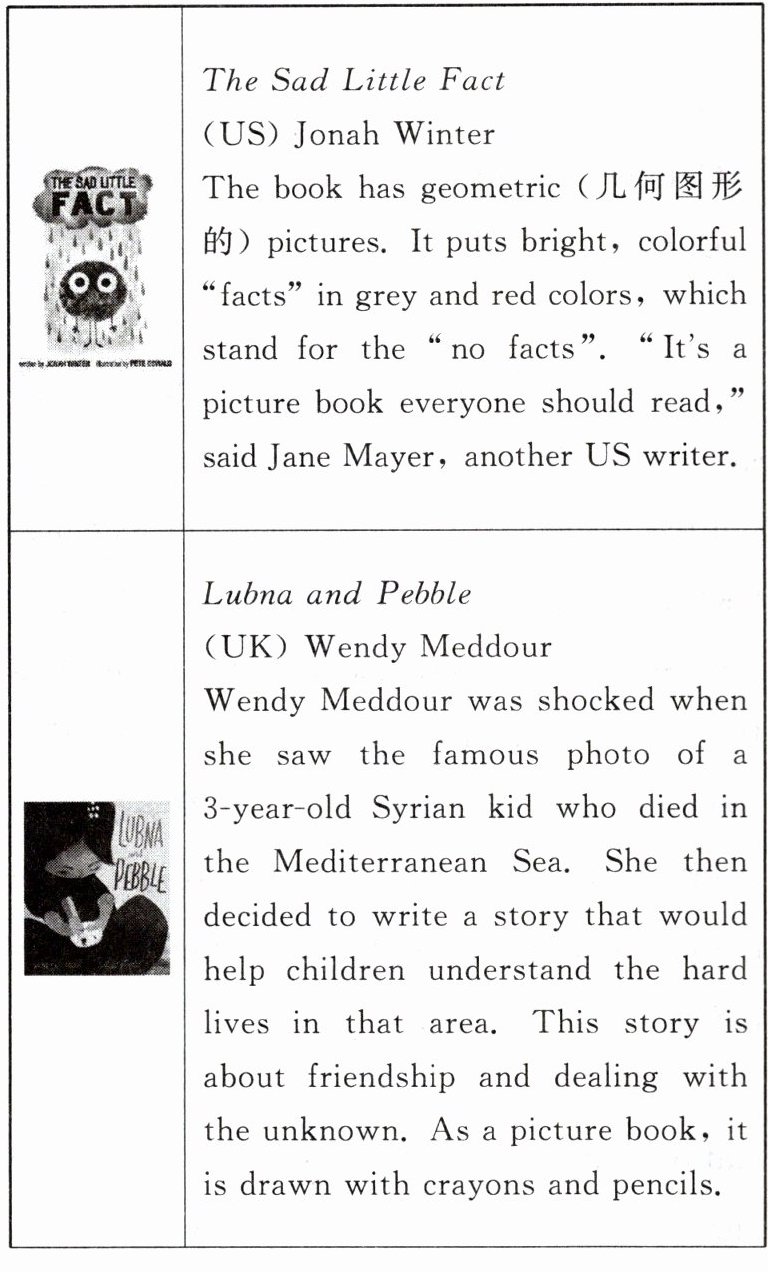
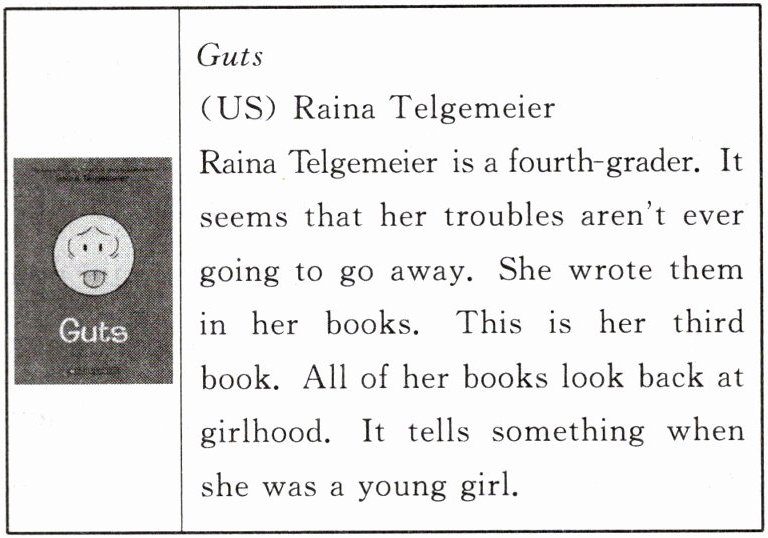
Which English-language books are teenagers from other countries reading? At the end of every year, Time magazine releases(发布)a list of the best children's books.
续表
1. What does Jane Mayer do?
A. A reader.
B. A writer.
C. A book seller.
D. A teacher.
2. What book is Lubna and Pebble?
A. A cartoon book with pictures.
B. A drawing exercise book.
C. A picture book about friendship.
D. A picture book about science.
3. Which of the following is TRUE about the book Guts?
A. It is Raina Telgemeier's first book.
B. Its writer is a UK fourth-grader.
C. It tells a true story about growing up.
D. It brings many troubles to the writer.
B
第一节 阅读选择(共10小题;每小题1.5分,满分15分)
A
Which English-language books are teenagers from other countries reading? At the end of every year, Time magazine releases(发布)a list of the best children's books.
续表
1. What does Jane Mayer do?
A. A reader.
B. A writer.
C. A book seller.
D. A teacher.
2. What book is Lubna and Pebble?
A. A cartoon book with pictures.
B. A drawing exercise book.
C. A picture book about friendship.
D. A picture book about science.
3. Which of the following is TRUE about the book Guts?
A. It is Raina Telgemeier's first book.
B. Its writer is a UK fourth-grader.
C. It tells a true story about growing up.
D. It brings many troubles to the writer.
B
答案
1.B 2.A 3.C
解析
【分析】
本题为英语阅读理解细节选择题,解题思路是根据题干关键词定位原文对应信息,将原文内容与选项逐一比对,排除错误选项,选出正确答案。3道小题均为细节理解题,需分别定位每道题的关键词(如第1题“Jane Mayer”、第2题“Lubna and Pebble”、第3题“Guts”),匹配原文描述与选项内容。
【解析】
1. 定位原文中与“Jane Mayer”相关的内容,可知Jane Mayer是书籍的作者,选项A(读者)、C(书商)、D(教师)均不符合,故答案为B。
2. 定位“Lubna and Pebble”的相关描述,可知该书是带有图片的漫画类书籍,选项B(绘画练习册)、C(友谊主题图画书)、D(科学主题图画书)均不符合,故答案为A。
3. 定位“Guts”的相关内容,可知该书讲述作者成长的真实故事,选项A(不是作者第一本书)、B(作者身份描述错误)、D(未提及给作者带来麻烦)均错误,故答案为C。
【答案】
1.B 2.A 3.C
【知识点】
英语阅读理解(细节理解题)
【点评】
本题考查英语阅读理解的细节定位能力,属于基础题型,需准确抓取题干关键词对应原文信息,难度适中。
【难度系数】
0.6
本题为英语阅读理解细节选择题,解题思路是根据题干关键词定位原文对应信息,将原文内容与选项逐一比对,排除错误选项,选出正确答案。3道小题均为细节理解题,需分别定位每道题的关键词(如第1题“Jane Mayer”、第2题“Lubna and Pebble”、第3题“Guts”),匹配原文描述与选项内容。
【解析】
1. 定位原文中与“Jane Mayer”相关的内容,可知Jane Mayer是书籍的作者,选项A(读者)、C(书商)、D(教师)均不符合,故答案为B。
2. 定位“Lubna and Pebble”的相关描述,可知该书是带有图片的漫画类书籍,选项B(绘画练习册)、C(友谊主题图画书)、D(科学主题图画书)均不符合,故答案为A。
3. 定位“Guts”的相关内容,可知该书讲述作者成长的真实故事,选项A(不是作者第一本书)、B(作者身份描述错误)、D(未提及给作者带来麻烦)均错误,故答案为C。
【答案】
1.B 2.A 3.C
【知识点】
英语阅读理解(细节理解题)
【点评】
本题考查英语阅读理解的细节定位能力,属于基础题型,需准确抓取题干关键词对应原文信息,难度适中。
【难度系数】
0.6
When you are learning English, listening, speaking and writing are important, but reading can also be very helpful. When you read, you can not only learn some new words, but also learn how to use these English words. When you read, it gives you a good example for writing. Here are some good reading tips for you.
Try to read at the right level (水平). Read something that you can (more or less) understand. If you need to stop every three words to use a dictionary, it is not interesting.
Try to increase the number of your new words. If there are four or five new words on a page, write them in your notebook. But you don't have to write them while you read. Instead, try to guess their meanings as you read; mark them with a pen. Then come back when you have finished reading to look them up in a dictionary and write them in your own vocabulary book. Then try to remember them.
Try to read regularly (有规律地). For example, read for a short time once a day. Fifteen minutes every day is better than two hours every Sunday. Fix (固定) a time to read and keep to it. You could read for fifteen minutes when you go to bed, or when you get up or at lunch time.
Read what interests you. Choose a book or a magazine about a subject that you like, because you are going to spend time and money reading it. So, choose an interesting book. You can also read newspapers. There are many English newspapers in China. It is easy enough for you to understand. There is something interesting in it.
4. Which of the following is TRUE according to the passage?
A. You should read something that you can understand.
B. It's not necessary for you to remember the new words.
C. Reading for a long time once is better than reading for a short time once.
D. Read something difficult to improve your English better.
5. If you meet a few new words on a page while reading,
A. give up reading
B. guess the meaning at first
C. write them down at once
D. look them up in a dictionary at once
6. The passage is mainly about
A. what to read
B. when to read
C. how to read
D. why to read
Try to read at the right level (水平). Read something that you can (more or less) understand. If you need to stop every three words to use a dictionary, it is not interesting.
Try to increase the number of your new words. If there are four or five new words on a page, write them in your notebook. But you don't have to write them while you read. Instead, try to guess their meanings as you read; mark them with a pen. Then come back when you have finished reading to look them up in a dictionary and write them in your own vocabulary book. Then try to remember them.
Try to read regularly (有规律地). For example, read for a short time once a day. Fifteen minutes every day is better than two hours every Sunday. Fix (固定) a time to read and keep to it. You could read for fifteen minutes when you go to bed, or when you get up or at lunch time.
Read what interests you. Choose a book or a magazine about a subject that you like, because you are going to spend time and money reading it. So, choose an interesting book. You can also read newspapers. There are many English newspapers in China. It is easy enough for you to understand. There is something interesting in it.
4. Which of the following is TRUE according to the passage?
A. You should read something that you can understand.
B. It's not necessary for you to remember the new words.
C. Reading for a long time once is better than reading for a short time once.
D. Read something difficult to improve your English better.
5. If you meet a few new words on a page while reading,
B
.A. give up reading
B. guess the meaning at first
C. write them down at once
D. look them up in a dictionary at once
6. The passage is mainly about
C
.A. what to read
B. when to read
C. how to read
D. why to read
答案
4.A 5.B 6.C
解析
【分析】
做这几道英语阅读理解题时,需先通读全文理解大意,再针对每个题目定位原文对应内容,逐一分析选项,排除错误选项后确定正确答案。
【解析】
4题:根据原文第二段“Try to read at the right level (水平). Read something that you can (more or less) understand.”可知,A选项“读你能理解的内容”符合文意;B选项与原文“Then try to remember them”矛盾;C选项与原文“Fifteen minutes every day is better than two hours every Sunday”矛盾;D选项与“Read something that you can (more or less) understand”不符,故4选A。
5题:根据原文第三段“try to guess their meanings as you read; mark them with a pen. Then come back when you have finished reading to look them up in a dictionary”可知,遇到少量生词时应先猜测词义,故5选B。
6题:文章主要给出了关于英语阅读的四条建议(合适难度、增加词汇、定期阅读、读感兴趣的内容),核心是讲“如何阅读”,故6选C。
【答案】
4.A 5.B 6.C
【知识点】
英语阅读理解、细节理解题、主旨大意题
【点评】
本题为英语阅读理解基础题型,侧重考查学生对文章细节信息的定位能力和主旨的归纳能力,只要认真研读原文即可准确作答。
【难度系数】
0.8
做这几道英语阅读理解题时,需先通读全文理解大意,再针对每个题目定位原文对应内容,逐一分析选项,排除错误选项后确定正确答案。
【解析】
4题:根据原文第二段“Try to read at the right level (水平). Read something that you can (more or less) understand.”可知,A选项“读你能理解的内容”符合文意;B选项与原文“Then try to remember them”矛盾;C选项与原文“Fifteen minutes every day is better than two hours every Sunday”矛盾;D选项与“Read something that you can (more or less) understand”不符,故4选A。
5题:根据原文第三段“try to guess their meanings as you read; mark them with a pen. Then come back when you have finished reading to look them up in a dictionary”可知,遇到少量生词时应先猜测词义,故5选B。
6题:文章主要给出了关于英语阅读的四条建议(合适难度、增加词汇、定期阅读、读感兴趣的内容),核心是讲“如何阅读”,故6选C。
【答案】
4.A 5.B 6.C
【知识点】
英语阅读理解、细节理解题、主旨大意题
【点评】
本题为英语阅读理解基础题型,侧重考查学生对文章细节信息的定位能力和主旨的归纳能力,只要认真研读原文即可准确作答。
【难度系数】
0.8
