

 登录
登录
3. 根据表格内容,仿照例子写句子。
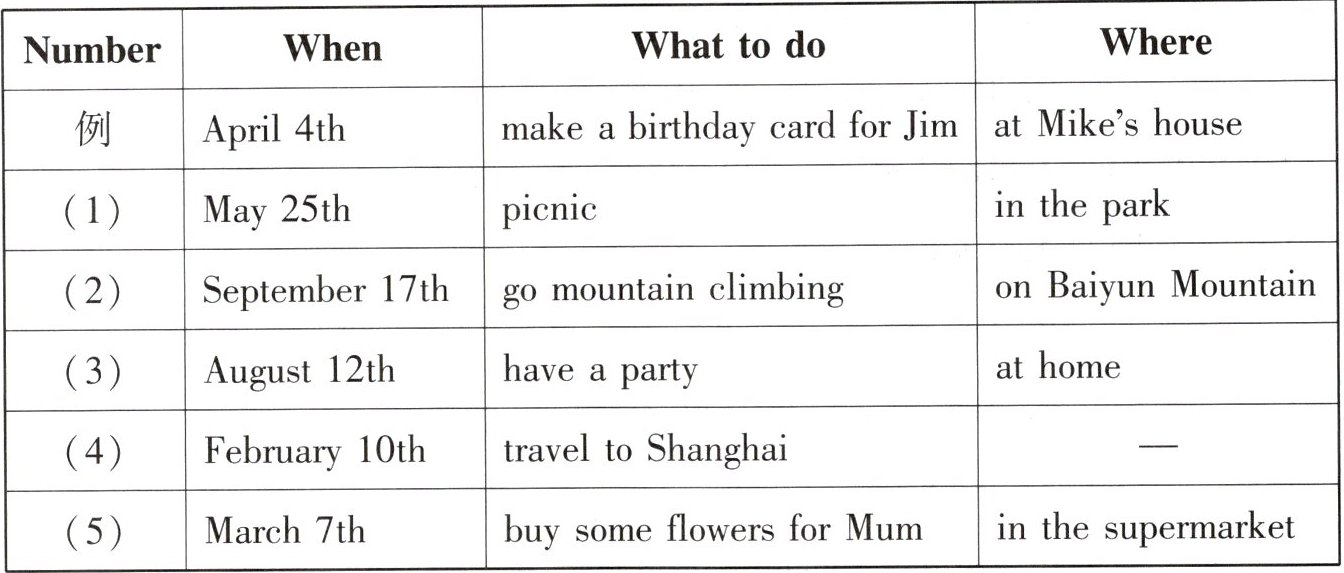
例:We are going to make a birthday card for Jim at Mike's house on April 4th.
(1) I will
(2) My family and I
(3) I
(4) We
(5) I
例:We are going to make a birthday card for Jim at Mike's house on April 4th.
(1) I will
go on a picnic in the park on May 25th.
(2) My family and I
will go mountain climbing on Baiyun Mountain on September 17th.
(3) I
will have a party at home on August 12th.
(4) We
will travel to Shanghai on February 10th.
(5) I
will buy some flowers for Mum in the supermarket on March 7th.
答案
3. (1) I will go on a picnic in the park on May 25th.
(2) My family and I will go mountain climbing on Baiyun Mountain on September 17th.
(3) I will have a party at home on August 12th.
(4) We will travel to Shanghai on February 10th.
(5) I will buy some flowers for Mum in the supermarket on March 7th.
(2) My family and I will go mountain climbing on Baiyun Mountain on September 17th.
(3) I will have a party at home on August 12th.
(4) We will travel to Shanghai on February 10th.
(5) I will buy some flowers for Mum in the supermarket on March 7th.
解析
【分析】
首先观察例句的结构:主语+将来时态表达+具体活动内容+地点+时间,其中将来时态可以用“be going to+动词原形”或“will+动词原形”。接下来解题步骤如下:
1. 明确每个小题给出的主语,确定将来时态的结构(题目中部分句子提示用will,所以统一采用“will+动词原形”的结构);
2. 从表格中提取对应编号的When(时间)、What to do(活动)、Where(地点)信息;
3. 按照例句的语序组合信息,注意活动的正确表达(如“picnic”要搭配成“go on a picnic”),时间通常放在句子末尾,地点放在活动之后。
【解析】
(1) 主语是I,将来时用will+动词原形,表格中活动是picnic,需转化为固定搭配go on a picnic,地点是in the park,时间是May 25th,按语序组合成完整句子的后半部分;
(2) 主语是My family and I,活动是go mountain climbing,地点是on Baiyun Mountain,时间是September 17th,结合will结构组合成完整句子的后半部分;
(3) 主语是I,活动是have a party,地点是at home,时间是August 12th,结合will结构组合成完整句子的后半部分;
(4) 主语是We,活动是travel to Shanghai,表格无地点信息,直接结合时间February 10th和will结构组合成完整句子的后半部分;
(5) 主语是I,活动是buy some flowers for Mum,地点是in the supermarket,时间是March 7th,结合will结构组合成完整句子的后半部分。
【答案】
(1) go on a picnic in the park on May 25th.
(2) will go mountain climbing on Baiyun Mountain on September 17th.
(3) will have a party at home on August 12th.
(4) will travel to Shanghai on February 10th.
(5) will buy some flowers for Mum in the supermarket on March 7th.
【知识点】
1. 一般将来时用法
2. 固定短语搭配
3. 句子语序组织
【点评】
本题考查一般将来时的实际运用,需要学生准确提取表格信息,并按照正确的语序和固定搭配组织句子,既考察了时态掌握,也锻炼了信息整合和语言输出能力。
【难度系数】
0.8
首先观察例句的结构:主语+将来时态表达+具体活动内容+地点+时间,其中将来时态可以用“be going to+动词原形”或“will+动词原形”。接下来解题步骤如下:
1. 明确每个小题给出的主语,确定将来时态的结构(题目中部分句子提示用will,所以统一采用“will+动词原形”的结构);
2. 从表格中提取对应编号的When(时间)、What to do(活动)、Where(地点)信息;
3. 按照例句的语序组合信息,注意活动的正确表达(如“picnic”要搭配成“go on a picnic”),时间通常放在句子末尾,地点放在活动之后。
【解析】
(1) 主语是I,将来时用will+动词原形,表格中活动是picnic,需转化为固定搭配go on a picnic,地点是in the park,时间是May 25th,按语序组合成完整句子的后半部分;
(2) 主语是My family and I,活动是go mountain climbing,地点是on Baiyun Mountain,时间是September 17th,结合will结构组合成完整句子的后半部分;
(3) 主语是I,活动是have a party,地点是at home,时间是August 12th,结合will结构组合成完整句子的后半部分;
(4) 主语是We,活动是travel to Shanghai,表格无地点信息,直接结合时间February 10th和will结构组合成完整句子的后半部分;
(5) 主语是I,活动是buy some flowers for Mum,地点是in the supermarket,时间是March 7th,结合will结构组合成完整句子的后半部分。
【答案】
(1) go on a picnic in the park on May 25th.
(2) will go mountain climbing on Baiyun Mountain on September 17th.
(3) will have a party at home on August 12th.
(4) will travel to Shanghai on February 10th.
(5) will buy some flowers for Mum in the supermarket on March 7th.
【知识点】
1. 一般将来时用法
2. 固定短语搭配
3. 句子语序组织
【点评】
本题考查一般将来时的实际运用,需要学生准确提取表格信息,并按照正确的语序和固定搭配组织句子,既考察了时态掌握,也锻炼了信息整合和语言输出能力。
【难度系数】
0.8
4. 选择适当的句子填空,把其大写字母编号写在横线上,使对话完整。
A. I'd love to.
B. Where shall we have dinner?
C. Then where and when shall we meet?
D. See you.
E. Nothing. Why?
—Hi, Linda. Are you doing anything tomorrow evening?
—
—There will be a football match at the sports centre. Would you like to watch it with me?
— ______ What time will the match begin?
—At 8:00.
—
—Let's meet at the gate of the sports centre at 6:00.
—So early?
—We need to buy tickets first. Then we can have dinner together before the match begins.
—Sounds fine.
—There is a very nice food shop near the sports centre. We can buy some dim sum for dinner. Is that OK?
—Fine. See you tomorrow evening.
—
A. I'd love to.
B. Where shall we have dinner?
C. Then where and when shall we meet?
D. See you.
E. Nothing. Why?
—Hi, Linda. Are you doing anything tomorrow evening?
—
—There will be a football match at the sports centre. Would you like to watch it with me?
— ______ What time will the match begin?
—At 8:00.
—
—Let's meet at the gate of the sports centre at 6:00.
—So early?
—We need to buy tickets first. Then we can have dinner together before the match begins.
—Sounds fine.
—There is a very nice food shop near the sports centre. We can buy some dim sum for dinner. Is that OK?
—Fine. See you tomorrow evening.
—
答案
4. E A C B D
解析
【分析】
我们可以根据对话的上下文语境来逐个确定填空内容:
1. 第一空:上句问“Are you doing anything tomorrow evening?”(你明天晚上有什么安排吗?),应先回答是否有安排并询问原因,选项E“Nothing. Why?”符合逻辑。
2. 第二空:上句是邀请“Would you like to watch it with me?”(你愿意和我一起看吗?),接受邀请常用“I'd love to.”,对应选项A,之后接着问比赛时间也符合对话流程。
3. 第三空:下句回答了见面的地点和时间“Let's meet at the gate of the sports centre at 6:00.”,所以此空应询问见面的地点和时间,选项C“Then where and when shall we meet?”正好对应。
4. 第四空:下句提到了吃饭的地点“There is a very nice food shop near the sports centre.”,所以此空是询问吃饭的地点,选项B“Where shall we have dinner?”符合语境。
5. 第五空:上句说“See you tomorrow evening.”(明天晚上见),回应告别用语用“See you.”,对应选项D。
【解析】
1. 第一空:针对“Are you doing anything tomorrow evening?”的询问,回答无安排并反问原因,选择E。
2. 第二空:回应对方的看比赛邀请,用接受邀请的常用表达“I'd love to.”,选择A。
3. 第三空:根据答语中给出的见面地点和时间,此处需询问相关信息,选择C。
4. 第四空:根据答语中提到的就餐地点,此处需询问就餐位置,选择B。
5. 第五空:回应对方的告别语,用对应的告别表达“See you.”,选择D。
【答案】
E A C B D
【知识点】
日常交际用语、邀请与应答
【点评】
本题考查日常情景对话中的用语运用,需要结合上下文的语境逻辑来选择合适的句子,重点考查学生对英语交际句型的掌握和灵活运用能力,平时积累常用的交际表达有助于快速解题。
【难度系数】
0.7
我们可以根据对话的上下文语境来逐个确定填空内容:
1. 第一空:上句问“Are you doing anything tomorrow evening?”(你明天晚上有什么安排吗?),应先回答是否有安排并询问原因,选项E“Nothing. Why?”符合逻辑。
2. 第二空:上句是邀请“Would you like to watch it with me?”(你愿意和我一起看吗?),接受邀请常用“I'd love to.”,对应选项A,之后接着问比赛时间也符合对话流程。
3. 第三空:下句回答了见面的地点和时间“Let's meet at the gate of the sports centre at 6:00.”,所以此空应询问见面的地点和时间,选项C“Then where and when shall we meet?”正好对应。
4. 第四空:下句提到了吃饭的地点“There is a very nice food shop near the sports centre.”,所以此空是询问吃饭的地点,选项B“Where shall we have dinner?”符合语境。
5. 第五空:上句说“See you tomorrow evening.”(明天晚上见),回应告别用语用“See you.”,对应选项D。
【解析】
1. 第一空:针对“Are you doing anything tomorrow evening?”的询问,回答无安排并反问原因,选择E。
2. 第二空:回应对方的看比赛邀请,用接受邀请的常用表达“I'd love to.”,选择A。
3. 第三空:根据答语中给出的见面地点和时间,此处需询问相关信息,选择C。
4. 第四空:根据答语中提到的就餐地点,此处需询问就餐位置,选择B。
5. 第五空:回应对方的告别语,用对应的告别表达“See you.”,选择D。
【答案】
E A C B D
【知识点】
日常交际用语、邀请与应答
【点评】
本题考查日常情景对话中的用语运用,需要结合上下文的语境逻辑来选择合适的句子,重点考查学生对英语交际句型的掌握和灵活运用能力,平时积累常用的交际表达有助于快速解题。
【难度系数】
0.7
