

 登录
登录
【Language Focus】
A. 词汇与语法
Helping Others Around Us
Last week, our teacher told us about helping people. We learned about 1. (fireman) and how they saved people from fires. We also talked about people who are sick. Some have a long 2. (ill) and they need good 3. (treat).
On Saturday, I went to the park with my mum. I saw a 4. (home) man sitting on a bench. I wanted to buy him food, but I could not afford 5. (buy) much. So I shared my apples with him. He smiled, and I felt a 6. (warm) in my heart.
At school, my friend 7. (forget) her red crayon. I gave her mine. She said “thank you” and smiled. I told her, “No thanks are needed when we help friends.”
Helping others never brings 8. (disappoint). It always makes us happy. I think we are very 9. (luck) to be able to help.
任务一:用括号中所给单词的正确形式填空。
任务二:根据短文内容,回答下列问题。
1. What did the teacher tell the class about last week?
2. What did firemen do?
3. Who did I share my apples with in the park?
4. Why did I give my crayon to my friend at school?
5. How do we feel when we help others?
B. 语法总结
A Weekend of Helping Out
Last Saturday, my classmates and I could put our helping plan into action. We knew we should do something for our community, and this weekend was the perfect time.
First, we visited the elderly home. “May I help you walk in the garden, Grandma Li?” I asked politely. She smiled and said, “Yes. But you must be careful. The path is a little slippery.” We chatted while walking slowly. She told me that when she was young, she would volunteer at the hospital every weekend.
Next, we went to the community library. “You can put the returned books on this cart,” the librarian told us. Tom whispered to me, “We shouldn’t make too much noise here.” After organizing the books, I found a lost bag. “This might belong to someone who just left,” I said. We decided to take it to the information desk.
Finally, we helped clean the small park nearby. “Could you pick up the trash over there?” our teacher asked. Lucy said, “We should finish before it gets dark.” Though we were tired, we knew we must keep our environment clean.
On our way home, we talked about the day. “We can do this every month!” said Emma. I agreed, thinking that helping others should be a regular part of our lives.
任务一:用下划线标出文中的情态动词。
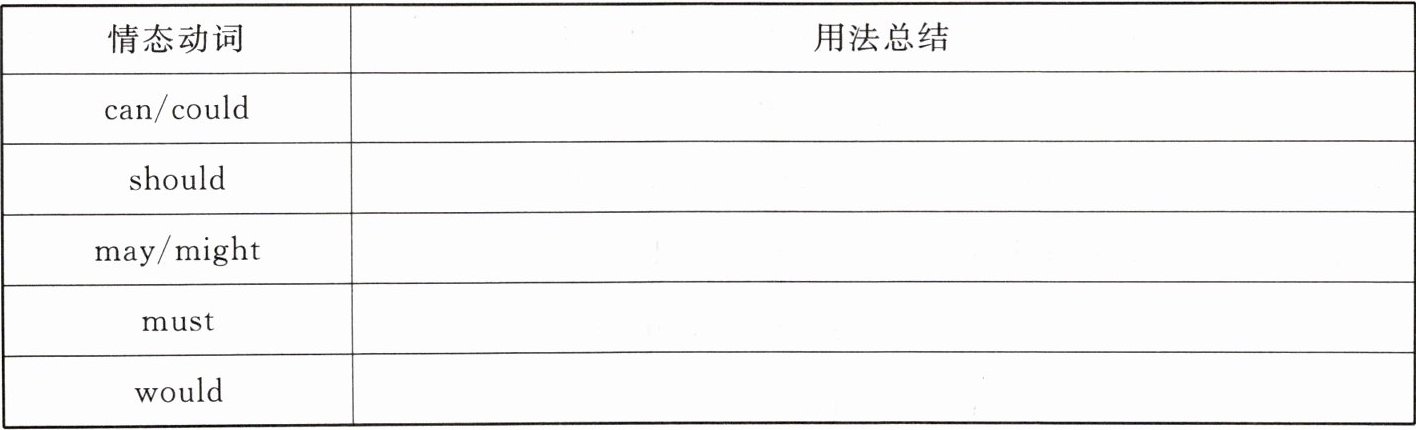
任务二:总结所找出的情态动词都有哪些主要用法,完成表格。
【实践篇】
Tina: Hi, Luke! I heard you recently started a program at school to help new students.
Luke: Yes, Tina! Two new students joined our class this semester, and I noticed they seemed a little lonely at first, so I wanted to do something about it.
Tina: That’s such a nice idea! Why do you think helping others is important?
Luke: I believe helping others not only makes them feel cared for, but it also makes us happier. Like last week, I helped our new classmate Wang Qiang review math. His grades improved, and I got to review the material too. We both felt good about it!
Tina: That’s so true! How did you actually start the program?
Luke: First, I talked with our teacher. Then, I launched a “Friendship Buddy” system in our class. Each existing student pairs up with a new student to help them get familiar with the school, join activities, and even study together.
Tina: That sounds very well. Have you seen any changes?
Luke: Definitely! The new students are now more confident and active. Some have even joined the basketball team and the reading club. What’s more, our whole class feels closer and more united.
Tina: It’s wonderful how a small act can make such a big difference. What do you think is the most meaningful part of helping?
Luke: To me, the most meaningful part is seeing someone smile because of something you did. It’s not about being praised. It’s about knowing you’ve made someone’s day a little better.
Tina: Do you think everyone can help others in some way?
Luke: Absolutely! Helping doesn’t have to be a big project. It can be small things, like listening to a friend, sharing your notes, or even holding the door for someone. Every kind act matters.
Tina: What’s your next plan?
Luke: We want to extend(扩展) the “Helping Hands” program to other grades and also organise a monthly community service day, like cleaning up a nearby park or visiting an elderly home.
Tina: That’s inspiring! I’d love to join too.
Luke: Everyone is welcome! After all, helping others is something we can all do, and it makes our school or our world a warmer place.
()1. Why did Luke start the program at school?
A. Because his teacher asked him to.
B. Because he noticed new students feel lonely.
C. Because he wanted to become more popular.
D. Because he wanted to get praise.
()2. What is one example Luke gives of helping others?
A. Cleaning the classroom alone.
B. Helping a new classmate review math.
C. Organising a sports competition.
D. Giving books to poor students.
()3. What does Luke think is the most meaningful part of helping?
A. Receiving praise from teachers.
B. Getting better grades.
C. Seeing someone smile because of his help.
D. Getting good grades.
()4. According to Luke, how can everyone help others?
A. Only by joining big projects.
B. Through small daily acts of kindness.
C. By donating money.
D. By teaching them knowledge.
A. 词汇与语法
Helping Others Around Us
Last week, our teacher told us about helping people. We learned about 1. (fireman) and how they saved people from fires. We also talked about people who are sick. Some have a long 2. (ill) and they need good 3. (treat).
On Saturday, I went to the park with my mum. I saw a 4. (home) man sitting on a bench. I wanted to buy him food, but I could not afford 5. (buy) much. So I shared my apples with him. He smiled, and I felt a 6. (warm) in my heart.
At school, my friend 7. (forget) her red crayon. I gave her mine. She said “thank you” and smiled. I told her, “No thanks are needed when we help friends.”
Helping others never brings 8. (disappoint). It always makes us happy. I think we are very 9. (luck) to be able to help.
任务一:用括号中所给单词的正确形式填空。
任务二:根据短文内容,回答下列问题。
1. What did the teacher tell the class about last week?
2. What did firemen do?
3. Who did I share my apples with in the park?
4. Why did I give my crayon to my friend at school?
5. How do we feel when we help others?
B. 语法总结
A Weekend of Helping Out
Last Saturday, my classmates and I could put our helping plan into action. We knew we should do something for our community, and this weekend was the perfect time.
First, we visited the elderly home. “May I help you walk in the garden, Grandma Li?” I asked politely. She smiled and said, “Yes. But you must be careful. The path is a little slippery.” We chatted while walking slowly. She told me that when she was young, she would volunteer at the hospital every weekend.
Next, we went to the community library. “You can put the returned books on this cart,” the librarian told us. Tom whispered to me, “We shouldn’t make too much noise here.” After organizing the books, I found a lost bag. “This might belong to someone who just left,” I said. We decided to take it to the information desk.
Finally, we helped clean the small park nearby. “Could you pick up the trash over there?” our teacher asked. Lucy said, “We should finish before it gets dark.” Though we were tired, we knew we must keep our environment clean.
On our way home, we talked about the day. “We can do this every month!” said Emma. I agreed, thinking that helping others should be a regular part of our lives.
任务一:用下划线标出文中的情态动词。
任务二:总结所找出的情态动词都有哪些主要用法,完成表格。
【实践篇】
Tina: Hi, Luke! I heard you recently started a program at school to help new students.
Luke: Yes, Tina! Two new students joined our class this semester, and I noticed they seemed a little lonely at first, so I wanted to do something about it.
Tina: That’s such a nice idea! Why do you think helping others is important?
Luke: I believe helping others not only makes them feel cared for, but it also makes us happier. Like last week, I helped our new classmate Wang Qiang review math. His grades improved, and I got to review the material too. We both felt good about it!
Tina: That’s so true! How did you actually start the program?
Luke: First, I talked with our teacher. Then, I launched a “Friendship Buddy” system in our class. Each existing student pairs up with a new student to help them get familiar with the school, join activities, and even study together.
Tina: That sounds very well. Have you seen any changes?
Luke: Definitely! The new students are now more confident and active. Some have even joined the basketball team and the reading club. What’s more, our whole class feels closer and more united.
Tina: It’s wonderful how a small act can make such a big difference. What do you think is the most meaningful part of helping?
Luke: To me, the most meaningful part is seeing someone smile because of something you did. It’s not about being praised. It’s about knowing you’ve made someone’s day a little better.
Tina: Do you think everyone can help others in some way?
Luke: Absolutely! Helping doesn’t have to be a big project. It can be small things, like listening to a friend, sharing your notes, or even holding the door for someone. Every kind act matters.
Tina: What’s your next plan?
Luke: We want to extend(扩展) the “Helping Hands” program to other grades and also organise a monthly community service day, like cleaning up a nearby park or visiting an elderly home.
Tina: That’s inspiring! I’d love to join too.
Luke: Everyone is welcome! After all, helping others is something we can all do, and it makes our school or our world a warmer place.
()1. Why did Luke start the program at school?
A. Because his teacher asked him to.
B. Because he noticed new students feel lonely.
C. Because he wanted to become more popular.
D. Because he wanted to get praise.
()2. What is one example Luke gives of helping others?
A. Cleaning the classroom alone.
B. Helping a new classmate review math.
C. Organising a sports competition.
D. Giving books to poor students.
()3. What does Luke think is the most meaningful part of helping?
A. Receiving praise from teachers.
B. Getting better grades.
C. Seeing someone smile because of his help.
D. Getting good grades.
()4. According to Luke, how can everyone help others?
A. Only by joining big projects.
B. Through small daily acts of kindness.
C. By donating money.
D. By teaching them knowledge.
答案
A.词汇与语法
任务一:
1. firemen
2. illness
3. treatment
4. homeless
5. to buy
6. warmth
7. forgot
8. disappointment
9. lucky
任务二:
1. He told the class about helping people.
2. They saved people from fires.
3. A homeless man.
4. Because my friend forgot her red crayon, and we should help our friends.
5. We feel happy.
B.语法总结
任务一:文中需标出的情态动词:could、should、May、must、would、can、should、might、Could、should、must、can、should
任务二:
|情态动词|用法总结|
| ---- | ---- |
|can/could|表示能力、委婉提出请求、说明许可,could比can语气更客气委婉,也可作为can的过去式|
|should|表示建议、提醒责任和义务,含义为“应该”|
|may/might|表示礼貌请求许可、推测可能性,might的不确定程度比may更高|
|must|表示强制的义务、强烈的提醒,含义为“必须”|
|would|表示过去经常性、习惯性的动作,含义为“过去常常”|
实践篇
1. B
2. B
3. C
4. B
任务一:
1. firemen
2. illness
3. treatment
4. homeless
5. to buy
6. warmth
7. forgot
8. disappointment
9. lucky
任务二:
1. He told the class about helping people.
2. They saved people from fires.
3. A homeless man.
4. Because my friend forgot her red crayon, and we should help our friends.
5. We feel happy.
B.语法总结
任务一:文中需标出的情态动词:could、should、May、must、would、can、should、might、Could、should、must、can、should
任务二:
|情态动词|用法总结|
| ---- | ---- |
|can/could|表示能力、委婉提出请求、说明许可,could比can语气更客气委婉,也可作为can的过去式|
|should|表示建议、提醒责任和义务,含义为“应该”|
|may/might|表示礼貌请求许可、推测可能性,might的不确定程度比may更高|
|must|表示强制的义务、强烈的提醒,含义为“必须”|
|would|表示过去经常性、习惯性的动作,含义为“过去常常”|
实践篇
1. B
2. B
3. C
4. B
解析
【Language Focus A部分】
任务一:本题考查词形转换,结合语境、固定搭配和语法规则变形:
1. 后文中的they指代该空名词,需用fireman的复数形式;
2. 不定冠词a和形容词long后需接名词,将形容词ill变为对应名词;
3. 形容词good后需接名词,将动词treat变为对应名词;
4. 修饰名词man,结合语境要表达“无家可归的”含义,将home变为对应形容词;
5. 固定搭配afford to do sth. 意为“负担得起做某事”,接不定式结构;
6. 不定冠词a后需接名词,将形容词warm变为对应名词;
7. 全文叙述过去发生的事,用一般过去时,forget变为过去式;
8. 动词brings后接名词作宾语,将动词disappoint变为对应名词;
9. 系动词are后接形容词作表语,将名词luck变为对应形容词。
任务二:本题为细节理解题,答案均可从原文直接定位提取。
【Language Focus B部分】
任务一:定位全文所有符合定义的情态动词即可。
任务二:本题考查八年级核心情态动词的用法,结合文中出现的场景总结对应功能。
【实践篇】
本题为阅读理解细节题,所有选项均可从对话原文找到对应依据:
1. 原文提到Luke注意到新生一开始很孤单,所以发起项目;
2. Luke举了帮新同学王强复习数学的例子;
3. Luke认为帮助他人最有意义的部分是看到别人因为自己的帮助露出笑容;
4. Luke说明帮助他人不需要是大项目,日常的小善举就可以实现。
任务一:本题考查词形转换,结合语境、固定搭配和语法规则变形:
1. 后文中的they指代该空名词,需用fireman的复数形式;
2. 不定冠词a和形容词long后需接名词,将形容词ill变为对应名词;
3. 形容词good后需接名词,将动词treat变为对应名词;
4. 修饰名词man,结合语境要表达“无家可归的”含义,将home变为对应形容词;
5. 固定搭配afford to do sth. 意为“负担得起做某事”,接不定式结构;
6. 不定冠词a后需接名词,将形容词warm变为对应名词;
7. 全文叙述过去发生的事,用一般过去时,forget变为过去式;
8. 动词brings后接名词作宾语,将动词disappoint变为对应名词;
9. 系动词are后接形容词作表语,将名词luck变为对应形容词。
任务二:本题为细节理解题,答案均可从原文直接定位提取。
【Language Focus B部分】
任务一:定位全文所有符合定义的情态动词即可。
任务二:本题考查八年级核心情态动词的用法,结合文中出现的场景总结对应功能。
【实践篇】
本题为阅读理解细节题,所有选项均可从对话原文找到对应依据:
1. 原文提到Luke注意到新生一开始很孤单,所以发起项目;
2. Luke举了帮新同学王强复习数学的例子;
3. Luke认为帮助他人最有意义的部分是看到别人因为自己的帮助露出笑容;
4. Luke说明帮助他人不需要是大项目,日常的小善举就可以实现。
