

 登录
18.(8分)如图,在$\mathrm{Rt}△ ABC$中,$∠ A=90°$,$CM$平分$∠ ACB$交$AB$于点$M$,过点$M$作$MN// BC$交$AC$于点$N$,且$MN$平分$∠ AMC$,$AN=1$.
(1)求$∠ B$的度数.
(2)求$CN$的长.

(1)求$∠ B$的度数.
(2)求$CN$的长.
答案
18. 解:(1) $\because CM$ 平分 $∠ ACB, MN$ 平分 $∠ AMC, \therefore ∠ ACM=∠ BCM, ∠ AMN=∠ CMN.$ 又 $\because MN // BC, \therefore ∠ AMN=∠ B, ∠ CMN=∠ BCM, \therefore ∠ B=∠ BCM=∠ ACM. \because ∠ A=90°, \therefore ∠ B=\frac{1}{3} × 90°=30°.$
(2) 由(1)得, $∠ AMN=∠ B=30°, ∠ MCN=∠ CMN, \therefore MN=CN. \because$ 在 $\mathrm{Rt}△ AMN$ 中, $∠ A=90°, ∠ AMN=30°, \therefore MN=2AN=2, \therefore CN=2.$
(2) 由(1)得, $∠ AMN=∠ B=30°, ∠ MCN=∠ CMN, \therefore MN=CN. \because$ 在 $\mathrm{Rt}△ AMN$ 中, $∠ A=90°, ∠ AMN=30°, \therefore MN=2AN=2, \therefore CN=2.$
19.(10分)如图,点C是线段AB上除点A,B外的任意一点,分别以AC,BC为边在线段AB的同旁作等边三角形ACD和等边三角形BCE,连接AE交DC于点M,连接BD交CE于点N,连接MN.
(1)求证:AE=BD.
(2)请判断$△ CMN$的形状,并说明理由.

(1)求证:AE=BD.
(2)请判断$△ CMN$的形状,并说明理由.
答案
19. (1) 证明: $\because △ ACD$ 和 $△ BCE$ 是等边三角形, $\therefore AC=DC, CE=CB, ∠ DCA=60°, ∠ ECB=60°, \therefore ∠ DCA+∠ DCE=∠ ECB+∠ DCE$, 即 $∠ ACE=∠ DCB.$ 在 $△ ACE$ 与 $△ DCB$ 中,
$\begin{cases}AC=DC \\∠ ACE=∠ DCB, \\CE=CB\end{cases}$
$\therefore △ ACE ≌ △ DCB (\mathrm{SAS}), \therefore AE=BD.$
(2) 解: $△ CMN$ 为等边三角形. 理由如下: 由(1), 得 $△ ACE ≌ △ DCB, \therefore ∠ CAM=∠ CDN. \because ∠ ACD=∠ ECB=60°$, 而 $A,C,B$ 三点共线, $\therefore ∠ DCN=60°.$ 在 $△ ACM$ 与 $△ DCN$ 中,
$\begin{cases}∠ CAM=∠ CDN \\AC=DC \\∠ ACM=∠ DCN\end{cases}$
$\therefore △ ACM ≌ △ DCN (\mathrm{ASA}), \therefore MC=NC. \because ∠ MCN=60°, \therefore △ CMN$ 为等边三角形.
20.(12分)如图①,在等边三角形ABC中,D是AB边上的动点,以CD为一边,向上作等边三角形EDC,连接AE.
(1)△BCD和△ACE全等吗?请说明理由.
(2)求证:AE//BC.
(3)如图②,将图①中的动点D运动到边BA的延长线上,所作的△EDC仍为等边三角形,请问此时AE//BC吗?证明你的猜想.
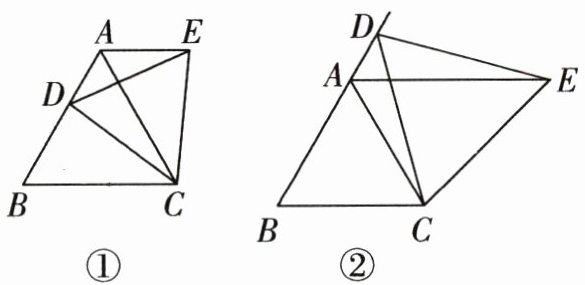
(1)△BCD和△ACE全等吗?请说明理由.
(2)求证:AE//BC.
(3)如图②,将图①中的动点D运动到边BA的延长线上,所作的△EDC仍为等边三角形,请问此时AE//BC吗?证明你的猜想.
答案
20. 解:(1) $△ BCD$ 和 $△ ACE$ 全等. 理由如下: $\because △ ABC, △ EDC$ 是等边三角形, $\therefore BC=AC, ∠ ACB=∠ ECD=60°, DC=EC, \therefore ∠ BCD=∠ ACE.$ 在 $△ BCD$ 和 $△ ACE$ 中,
$\begin{cases}BC=AC \\∠ BCD=∠ ACE, \\DC=EC\end{cases}$
$\therefore △ BCD ≌ △ ACE (\mathrm{SAS}).$
(2) 证明: 由(1)知, $△ BCD ≌ △ ACE, \therefore ∠ B=∠ EAC=60°, \therefore ∠ EAC=∠ ACB, \therefore AE // BC.$
(3) $AE // BC.$ 证明: $\because △ ABC, △ EDC$ 是等边三角形, $\therefore BC=AC, ∠ ACB=∠ ECD=60°, DC=EC, \therefore ∠ BCD=∠ ACE.$ 在 $△ BCD$ 和 $△ ACE$ 中,
$\begin{cases}BC=AC \\∠ BCD=∠ ACE, \\DC=EC\end{cases}$
$\therefore △ BCD ≌ △ ACE (\mathrm{SAS}), \therefore ∠ B=∠ EAC=60°, \therefore ∠ EAC=∠ ACB, \therefore AE // BC.$
$\begin{cases}BC=AC \\∠ BCD=∠ ACE, \\DC=EC\end{cases}$
$\therefore △ BCD ≌ △ ACE (\mathrm{SAS}).$
(2) 证明: 由(1)知, $△ BCD ≌ △ ACE, \therefore ∠ B=∠ EAC=60°, \therefore ∠ EAC=∠ ACB, \therefore AE // BC.$
(3) $AE // BC.$ 证明: $\because △ ABC, △ EDC$ 是等边三角形, $\therefore BC=AC, ∠ ACB=∠ ECD=60°, DC=EC, \therefore ∠ BCD=∠ ACE.$ 在 $△ BCD$ 和 $△ ACE$ 中,
$\begin{cases}BC=AC \\∠ BCD=∠ ACE, \\DC=EC\end{cases}$
$\therefore △ BCD ≌ △ ACE (\mathrm{SAS}), \therefore ∠ B=∠ EAC=60°, \therefore ∠ EAC=∠ ACB, \therefore AE // BC.$
