

 登录
登录
Ⅰ. Change the following words into nouns using one of these suffixes: -er, -or, -th, -ment, and -ship.
1. visit
2. friend
3. true
4. teach
5. argue
6. warm
1. visit
visitor
2. friend
friendship
3. true
truth
4. teach
teacher
5. argue
argument
6. warm
warmth
答案
1. visitor 2. friendship 3. truth 4. teacher 5. argument 6. warmth
解析
【分析】本题考查英语中常见名词后缀(-er、-or、-th、-ment、-ship)的构词用法,解题时需根据每个单词的词性和含义,匹配对应的后缀将其转换为正确的名词:先明确每个单词的原词属性,再回忆各后缀的适用规则,逐一转换即可。
【解析】1. 动词visit(参观)加后缀-er,变为名词visitor(参观者);2. 名词friend(朋友)加后缀-ship,变为名词friendship(友谊);3. 形容词true(真实的)加后缀-th,变为名词truth(真相);4. 动词teach(教)加后缀-er,变为名词teacher(教师);5. 动词argue(争论)加后缀-ment,变为名词argument(争论;论点);6. 形容词warm(温暖的)加后缀-th,变为名词warmth(温暖)。
【答案】1. visitor 2. friendship 3. truth 4. teacher 5. argument 6. warmth
【知识点】英语名词后缀、词形转换
【点评】本题为基础词汇构词题,考查常见名词后缀的运用,是英语学习中需掌握的基础知识点,难度较低。
【难度系数】0.8
【解析】1. 动词visit(参观)加后缀-er,变为名词visitor(参观者);2. 名词friend(朋友)加后缀-ship,变为名词friendship(友谊);3. 形容词true(真实的)加后缀-th,变为名词truth(真相);4. 动词teach(教)加后缀-er,变为名词teacher(教师);5. 动词argue(争论)加后缀-ment,变为名词argument(争论;论点);6. 形容词warm(温暖的)加后缀-th,变为名词warmth(温暖)。
【答案】1. visitor 2. friendship 3. truth 4. teacher 5. argument 6. warmth
【知识点】英语名词后缀、词形转换
【点评】本题为基础词汇构词题,考查常见名词后缀的运用,是英语学习中需掌握的基础知识点,难度较低。
【难度系数】0.8
Ⅱ. Complete the passage with the correct forms of the words in the box.
benefit take place reply nothing impolitely
The ant and the cricket(蟋蟀) were friends. One summer day, something 1.
When winter came, the cricket had 3.
You see, preparing well brings 5.
benefit take place reply nothing impolitely
The ant and the cricket(蟋蟀) were friends. One summer day, something 1.
took place
between them. The ant worked hard to store food for winter. The cricket laughed 2. impolitely
, “Why work? Let’s sing and dance!”When winter came, the cricket had 3.
nothing
to eat. He visited the ant and cried, “I’m hungry!” The ant 4. replied
, “I worked while you played.” Still, the ant kindly shared some food.You see, preparing well brings 5.
benefits
when challenges come.答案
1. took place 2. impolitely 3. nothing 4. replied 5. benefits
解析
【分析】
本题为用方框内单词的正确形式填空的题型,解题思路如下:①先通读短文,理解蚂蚁和蟋蟀的故事语境;②逐个分析每个空格的句子结构,判断所需词性(动词、副词、不定代词等);③结合上下文时态(全文为过去时态),选择方框内的单词并进行正确变形,确保符合语法和语义逻辑。
【解析】
1. 空格处需作谓语动词,结合语境“一个夏天它们之间发生了某事”,方框内take place(发生)符合,全文为过去时态,故用过去式took place;
2. 空格处修饰动词laughed,需用副词,方框内impolitely(不礼貌地)是副词,符合语境;
3. 空格处需表达“没东西”,have nothing to eat是固定搭配,意为“没东西吃”,故填nothing;
4. 空格处需作谓语动词,结合语境“蚂蚁回答道”,方框内reply(回答)符合,过去时态下用过去式replied;
5. 空格处需作宾语,结合语境“准备充分带来好处”,benefit(好处)是可数名词,此处表泛指用复数形式benefits。
【答案】
1. took place 2. impolitely 3. nothing 4. replied 5. benefits
【知识点】
动词过去式、副词用法、不定代词、名词复数
【点评】
本题考查词汇在语境中的正确形式运用,需结合词性、时态及语义选择并变形单词,属于初中英语基础题型,难度适中,学生只要掌握基础词汇的不同形式用法即可解答。
【难度系数】
0.5
本题为用方框内单词的正确形式填空的题型,解题思路如下:①先通读短文,理解蚂蚁和蟋蟀的故事语境;②逐个分析每个空格的句子结构,判断所需词性(动词、副词、不定代词等);③结合上下文时态(全文为过去时态),选择方框内的单词并进行正确变形,确保符合语法和语义逻辑。
【解析】
1. 空格处需作谓语动词,结合语境“一个夏天它们之间发生了某事”,方框内take place(发生)符合,全文为过去时态,故用过去式took place;
2. 空格处修饰动词laughed,需用副词,方框内impolitely(不礼貌地)是副词,符合语境;
3. 空格处需表达“没东西”,have nothing to eat是固定搭配,意为“没东西吃”,故填nothing;
4. 空格处需作谓语动词,结合语境“蚂蚁回答道”,方框内reply(回答)符合,过去时态下用过去式replied;
5. 空格处需作宾语,结合语境“准备充分带来好处”,benefit(好处)是可数名词,此处表泛指用复数形式benefits。
【答案】
1. took place 2. impolitely 3. nothing 4. replied 5. benefits
【知识点】
动词过去式、副词用法、不定代词、名词复数
【点评】
本题考查词汇在语境中的正确形式运用,需结合词性、时态及语义选择并变形单词,属于初中英语基础题型,难度适中,学生只要掌握基础词汇的不同形式用法即可解答。
【难度系数】
0.5
Ⅲ. Complete the passage with the sentences in the box. There is one extra option. Then answer the question.
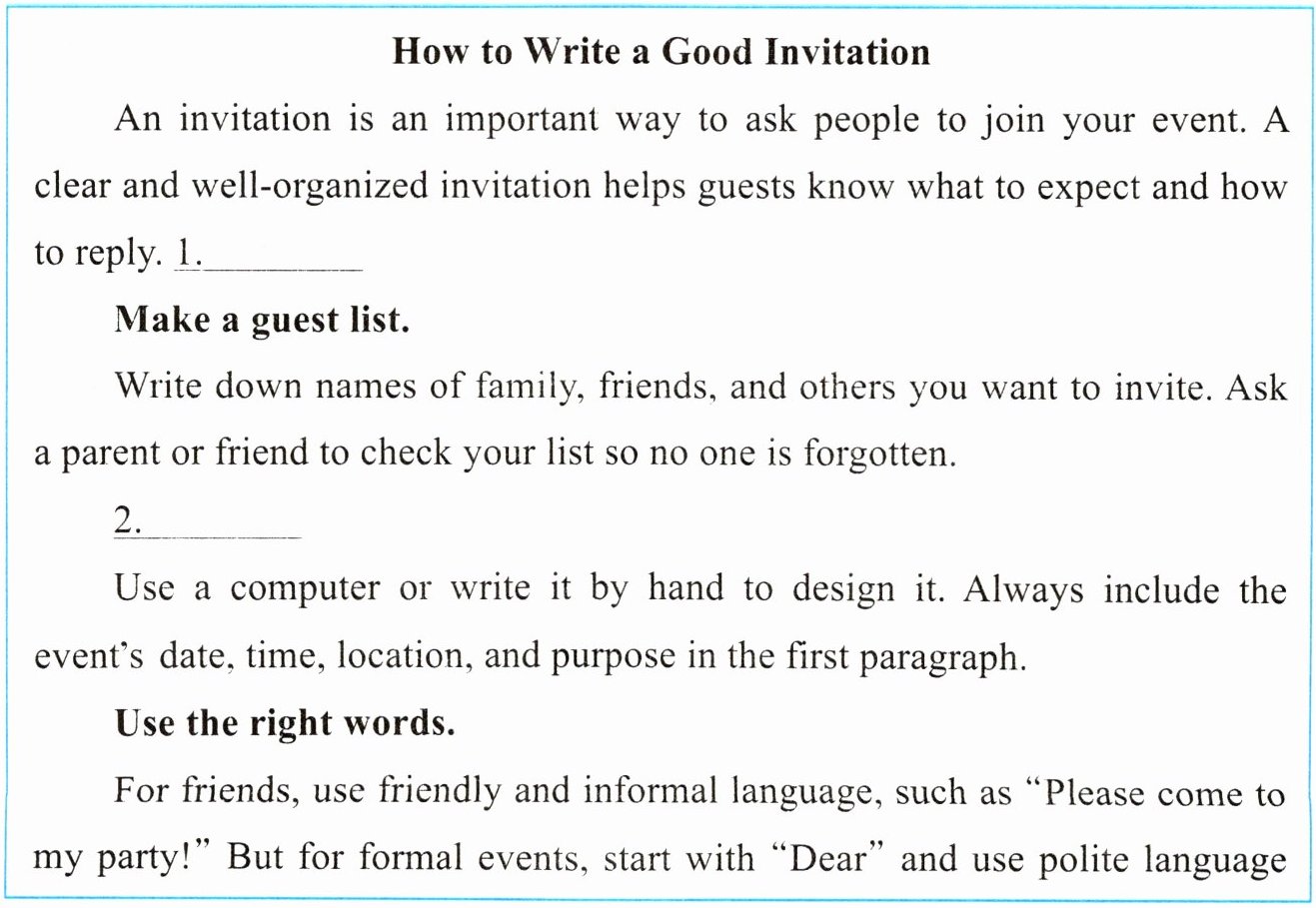
How to Write a Good Invitation
An invitation is an important way to ask people to join your event. A clear and well-organized invitation helps guests know what to expect and how to reply. 1.
Make a guest list.
Write down names of family, friends, and others you want to invite. Ask a parent or friend to check your list so one is forgotten.
2.
Use a computer or write it by hand to design it. Always include the event’s date, time, location, and purpose in the first paragraph.
Use the right words.
For friends, use friendly and informal language, such as “Please come to my party!” But for formal events, start with “Dear” and use polite language
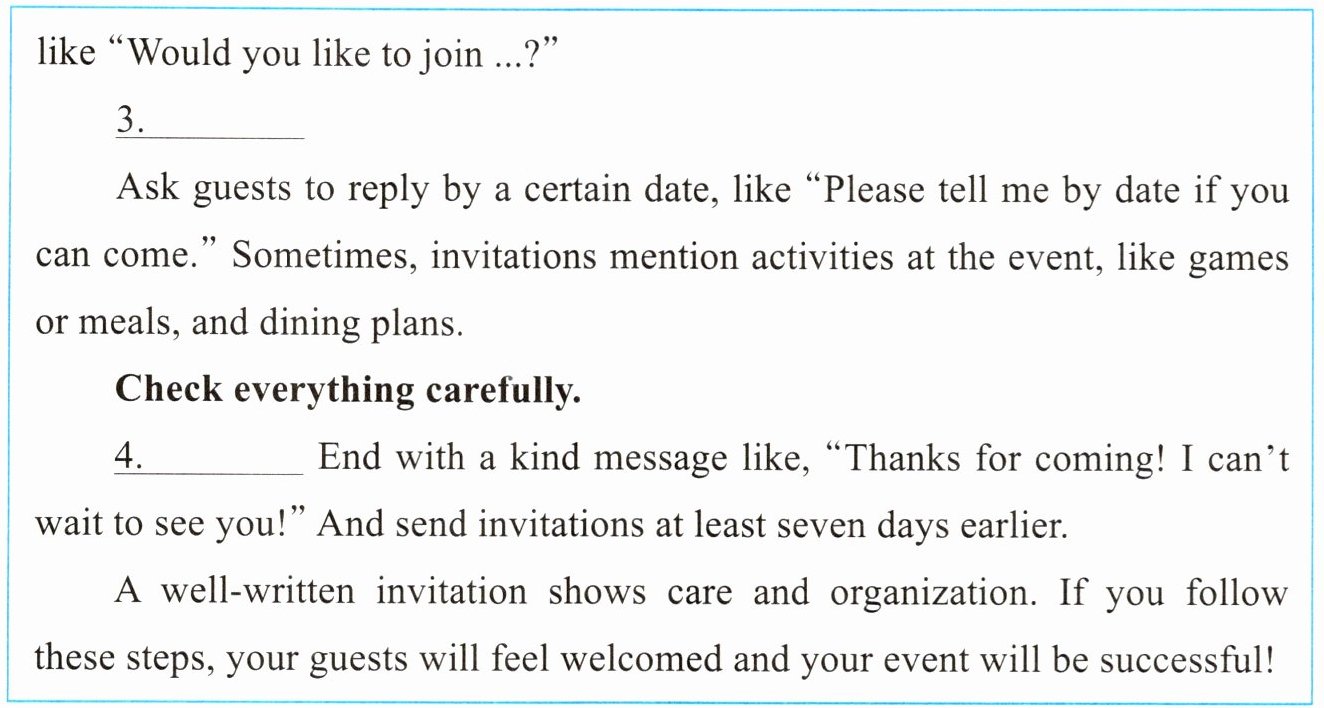
like “Would you like to join ...?”
3.
Ask guests to reply by a certain date, like “Please tell me by date if you can come.” Sometimes, invitations mention activities at the event, like games or meals, and dining plans.
Check everything carefully.
4.
A well-written invitation shows care and organization. If you follow these steps, your guests will feel welcomed and your event will be successful!
A. Design the invitation.
B. Add important details.
C. Send a thank-you note.
D. Check for mistakes in dates, times, or addresses.
E. Follow these easy steps to make a great invitation.
5. Would you like to design your invitation by hand or computer? Why?
How to Write a Good Invitation
An invitation is an important way to ask people to join your event. A clear and well-organized invitation helps guests know what to expect and how to reply. 1.
E
Make a guest list.
Write down names of family, friends, and others you want to invite. Ask a parent or friend to check your list so one is forgotten.
2.
A
Use a computer or write it by hand to design it. Always include the event’s date, time, location, and purpose in the first paragraph.
Use the right words.
For friends, use friendly and informal language, such as “Please come to my party!” But for formal events, start with “Dear” and use polite language
like “Would you like to join ...?”
3.
B
Ask guests to reply by a certain date, like “Please tell me by date if you can come.” Sometimes, invitations mention activities at the event, like games or meals, and dining plans.
Check everything carefully.
4.
D
End with a kind message like, “Thanks for coming! I can’t wait to see you!” And send invitations at least seven days earlier.A well-written invitation shows care and organization. If you follow these steps, your guests will feel welcomed and your event will be successful!
A. Design the invitation.
B. Add important details.
C. Send a thank-you note.
D. Check for mistakes in dates, times, or addresses.
E. Follow these easy steps to make a great invitation.
5. Would you like to design your invitation by hand or computer? Why?
Possible versions: By computer. Because it's faster and more colourful. / By hand. Because handmade invitations feel special.
答案
1. E 2. A 3. B 4. D
5. Possible versions: By computer. Because it's faster and more colourful. / By hand. Because handmade invitations feel special.
5. Possible versions: By computer. Because it's faster and more colourful. / By hand. Because handmade invitations feel special.
解析
【分析】
本题分为两部分:一是补全短文,需结合上下文语境匹配对应句子;二是开放性问答,需结合实际合理作答。补全短文时,先通读全文明确主题为“如何写好邀请”,再分析每个空格前后内容:第1空承上启下,引出下文步骤;第2空对应“设计邀请”的内容;第3空对应邀请需包含的细节;第4空对应“仔细检查”的要求。开放性问答需选择设计邀请的方式,说明合理理由即可。
【解析】
1. 补全短文:
第1空:前文讲邀请的重要性,后文是具体步骤,需选引出步骤的句子,故选E。
第2空:后文围绕“设计邀请”的方式展开,故选A。
第3空:后文提及邀请需包含的日期、回复时间等细节,故选B。
第4空:前文强调“仔细检查”,对应检查错误的内容,故选D。
2. 开放性问答:选择用电脑或手写设计邀请均可,理由需合理,如电脑设计更快、更美观,手写更有心意等。
【答案】
1.E 2.A 3.B 4.D
5. Possible versions: By computer. Because it's faster and more colourful. / By hand. Because handmade invitations feel special.
【知识点】
英语语篇补全、英语开放性表达
【点评】
本题结合生活实际场景,考查学生的语篇逻辑理解能力与语言运用能力,补全部分需把握上下文逻辑关系,开放性问题贴近生活,易于学生结合自身实际作答。
【难度系数】
0.5
本题分为两部分:一是补全短文,需结合上下文语境匹配对应句子;二是开放性问答,需结合实际合理作答。补全短文时,先通读全文明确主题为“如何写好邀请”,再分析每个空格前后内容:第1空承上启下,引出下文步骤;第2空对应“设计邀请”的内容;第3空对应邀请需包含的细节;第4空对应“仔细检查”的要求。开放性问答需选择设计邀请的方式,说明合理理由即可。
【解析】
1. 补全短文:
第1空:前文讲邀请的重要性,后文是具体步骤,需选引出步骤的句子,故选E。
第2空:后文围绕“设计邀请”的方式展开,故选A。
第3空:后文提及邀请需包含的日期、回复时间等细节,故选B。
第4空:前文强调“仔细检查”,对应检查错误的内容,故选D。
2. 开放性问答:选择用电脑或手写设计邀请均可,理由需合理,如电脑设计更快、更美观,手写更有心意等。
【答案】
1.E 2.A 3.B 4.D
5. Possible versions: By computer. Because it's faster and more colourful. / By hand. Because handmade invitations feel special.
【知识点】
英语语篇补全、英语开放性表达
【点评】
本题结合生活实际场景,考查学生的语篇逻辑理解能力与语言运用能力,补全部分需把握上下文逻辑关系,开放性问题贴近生活,易于学生结合自身实际作答。
【难度系数】
0.5
