

 登录
登录
听一段对话,回答第11-12小题。答题完毕,请等待“嘀”的信号,进入第一篇短文。
11. What do we know about dark matter?
A. It has no reaction to light.
B. It's widely known by people.
C. It's the most important part of the universe.
12. How much of the universe is made up of dark energy?
A. About 69%.
B. About 26%.
C. About 5%.
11. What do we know about dark matter?
A. It has no reaction to light.
B. It's widely known by people.
C. It's the most important part of the universe.
12. How much of the universe is made up of dark energy?
A. About 69%.
B. About 26%.
C. About 5%.
答案
11.A 12.A
听第一篇短文,回答第13-15小题。请根据短文内容,选择正确答案,完成信息记录表。答题完毕,请等待“嘀”的信号,进入下一篇短文。
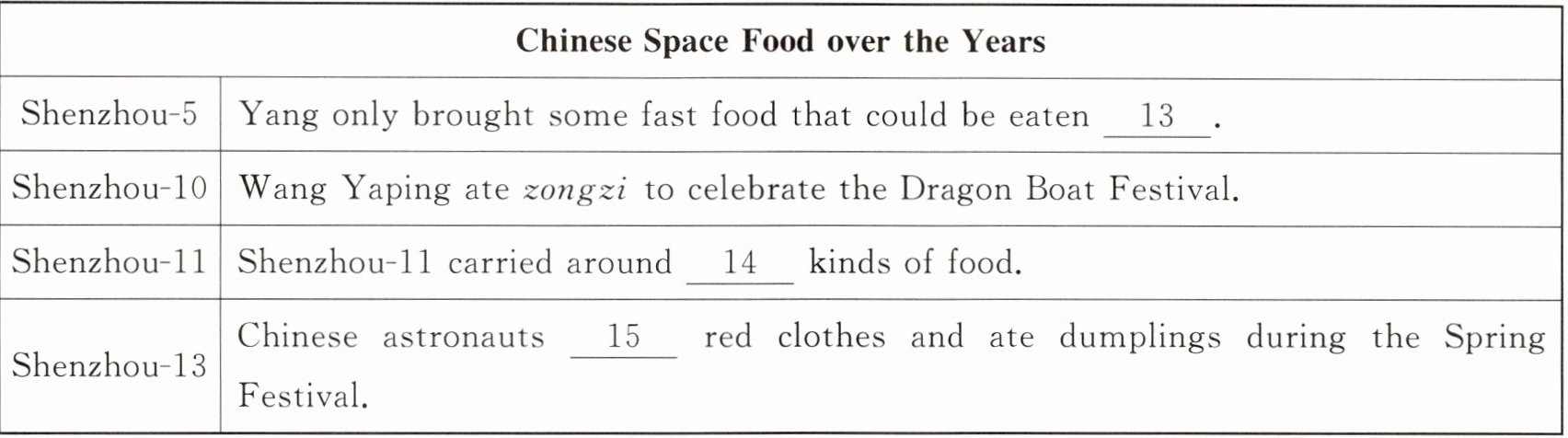
13. 信息推断 A. slowly B. directly C. publicly
14. A. 20 B. 80 C. 100
15. A. wore B. dressed C. created
13. 信息推断 A. slowly B. directly C. publicly
14. A. 20 B. 80 C. 100
15. A. wore B. dressed C. created
答案
13.B 14.C 15.A
听第二篇短文,回答第16-20小题。
16. How long did it take “Feiyan-1” to reach its highest point?
A. 30 seconds.
B. 60 seconds.
C. 90 seconds.
17. 信息推断 What can we learn about Wang Yuning?
A. He started the aerospace club all by himself.
B. He learned most of his rocket knowledge from the club.
C. His school played an important role in his aerospace journey.
18. Where did the teenagers build and test the rocket?
A. In Beijing.
B. In Lenghu, Qinghai.
C. In their own schools.
19. 信息推断 What can we learn from the success of “Feiyan-1”?
A. Young people can do great things if encouraged.
B. Building rockets should be part of school lessons.
C. Rocket science is too hard for high school students.
20. 信息推断 What does the name “Feiyan-1” mean according to Wang Yuning?
A. The freedom and high ambitions of teenagers.
B. The hope for peace in aerospace development.
C. The teamwork of students from different cities.
16. How long did it take “Feiyan-1” to reach its highest point?
A. 30 seconds.
B. 60 seconds.
C. 90 seconds.
17. 信息推断 What can we learn about Wang Yuning?
A. He started the aerospace club all by himself.
B. He learned most of his rocket knowledge from the club.
C. His school played an important role in his aerospace journey.
18. Where did the teenagers build and test the rocket?
A. In Beijing.
B. In Lenghu, Qinghai.
C. In their own schools.
19. 信息推断 What can we learn from the success of “Feiyan-1”?
A. Young people can do great things if encouraged.
B. Building rockets should be part of school lessons.
C. Rocket science is too hard for high school students.
20. 信息推断 What does the name “Feiyan-1” mean according to Wang Yuning?
A. The freedom and high ambitions of teenagers.
B. The hope for peace in aerospace development.
C. The teamwork of students from different cities.
答案
16.B 17.C 18.C 19.A 20.A
