

 登录
登录
2. 你能正确使用some与any吗?
观察下面句子,探索some与any的用法:
There is some food at home. 家里有些食物。
→$\{\begin{array}{l}There\ isn’t\ any\ food\ at\ home.\ 家里没有食物。\\ Is\ there\ any\ food\ at\ home?\ 家里有食物吗?\end{array} $
I have some books. 我有一些书。
→$\{\begin{array}{l}I\ don’t\ have\ any\ books.\ 我没有书。\\ Do\ you\ have\ any\ books?\ 你有一些书吗?\end{array} $
— Would you like some tea? 你想喝点茶吗?
— Yes, please. / No, thanks. 好的。/不用了,谢谢。
总结: 通常some用于 ① 句中,any用于② 句和③ 句。在表示建议或希望得到肯定回答时,some也可用于④ 句,此时不能用⑤。
观察下面句子,探索some与any的用法:
There is some food at home. 家里有些食物。
→$\{\begin{array}{l}There\ isn’t\ any\ food\ at\ home.\ 家里没有食物。\\ Is\ there\ any\ food\ at\ home?\ 家里有食物吗?\end{array} $
I have some books. 我有一些书。
→$\{\begin{array}{l}I\ don’t\ have\ any\ books.\ 我没有书。\\ Do\ you\ have\ any\ books?\ 你有一些书吗?\end{array} $
— Would you like some tea? 你想喝点茶吗?
— Yes, please. / No, thanks. 好的。/不用了,谢谢。
总结: 通常some用于 ① 句中,any用于② 句和③ 句。在表示建议或希望得到肯定回答时,some也可用于④ 句,此时不能用⑤。
答案
①肯定 ②否定 ③疑问 ④疑问 ⑤any
解析
【分析】先观察题目给出的三组例句:第一组肯定句用some,对应的否定句、疑问句都用any;第二组同样,肯定句用some,否定、疑问句用any;第三组表建议的疑问句用some。由此梳理规则:常规下some的使用场景,any的使用场景,以及特殊情况(表建议或希望肯定回答的疑问句)中some的用法,对比得出答案。
【解析】分析例句:1. 肯定句“There is some food...”变否定句用“any”(isn’t any)、疑问句用“any”(Is there any);2. 肯定句“I have some...”变否定句用“any”(don’t have any)、疑问句用“any”(Do you have any);3. 表建议的疑问句“Would you like some tea?”用some。总结规则:通常some用于肯定句,any用于否定句和疑问句;表建议或希望得到肯定回答时,some也可用于疑问句,此时不能用any。
【答案】①肯定 ②否定 ③疑问 ④疑问 ⑤any
【知识点】英语不定代词用法;some与any的用法
【点评】本题通过具体例句对比总结some和any的用法,属于基础英语语法题,考查学生对常用不定代词的掌握,结合例句分析即可得出结论。
【难度系数】0.8
【解析】分析例句:1. 肯定句“There is some food...”变否定句用“any”(isn’t any)、疑问句用“any”(Is there any);2. 肯定句“I have some...”变否定句用“any”(don’t have any)、疑问句用“any”(Do you have any);3. 表建议的疑问句“Would you like some tea?”用some。总结规则:通常some用于肯定句,any用于否定句和疑问句;表建议或希望得到肯定回答时,some也可用于疑问句,此时不能用any。
【答案】①肯定 ②否定 ③疑问 ④疑问 ⑤any
【知识点】英语不定代词用法;some与any的用法
【点评】本题通过具体例句对比总结some和any的用法,属于基础英语语法题,考查学生对常用不定代词的掌握,结合例句分析即可得出结论。
【难度系数】0.8
3. 你能明白两种“后面”的表达吗?
at the back of和behind的区别如下:

We put our things ① the drawer. 我们把我们的东西放在抽屉的后面。
I put my fishing rod ② the door. 我把我的钓鱼竿放在门后面。
There is a blackboard ③ the classroom. 教室后面有一块黑板。
There is a music hall ④ the teaching building.
教学楼的后面有个音乐大厅。
总结: 空间概念上的区别: at the back of 强调物体内部的靠后位置, 而 behind 则侧重于一个物体的外部后面。
at the back of和behind的区别如下:
We put our things ① the drawer. 我们把我们的东西放在抽屉的后面。
I put my fishing rod ② the door. 我把我的钓鱼竿放在门后面。
There is a blackboard ③ the classroom. 教室后面有一块黑板。
There is a music hall ④ the teaching building.
教学楼的后面有个音乐大厅。
总结: 空间概念上的区别: at the back of 强调物体内部的靠后位置, 而 behind 则侧重于一个物体的外部后面。
答案
① at the back of ② behind ③ at the back of ④ behind
解析
【分析】
首先明确两个方位短语的核心区别:at the back of表示在某一物体内部的后部,behind表示在某一物体外部的后面。再结合每个句子的语境判断空间属性:①抽屉是内部空间,物品放在其内部后部;②门是外部物体,物品放在其外部后面;③教室是内部空间,黑板在其内部后部;④教学楼是外部物体,音乐大厅在其外部后面。
【解析】
根据方位短语的用法规则:
1. 抽屉为内部空间,“在抽屉的后面”指内部后部,故填at the back of;
2. 门为外部物体,“在门后面”指外部后面,故填behind;
3. 教室为内部空间,“在教室后面”指内部后部,故填at the back of;
4. 教学楼为外部物体,“在教学楼后面”指外部后面,故填behind。
【答案】
① at the back of ② behind ③ at the back of ④ behind
【知识点】
方位介词短语辨析
【点评】
本题考查易混方位介词短语的用法,需结合语境判断物体内部或外部的空间位置,属于基础知识点的应用,难度适中。
【难度系数】
0.5
首先明确两个方位短语的核心区别:at the back of表示在某一物体内部的后部,behind表示在某一物体外部的后面。再结合每个句子的语境判断空间属性:①抽屉是内部空间,物品放在其内部后部;②门是外部物体,物品放在其外部后面;③教室是内部空间,黑板在其内部后部;④教学楼是外部物体,音乐大厅在其外部后面。
【解析】
根据方位短语的用法规则:
1. 抽屉为内部空间,“在抽屉的后面”指内部后部,故填at the back of;
2. 门为外部物体,“在门后面”指外部后面,故填behind;
3. 教室为内部空间,“在教室后面”指内部后部,故填at the back of;
4. 教学楼为外部物体,“在教学楼后面”指外部后面,故填behind。
【答案】
① at the back of ② behind ③ at the back of ④ behind
【知识点】
方位介词短语辨析
【点评】
本题考查易混方位介词短语的用法,需结合语境判断物体内部或外部的空间位置,属于基础知识点的应用,难度适中。
【难度系数】
0.5
4. 如何表达不同的“角落”?
She put all the books ① the room.
她把所有的书都堆在了房间的墙角处。
There is a tree ② the garden.
花园的角落有一棵树。
I'll meet you ③. 我在那个角落等你。
探究: in the corner指某空间内部的角落,而on / at the corner指外部的转角处。如: ④ the classroom; ⑤ the building。

She put all the books ① the room.
她把所有的书都堆在了房间的墙角处。
There is a tree ② the garden.
花园的角落有一棵树。
I'll meet you ③. 我在那个角落等你。
探究: in the corner指某空间内部的角落,而on / at the corner指外部的转角处。如: ④ the classroom; ⑤ the building。
答案
① in the corner of
② in the corner of
③ at the corner / on the corner
④ in the corner of
⑤ on/at the corner of
② in the corner of
③ at the corner / on the corner
④ in the corner of
⑤ on/at the corner of
解析
【分析】
要解决这道题,需先明确方位介词短语的核心区别:in the corner指空间内部的角落,on/at the corner指外部的转角处;表示“……的角落”时需加介词of连接所属对象。再结合每个句子的语境判断:①是房间内部的墙角,②是花园内部的角落,④是教室内部的角落,均对应内部角落;③是约定在外部转角,⑤是建筑物的外部转角,对应外部转角。
【解析】
1. 空①:书放在房间内部的墙角,属于空间内部,加上所属对象“房间”需加of,故填in the corner of;
2. 空②:树在花园内部的角落,属于空间内部,故填in the corner of;
3. 空③:约定在拐角处,属于外部转角,故填at the corner / on the corner;
4. 空④:教室内部的角落,属于空间内部,故填in the corner of;
5. 空⑤:建筑物的转角处,属于外部转角,故填on/at the corner of。
【答案】
① in the corner of;② in the corner of;③ at the corner / on the corner;④ in the corner of;⑤ on/at the corner of
【知识点】
方位介词辨析,介词短语搭配
【点评】
本题考查方位介词in、on、at在表示“角落”时的用法差异,核心是区分内部角落与外部转角,同时掌握“……的角落”的表达结构,属于基础介词应用题型,理清两者区别即可作答。
【难度系数】
0.3
要解决这道题,需先明确方位介词短语的核心区别:in the corner指空间内部的角落,on/at the corner指外部的转角处;表示“……的角落”时需加介词of连接所属对象。再结合每个句子的语境判断:①是房间内部的墙角,②是花园内部的角落,④是教室内部的角落,均对应内部角落;③是约定在外部转角,⑤是建筑物的外部转角,对应外部转角。
【解析】
1. 空①:书放在房间内部的墙角,属于空间内部,加上所属对象“房间”需加of,故填in the corner of;
2. 空②:树在花园内部的角落,属于空间内部,故填in the corner of;
3. 空③:约定在拐角处,属于外部转角,故填at the corner / on the corner;
4. 空④:教室内部的角落,属于空间内部,故填in the corner of;
5. 空⑤:建筑物的转角处,属于外部转角,故填on/at the corner of。
【答案】
① in the corner of;② in the corner of;③ at the corner / on the corner;④ in the corner of;⑤ on/at the corner of
【知识点】
方位介词辨析,介词短语搭配
【点评】
本题考查方位介词in、on、at在表示“角落”时的用法差异,核心是区分内部角落与外部转角,同时掌握“……的角落”的表达结构,属于基础介词应用题型,理清两者区别即可作答。
【难度系数】
0.3
5. 你能区分含有put的短语的含义吗?
We put our things in the desk drawers.
我们把东西放进课桌的抽屉里。
Please put your books on your desk. 请把你的书放在课桌上。
His father put up a new house for their dogs. 他父亲为他们的狗搭建了一座新房子。
The students often put up notices on the blackboard. 学生们经常在黑板上张贴通知。
The box is too heavy. I can't put it up. 这个箱子太重了,我举不起来。
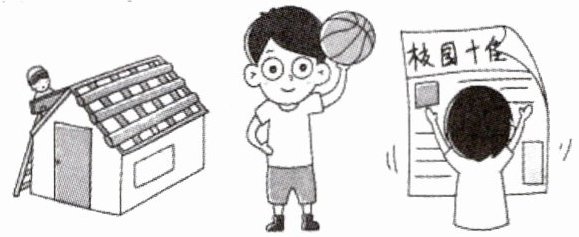
总结put up的含义:
① ② ③
We put our things in the desk drawers.
我们把东西放进课桌的抽屉里。
Please put your books on your desk. 请把你的书放在课桌上。
His father put up a new house for their dogs. 他父亲为他们的狗搭建了一座新房子。
The students often put up notices on the blackboard. 学生们经常在黑板上张贴通知。
The box is too heavy. I can't put it up. 这个箱子太重了,我举不起来。
总结put up的含义:
① ② ③
答案
① 搭建,建造 ② 张贴 ③ 举起,抬起
解析
【分析】要总结put up的含义,需结合每个句子的具体语境,分析put up在不同语境下所表达的动作,进而归纳出对应的含义。
【解析】1. 在句子“His father put up a new house for their dogs.”中,put up搭配的宾语是“a new house”,结合语境可知是搭建房屋,故含义为搭建,建造;2. 在句子“The students often put up notices on the blackboard.”中,put up搭配的宾语是“notices”,地点是黑板上,动作是贴通知,故含义为张贴;3. 在句子“The box is too heavy. I can't put it up.”中,put up搭配的宾语是“the box”,动作是举箱子,故含义为举起,抬起。
【答案】① 搭建,建造 ② 张贴 ③ 举起,抬起
【知识点】动词短语put up的含义;短语辨析
【点评】本题通过具体例句考查put up的多重含义,需结合语境理解短语用法,是英语学习中常见的短语辨析题型,要注意积累不同语境下短语的不同意思。
【难度系数】0.5
【解析】1. 在句子“His father put up a new house for their dogs.”中,put up搭配的宾语是“a new house”,结合语境可知是搭建房屋,故含义为搭建,建造;2. 在句子“The students often put up notices on the blackboard.”中,put up搭配的宾语是“notices”,地点是黑板上,动作是贴通知,故含义为张贴;3. 在句子“The box is too heavy. I can't put it up.”中,put up搭配的宾语是“the box”,动作是举箱子,故含义为举起,抬起。
【答案】① 搭建,建造 ② 张贴 ③ 举起,抬起
【知识点】动词短语put up的含义;短语辨析
【点评】本题通过具体例句考查put up的多重含义,需结合语境理解短语用法,是英语学习中常见的短语辨析题型,要注意积累不同语境下短语的不同意思。
【难度系数】0.5
