登录
登录
1 [2025南通启东期中]综合与探究
问题情境:如图1,已知AB为$\odot O$的直径,C为$\odot O$上异于A,B的一点,过点C作$\odot O$的切线CE,过点A作$AD ⊥ CE$于点D,连接OC,AC.
(1)【探究发现】证明:无论点C在何处,将$△ ADC$沿AC折叠,点D一定落在直径AB上.
(2)【探究引申】如图2,小明同学继续探究发现,若$△ AOC$是等腰三角形且对称轴经过点D时,CD与AB存在数量关系,请写出结论并证明.
(3)【探究规律】如图3,小亮同学继续探究发现,当$△ AOC$为等边三角形时,CD与AB存在数量关系,请写出结论并证明.
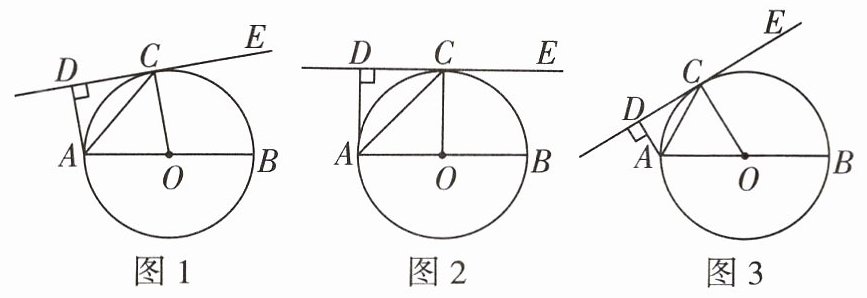
问题情境:如图1,已知AB为$\odot O$的直径,C为$\odot O$上异于A,B的一点,过点C作$\odot O$的切线CE,过点A作$AD ⊥ CE$于点D,连接OC,AC.
(1)【探究发现】证明:无论点C在何处,将$△ ADC$沿AC折叠,点D一定落在直径AB上.
(2)【探究引申】如图2,小明同学继续探究发现,若$△ AOC$是等腰三角形且对称轴经过点D时,CD与AB存在数量关系,请写出结论并证明.
(3)【探究规律】如图3,小亮同学继续探究发现,当$△ AOC$为等边三角形时,CD与AB存在数量关系,请写出结论并证明.
答案
(1)证明:
∵ DE 为$\odot O$的切线,$\therefore OC⊥DE$.
$\because AD⊥DE,\therefore AD// OC$,
$\therefore ∠DAC=∠OCA$.
$\because OA=OC,\therefore ∠OAC=∠OCA$,
$\therefore ∠DAC=∠OAC$,
∴ 无论点C在何处,将$△ADC$沿AC折叠,点D一定落在直径AB上.
(2)解:$CD=\frac{1}{2}AB$. 证明如下:
$\because △AOC$是等腰三角形且对称轴经过点D,
$\therefore DA=DC$.
$\because AD⊥CE,\therefore ∠DCA=45^{\circ }$.
$\because DE$为$\odot O$的切线,
$\therefore OC⊥DE,\therefore ∠OCD=90^{\circ }$,
$\therefore ∠OCA=45^{\circ },\therefore ∠COA=90^{\circ }$.
$\because ∠ADC=∠AOC=∠OCD=90^{\circ }$,
∴ 四边形AOCD为矩形,
$\therefore CD=AO,\therefore CD=\frac{1}{2}AB$.
(3)解:$CD=\frac{\sqrt{3}}{4}AB$. 证明如下:
$\because △AOC$为等边三角形,
$\therefore OA=AC,∠OCA=60^{\circ }$.
$\because DE$为$\odot O$的切线,$\therefore OC⊥DE$,
$\therefore ∠OCD=90^{\circ },\therefore ∠ACD=30^{\circ }$,
$\therefore AD=\frac{1}{2}AC,\therefore CD=\sqrt{AC^{2}-AD^{2}}=\frac{\sqrt{3}}{2}AC$.
又$\because AC=OA=\frac{1}{2}AB,\therefore CD=\frac{\sqrt{3}}{4}AB$.
∵ DE 为$\odot O$的切线,$\therefore OC⊥DE$.
$\because AD⊥DE,\therefore AD// OC$,
$\therefore ∠DAC=∠OCA$.
$\because OA=OC,\therefore ∠OAC=∠OCA$,
$\therefore ∠DAC=∠OAC$,
∴ 无论点C在何处,将$△ADC$沿AC折叠,点D一定落在直径AB上.
(2)解:$CD=\frac{1}{2}AB$. 证明如下:
$\because △AOC$是等腰三角形且对称轴经过点D,
$\therefore DA=DC$.
$\because AD⊥CE,\therefore ∠DCA=45^{\circ }$.
$\because DE$为$\odot O$的切线,
$\therefore OC⊥DE,\therefore ∠OCD=90^{\circ }$,
$\therefore ∠OCA=45^{\circ },\therefore ∠COA=90^{\circ }$.
$\because ∠ADC=∠AOC=∠OCD=90^{\circ }$,
∴ 四边形AOCD为矩形,
$\therefore CD=AO,\therefore CD=\frac{1}{2}AB$.
(3)解:$CD=\frac{\sqrt{3}}{4}AB$. 证明如下:
$\because △AOC$为等边三角形,
$\therefore OA=AC,∠OCA=60^{\circ }$.
$\because DE$为$\odot O$的切线,$\therefore OC⊥DE$,
$\therefore ∠OCD=90^{\circ },\therefore ∠ACD=30^{\circ }$,
$\therefore AD=\frac{1}{2}AC,\therefore CD=\sqrt{AC^{2}-AD^{2}}=\frac{\sqrt{3}}{2}AC$.
又$\because AC=OA=\frac{1}{2}AB,\therefore CD=\frac{\sqrt{3}}{4}AB$.
2 [2025 扬州江都区期中] 对于平面内的点 P 和图形 M,给出如下定义:以点 P 为圆心,r 为半径作圆,若$\odot P$与图形 M 有公共点,且半径 r 存在最大值与最小值,则将半径 r 的最大值与最小值的差叫作点 P 视角下图形 M 的宽度,记作 $d_{P-M}.$
(1)如图 1,O 为坐标原点,$P(0,4),Q(-3,4)$,则 $d_{O-线段PQ}=$
(2)如图 2,在菱形 ABCD 中,$A(2,0),B(6,0)$,$∠DAB = 60°$, 已 知 $M ( 0, \sqrt{3} )$,求 $d_{M-菱形ABCD}.$
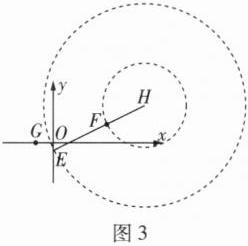
(3)如图 3,$E(0,-1)$,点 F 在第一象限且纵坐标为 2,H 是线段 EF 延长线上一点,且 $d_{H-线段EF}=3\sqrt{5}$,则点 F 的横坐标为
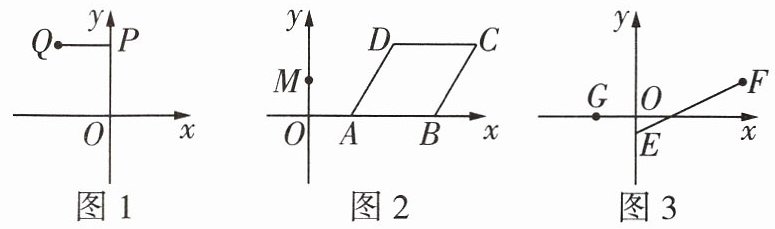
(1)如图 1,O 为坐标原点,$P(0,4),Q(-3,4)$,则 $d_{O-线段PQ}=$
1
.(2)如图 2,在菱形 ABCD 中,$A(2,0),B(6,0)$,$∠DAB = 60°$, 已 知 $M ( 0, \sqrt{3} )$,求 $d_{M-菱形ABCD}.$
(3)如图 3,$E(0,-1)$,点 F 在第一象限且纵坐标为 2,H 是线段 EF 延长线上一点,且 $d_{H-线段EF}=3\sqrt{5}$,则点 F 的横坐标为
6
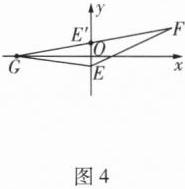
.若 G 为 x 轴负半轴上一动点,且点 G 的横坐标小于 -1,则 $d_{G-线段EF}$ 的最大值为 √37
.答案
(1)
连接 OQ. 由题意知,$d_{O-线段PQ}$表示以点 O 为圆心,r 为半径作圆,与线段 PQ 有交点时,r 的最大值与最小值的差.
∵ r 的最小值为$OP=4$,r 的最大值为$OQ=\sqrt{3^{2}+4^{2}}=5$,$\therefore d_{O-线段PQ}=5-4=1$.
(2)如图1,连接 CM,过点 C 作$CH⊥x$轴于点 H,过 M 作$MK⊥CH$于点 K.
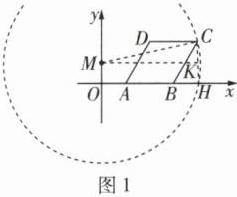
$\because ∠MOH=90^{\circ },\therefore$ 四边形 OM KH 是矩形,
$\therefore OM=KH$.
$\because A(2,0),B(6,0),\therefore AB=6-2=4$.
$\because$ 四边形 ABCD 是菱形,
$\therefore AD// BC,AB=BC=CD=DA=4$,
$\therefore ∠CBH=∠DAB=60^{\circ }$,
$\therefore ∠BCH=90^{\circ }-60^{\circ }=30^{\circ },\therefore BH=\frac{1}{2}BC=2$,
$\therefore CH=\sqrt{BC^{2}-BH^{2}}=2\sqrt{3}$,
$MK=OH=OB+BH=8$.
$\because M(0,\sqrt{3}),\therefore OM=KH=\sqrt{3}$,
$\therefore CK=CH-KH=\sqrt{3}$,
$\therefore MC=\sqrt{MK^{2}+CK^{2}}=\sqrt{67}$,
$\therefore r$ 的最大值为$\sqrt{67}$.
如图2,延长 CD 交 y 轴于点 F,过点 M 作$ME⊥AD$于点 E,过点 D 作$DN⊥AB$于点 N,连接 MA,MD.
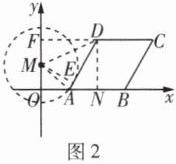
易知$AN=2,DN=OF=2\sqrt{3}$,
$\therefore ON=DF=4,\therefore D(4,2\sqrt{3})$,
$\therefore S_{梯形OADF}=\frac{1}{2}(OA+DF)· OF=6\sqrt{3},S_{△AOM}=\frac{1}{2}OA· OM=\sqrt{3},S_{△MFD}=\frac{1}{2}DF· MF=2\sqrt{3}$,
$\therefore S_{△AMD}=S_{梯形OADF}-S_{△AOM}-S_{△MFD}=3\sqrt{3}$.
$\because S_{△AMD}=\frac{1}{2}AD· ME=3\sqrt{3}$,且$AD=4$,
$\therefore ME=\frac{2S_{△AMD}}{AD}=\frac{3\sqrt{3}}{2},\therefore r$ 的最小值为$\frac{3\sqrt{3}}{2}$.
$\therefore d_{M-菱形ABCD}=\sqrt{67}-\frac{3\sqrt{3}}{2}$.
(3)
如图3,$\because d_{H-线段EF}=3\sqrt{5},\therefore HE-HF=3\sqrt{5}=EF$. 设$F(a,2)$,
$\because E(0,-1),\therefore EF=\sqrt{a^{2}+(2+1)^{2}}=3\sqrt{5}$,解得$a=6$(负值舍去),
∴ 点 F 的横坐标为 6. 如图4,作 E 关于 x 轴对称的点$E'$,则$E'(0,1)$,连接$FE'$,并延长交 x 轴于点 G,连接 GE,此时$GF-GE$取得最大值,即$d_{G-线段EF}$取得最大值. 由$F(6,2)$,$E'(0,1)$,得直线$FE'$的函数表达式为$y=\frac{1}{6}x+1$. 令$y=0$,得$x=-6$,即$G(-6,0)$,则$GF-GE$的最大值为$GF-GE'=E'F=\sqrt{(6-0)^{2}+(2-1)^{2}}=\sqrt{37}$,$\therefore d_{G-线段EF}$的最大值为$\sqrt{37}$.