

 登录
The solar system, held together by the Sun's gravity, includes eight planets, their moons, and countless smaller bodies like asteroids and comets. These planets go around the Sun, with the inner four being rocky and the outer four gas giants. Formed around 4.6 billion years ago, it is a dynamic (动力的) system that has evolved over time.
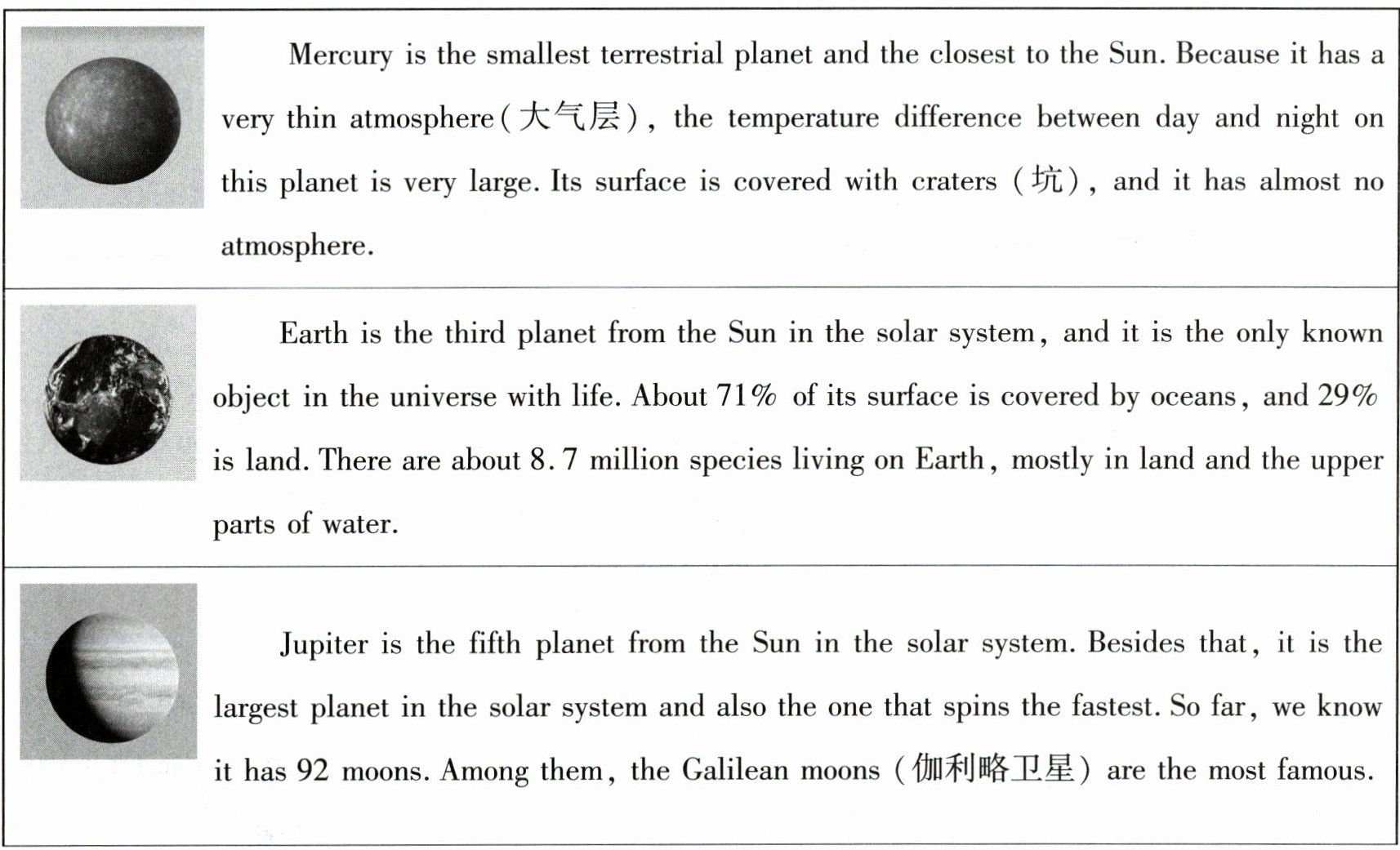
Mercury is the smallest terrestrial planet and the closest to the Sun. Because it has a very thin atmosphere (大气层), the temperature difference between day and night on this planet is very large. Its surface is covered with craters (坑), and it has almost no atmosphere.
Earth is the third planet from the Sun in the solar system, and it is the only known object in the universe with life. About 71% of its surface is covered by oceans, and 29% is land. There are about 8.7 million species living on Earth, mostly in land and the upper parts of water.
Jupiter is the fifth planet from the Sun in the solar system. Besides that, it is the largest planet in the solar system and also the one that spins the fastest. So far, we know it has 92 moons. Among them, the Galilean moons (伽利略卫星) are the most famous.
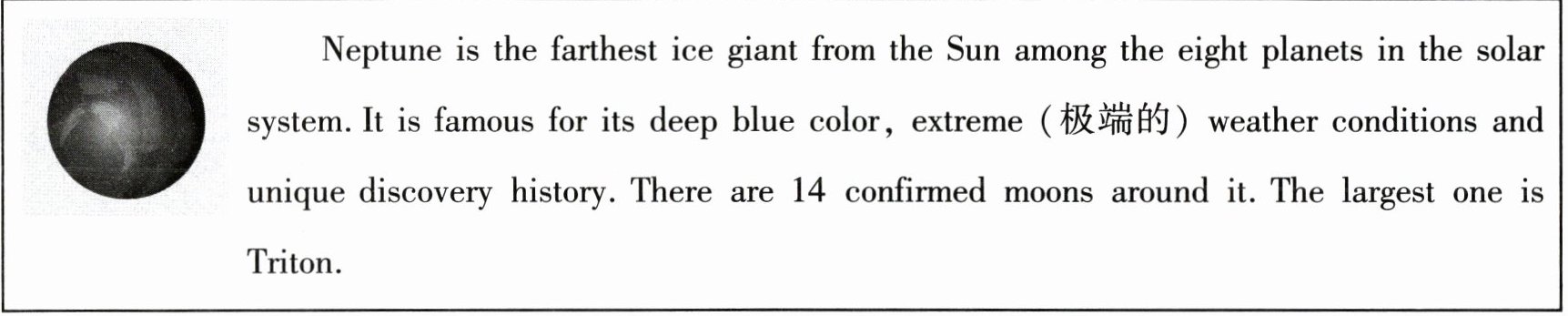
Neptune is the farthest ice giant from the Sun among the eight planets in the solar system. It is famous for its deep blue color, extreme (极端的) weather conditions and unique discovery history. There are 14 confirmed moons around it. The largest one is Triton.
(
A. The Sun.
B. Venus.
C. Moon.
D. Earth.
(
A. Because there's no air.
B. Because there's thin air.
C. Because it's near the Sun.
D. Because it has many craters.
(
A. Moon.
B. Earth.
C. Venus.
D. Jupiter.
(
A. Almost covered by oceans.
B. The largest planet in the solar system.
C. Deep blue color and extreme climate.
D. Covered with craters and no atmosphere.
(
A. Mercury is the biggest planet.
B. Jupiter spins the fastest in the solar system.
C. Earth has 92 moons in total.
D. Neptune is a terrestrial planet in the solar system.
B
Mercury is the smallest terrestrial planet and the closest to the Sun. Because it has a very thin atmosphere (大气层), the temperature difference between day and night on this planet is very large. Its surface is covered with craters (坑), and it has almost no atmosphere.
Earth is the third planet from the Sun in the solar system, and it is the only known object in the universe with life. About 71% of its surface is covered by oceans, and 29% is land. There are about 8.7 million species living on Earth, mostly in land and the upper parts of water.
Jupiter is the fifth planet from the Sun in the solar system. Besides that, it is the largest planet in the solar system and also the one that spins the fastest. So far, we know it has 92 moons. Among them, the Galilean moons (伽利略卫星) are the most famous.
Neptune is the farthest ice giant from the Sun among the eight planets in the solar system. It is famous for its deep blue color, extreme (极端的) weather conditions and unique discovery history. There are 14 confirmed moons around it. The largest one is Triton.
(
A
)16. What do the planets in the solar system go around?A. The Sun.
B. Venus.
C. Moon.
D. Earth.
(
B
)17. Why is the temperature difference between day and night on Mercury very large?A. Because there's no air.
B. Because there's thin air.
C. Because it's near the Sun.
D. Because it has many craters.
(
B
)18. Which planet has many signs of life?A. Moon.
B. Earth.
C. Venus.
D. Jupiter.
(
C
)19. What are the features of Neptune's surface?A. Almost covered by oceans.
B. The largest planet in the solar system.
C. Deep blue color and extreme climate.
D. Covered with craters and no atmosphere.
(
B
)20. Which of the following is TURE from the passage?A. Mercury is the biggest planet.
B. Jupiter spins the fastest in the solar system.
C. Earth has 92 moons in total.
D. Neptune is a terrestrial planet in the solar system.
B
答案
16. A 17. B 18. B 19. C 20. B
