

 登录
一、词性分类与应用。
根据所给句子,将句子中画线单词按词性归类填入表格中相应的位置。
| 名词 | position sadness actor | |
| 形容词 | short-term effective unforgettable |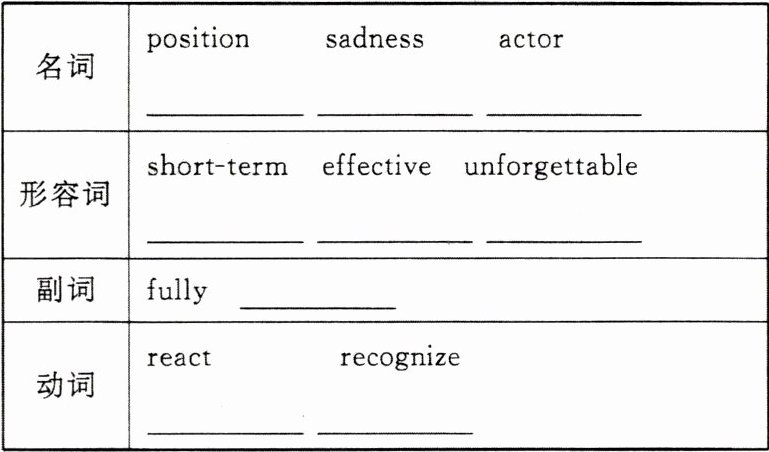 |
| 副词 | fully | |
| 动词 | react recognize | |
1. We need a stable home to live happily.
2. When I recall my childhood days, I always feel warm and peaceful.
3. Although the watch looks beautiful,it is too expensive for me to buy.
4. As a grown-up person, he knows what he should do when facing difficulties.
5. Education is necessary because it changes our future greatly.
6. She speaks softly when she talks to little kids.
7. Happiness is important because it makes our life warm and bright.
8. If you organize your time well, you will finish your work easily.
9. Every inventor spent years working hard before he succeeded.
根据所给句子,将句子中画线单词按词性归类填入表格中相应的位置。
| 名词 | position sadness actor | |
| 形容词 | short-term effective unforgettable |
|| 副词 | fully | |
| 动词 | react recognize | |
1. We need a stable home to live happily.
2. When I recall my childhood days, I always feel warm and peaceful.
3. Although the watch looks beautiful,it is too expensive for me to buy.
4. As a grown-up person, he knows what he should do when facing difficulties.
5. Education is necessary because it changes our future greatly.
6. She speaks softly when she talks to little kids.
7. Happiness is important because it makes our life warm and bright.
8. If you organize your time well, you will finish your work easily.
9. Every inventor spent years working hard before he succeeded.
答案
名词: education happiness inventor
形容词: grown-up expensive stable
副词: softly
动词: recall organize
形容词: grown-up expensive stable
副词: softly
动词: recall organize
二、用所给的短语造句。
情境:用语言描述一下自己在学习方面遇到的困难。
1. happen to 发生在……身上
2. feel stressed 感到焦虑、有压力
3. go through 经历(困难、痛苦)
4. run out (耗尽、用光)
5. special care (悉心照料、特殊照顾)
6. keep in mind (牢记、铭记)
7. instead of (而不是)
8. move on to (转向下一个话题/阶段)
9. have confidence in (对……有信心)
10. divide. . . into. . . (把某物分为)
情境:用语言描述一下自己在学习方面遇到的困难。
1. happen to 发生在……身上
Memory problems happen to me.
2. feel stressed 感到焦虑、有压力
I always felt stressed when I had to give a speech.
3. go through 经历(困难、痛苦)
I hope my parents understand what I'm going through.
4. run out (耗尽、用光)
My patience will never run out when I look after my grandparents.
5. special care (悉心照料、特殊照顾)
Maybe I need some special care.
6. keep in mind (牢记、铭记)
I will keep in mind key words in my speech.
7. instead of (而不是)
Instead of being upset, I stay with my parents patiently.
8. move on to (转向下一个话题/阶段)
I should accept the old people's memory problems and move on to cherish happy memories.
9. have confidence in (对……有信心)
I should have confidence in myself.
10. divide. . . into. . . (把某物分为)
I divided the speech into short sections.
答案
1. Memory problems happen to me.
2. I always felt stressed when I had to give a speech.
3. I hope my parents understand what I'm going through.
4. My patience will never run out when I look after my grandparents.
5. Maybe I need some special care.
6. I will keep in mind key words in my speech.
7. Instead of being upset, I stay with my parents patiently.
8. I should accept the old people's memory problems and move on to cherish happy memories.
9. I should have confidence in myself.
10. I divided the speech into short sections.
拓展提升
答案
拓展提升
三、阅读文章,根据短文内容,选择最佳答案。
Most people believe memory is only for humans. But wild animals also have surprising memory skills to survive (v.生存).
Elephants have one of the longest memories in the animal world. They can remember dangerous places and water sources (n.水源) for over 50 years. When droughts (n.干旱) come, they lead their families to safe places they knew long ago.
Crows (n.乌鸦) are smart birds with good short-term memory. They can remember where they hide food for months. How do they
do it? They mark places with stones or leaves.
Like humans, old animals also face memory loss (n.记忆衰退). When they grow old, they may forget family members or safe routes. Even so, they keep warm memories and move on to live a simple life.
(
A. Only humans have memory.
B. Wild animals have long memory.
C. Old animals have bad memory.
(
A. To places with stones.
B. To safe places they remembered.
C. To new water sources.
(
A. By singing loudly.
B. By marking with stones or leaves.
C. By asking other birds.
(
A. To make more friends.
B. To survive hard times.
C. To find old family members.
(
A. When they are hungry.
B. When they grow old.
C. When droughts come.
Most people believe memory is only for humans. But wild animals also have surprising memory skills to survive (v.生存).
Elephants have one of the longest memories in the animal world. They can remember dangerous places and water sources (n.水源) for over 50 years. When droughts (n.干旱) come, they lead their families to safe places they knew long ago.
Crows (n.乌鸦) are smart birds with good short-term memory. They can remember where they hide food for months. How do they
do it? They mark places with stones or leaves.
Like humans, old animals also face memory loss (n.记忆衰退). When they grow old, they may forget family members or safe routes. Even so, they keep warm memories and move on to live a simple life.
(
A
)1. What do most people think about memory at first?A. Only humans have memory.
B. Wild animals have long memory.
C. Old animals have bad memory.
(
B
)2. Where do elephants lead their families during droughts?A. To places with stones.
B. To safe places they remembered.
C. To new water sources.
(
B
)3. How do crows remember their food places?A. By singing loudly.
B. By marking with stones or leaves.
C. By asking other birds.
(
B
)4. Why do elephants keep long-term memory?A. To make more friends.
B. To survive hard times.
C. To find old family members.
(
B
)5. When do animals have memory problems?A. When they are hungry.
B. When they grow old.
C. When droughts come.
答案
1. A 2. B 3. B 4. B 5. B
