

 登录
登录
(
—
A.No, he can't.
B.Yes, he can.
A
)4. —Can Matt buy some ice cream?—
No, he can't.
A.No, he can't.
B.Yes, he can.
答案
4. A
解析
【分析】本题考查含情态动词can的一般疑问句的答语,解题思路是:首先明确一般疑问句答语需遵循“用什么提问用什么回答”的原则,问句以Can开头,答语需用can或can't回应;再结合选项及参考答案,确定正确答语为否定形式。
【解析】Can引导的一般疑问句,答语需保持情态动词一致,结构为:肯定回答是“Yes, 主语+can.”,否定回答是“No, 主语+can't.”。本题问句询问Matt能否买冰淇淋,结合参考答案,应选否定回答,对应选项A。
【答案】A
【知识点】情态动词can的一般疑问句答语
【点评】本题为英语基础题型,考查一般疑问句的答语规则,侧重基础知识点的应用,难度较低。
【难度系数】0.4
【解析】Can引导的一般疑问句,答语需保持情态动词一致,结构为:肯定回答是“Yes, 主语+can.”,否定回答是“No, 主语+can't.”。本题问句询问Matt能否买冰淇淋,结合参考答案,应选否定回答,对应选项A。
【答案】A
【知识点】情态动词can的一般疑问句答语
【点评】本题为英语基础题型,考查一般疑问句的答语规则,侧重基础知识点的应用,难度较低。
【难度系数】0.4
Ⅲ. 选词填空。
goods services buy food haircuts
1. People use money to buy
2. We need services like
3. We buy
4. Clothes and bags are things we use money to
goods services buy food haircuts
1. People use money to buy
goods
and pay for services
.2. We need services like
haircuts
and seeing a doctor.3. We buy
food
and school things in our life.4. Clothes and bags are things we use money to
buy
.答案
1. goods, services 2. haircuts 3. food 4. buy
解析
【分析】
先明确所给词汇的含义:goods(商品,名词)、services(服务,名词)、buy(买,动词)、food(食物,名词)、haircuts(理发,名词)。解题时需结合每个句子的语境,判断空格处需要的词性和词义,再匹配对应词汇。
【解析】
1. 第一句句意:人们用钱买商品并为服务付费。第一空作buy的宾语,需填名词,goods(商品)符合;第二空作pay for的宾语,需填名词,services(服务)符合。
2. 第二句句意:我们需要像理发和看医生这样的服务。空格处举例服务类名词,haircuts(理发)符合。
3. 第三句句意:我们在生活中买食物和学习用品。空格处作buy的宾语,需填名词,food(食物)符合。
4. 第四句句意:衣服和包是我们用钱买的东西。此处是不定式结构,to后接动词原形,buy(买)符合。
【答案】
1. goods, services 2. haircuts 3. food 4. buy
【知识点】
英语词汇辨析、选词填空
【点评】
本题考查基础英语词汇的词义理解与语境运用,属于常见的英语基础题型,需学生掌握核心词汇含义并结合句子逻辑填空。
【难度系数】
0.6
先明确所给词汇的含义:goods(商品,名词)、services(服务,名词)、buy(买,动词)、food(食物,名词)、haircuts(理发,名词)。解题时需结合每个句子的语境,判断空格处需要的词性和词义,再匹配对应词汇。
【解析】
1. 第一句句意:人们用钱买商品并为服务付费。第一空作buy的宾语,需填名词,goods(商品)符合;第二空作pay for的宾语,需填名词,services(服务)符合。
2. 第二句句意:我们需要像理发和看医生这样的服务。空格处举例服务类名词,haircuts(理发)符合。
3. 第三句句意:我们在生活中买食物和学习用品。空格处作buy的宾语,需填名词,food(食物)符合。
4. 第四句句意:衣服和包是我们用钱买的东西。此处是不定式结构,to后接动词原形,buy(买)符合。
【答案】
1. goods, services 2. haircuts 3. food 4. buy
【知识点】
英语词汇辨析、选词填空
【点评】
本题考查基础英语词汇的词义理解与语境运用,属于常见的英语基础题型,需学生掌握核心词汇含义并结合句子逻辑填空。
【难度系数】
0.6
Ⅳ. 读一读,从方框中选择合适的句子补全对话,将序号填在横线上。
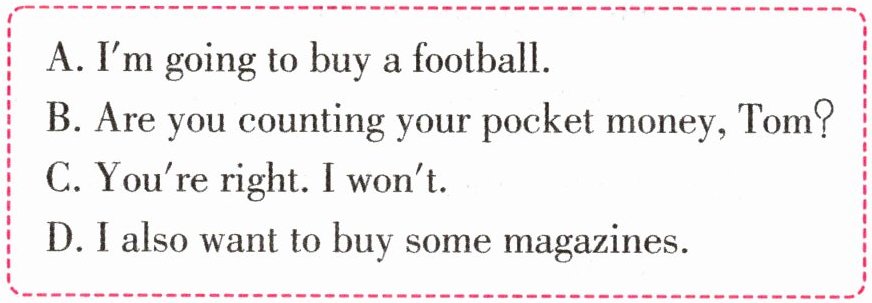
Lily: 1.
Tom: Yes. I have two hundred and eighty-five yuan.
Lily: Wow, that's a lot. How are you going to spend it?
Tom: 2.
Lily: Yes, you need a new one. You like playing sports.
Tom: 3.
Lily: Great idea! Maybe you can buy some magazines about science. They're interesting.
Tom: Should I also buy some drinks?
Lily: Sure, but don't drink too much.
Tom: 4.
Lily: 1.
B
Tom: Yes. I have two hundred and eighty-five yuan.
Lily: Wow, that's a lot. How are you going to spend it?
Tom: 2.
A
Lily: Yes, you need a new one. You like playing sports.
Tom: 3.
D
Lily: Great idea! Maybe you can buy some magazines about science. They're interesting.
Tom: Should I also buy some drinks?
Lily: Sure, but don't drink too much.
Tom: 4.
C
答案
1. B 2. A 3. D 4. C
解析
【分析】
补全对话需结合上下文的问答逻辑与语境选择合适句子:第1空,Tom答句是“Yes”,说明Lily的问句是一般疑问句,对应选项B;第2空,Lily问如何花钱,需回答计划,对应选项A;第3空,承接上文“买杂志”的话题,对应选项D;第4空,回应Lily“别喝太多”的提醒,对应选项C。
【解析】
1. 第1空:根据Tom的答句“Yes”,可知此处应为一般疑问句,选项B“Are you counting your pocket money, Tom?”符合语境,故选B。
2. 第2空:Lily问“How are you going to spend it?”,需回答花钱的计划,选项A“I'm going to buy a football.”符合语境,故选A。
3. 第3空:Lily提到买杂志的好主意,此处应承接该话题,选项D“I also want to buy some magazines.”符合语境,故选D。
4. 第4空:Lily提醒“不要喝太多”,此处需回应同意,选项C“You're right. I won't.”符合语境,故选C。
【答案】
1.B 2.A 3.D 4.C
【知识点】
补全对话、日常交际用语
【点评】
本题考查日常交际用语的运用,需结合上下文语境和问答逻辑选择句子,难度适中,适合学生练习日常对话表达。
【难度系数】
0.6
补全对话需结合上下文的问答逻辑与语境选择合适句子:第1空,Tom答句是“Yes”,说明Lily的问句是一般疑问句,对应选项B;第2空,Lily问如何花钱,需回答计划,对应选项A;第3空,承接上文“买杂志”的话题,对应选项D;第4空,回应Lily“别喝太多”的提醒,对应选项C。
【解析】
1. 第1空:根据Tom的答句“Yes”,可知此处应为一般疑问句,选项B“Are you counting your pocket money, Tom?”符合语境,故选B。
2. 第2空:Lily问“How are you going to spend it?”,需回答花钱的计划,选项A“I'm going to buy a football.”符合语境,故选A。
3. 第3空:Lily提到买杂志的好主意,此处应承接该话题,选项D“I also want to buy some magazines.”符合语境,故选D。
4. 第4空:Lily提醒“不要喝太多”,此处需回应同意,选项C“You're right. I won't.”符合语境,故选C。
【答案】
1.B 2.A 3.D 4.C
【知识点】
补全对话、日常交际用语
【点评】
本题考查日常交际用语的运用,需结合上下文语境和问答逻辑选择句子,难度适中,适合学生练习日常对话表达。
【难度系数】
0.6
阅读短文,完成任务。
Pocket money is important in our life. It teaches us to manage money well. Matt saves his pocket money. Now he has 357 yuan. His old schoolbag is broken, so he will buy a new one first. He likes animals, so he plans to buy some animal books.
Amy uses her pocket money too. She pays for services like haircuts and dance classes. Sometimes she goes to the cinema with friends. This weekend, Amy is going to pay for a home delivery of snacks.
We use money for two main things: buying goods and paying for services. Goods are things we can touch, like school things and clothes. Services are things others do for us, like haircuts and seeing a doctor. Learning to use pocket money wisely helps us in the future.
任务一:阅读短文,判断句子正(T)误(F)。
(
(
(
(
(
任务二:根据实际情况,回答问题。
How do you use your pocket money?
Pocket money is important in our life. It teaches us to manage money well. Matt saves his pocket money. Now he has 357 yuan. His old schoolbag is broken, so he will buy a new one first. He likes animals, so he plans to buy some animal books.
Amy uses her pocket money too. She pays for services like haircuts and dance classes. Sometimes she goes to the cinema with friends. This weekend, Amy is going to pay for a home delivery of snacks.
We use money for two main things: buying goods and paying for services. Goods are things we can touch, like school things and clothes. Services are things others do for us, like haircuts and seeing a doctor. Learning to use pocket money wisely helps us in the future.
任务一:阅读短文,判断句子正(T)误(F)。
(
F
) 1. Matt has 375 yuan now.(
T
) 2. Matt will buy a new schoolbag because his old one is broken.(
T
) 3. Amy pays for haircuts and dance classes.(
F
) 4. We only use money to pay for services.(
T
) 5. Using pocket money wisely is good for our future.任务二:根据实际情况,回答问题。
How do you use your pocket money?
答案
任务一:1. F 2. T 3. T 4. F 5. T
解析
【分析】
做任务一的判断正误题时,需先通读短文,定位每个句子对应的原文内容,对比句子表述与原文是否一致,重点关注数字、原因、限定词等细节;任务二为开放性问题,结合自身实际情况作答即可。
【解析】
任务一:1. 原文明确提到Matt has 357 yuan,题目中数字为375,与原文不符,故判断为F;2. 原文表述为His old schoolbag is broken, so he will buy a new one first,与题目表述一致,故判断为T;3. 原文提到She pays for services like haircuts and dance classes,与题目表述一致,故判断为T;4. 原文说明We use money for two main things: buying goods and paying for services,题目中“only”限定了用途,与原文不符,故判断为F;5. 原文最后一句Learning to use pocket money wisely helps us in the future,与题目表述一致,故判断为T。任务二:结合自身实际,合理表述即可,例如I use my pocket money to buy storybooks and school supplies.
【答案】
任务一:1. F 2. T 3. T 4. F 5. T;任务二:I use my pocket money to buy storybooks and school supplies.(答案不唯一,符合实际即可)
【知识点】
英语阅读理解、细节判断、开放性问答
【点评】
本题考查英语阅读理解的细节理解能力,任务一需精准定位原文细节,注意数字、限定词等易错点;任务二为开放性问题,难度较低,学生易作答。
【难度系数】
0.7
做任务一的判断正误题时,需先通读短文,定位每个句子对应的原文内容,对比句子表述与原文是否一致,重点关注数字、原因、限定词等细节;任务二为开放性问题,结合自身实际情况作答即可。
【解析】
任务一:1. 原文明确提到Matt has 357 yuan,题目中数字为375,与原文不符,故判断为F;2. 原文表述为His old schoolbag is broken, so he will buy a new one first,与题目表述一致,故判断为T;3. 原文提到She pays for services like haircuts and dance classes,与题目表述一致,故判断为T;4. 原文说明We use money for two main things: buying goods and paying for services,题目中“only”限定了用途,与原文不符,故判断为F;5. 原文最后一句Learning to use pocket money wisely helps us in the future,与题目表述一致,故判断为T。任务二:结合自身实际,合理表述即可,例如I use my pocket money to buy storybooks and school supplies.
【答案】
任务一:1. F 2. T 3. T 4. F 5. T;任务二:I use my pocket money to buy storybooks and school supplies.(答案不唯一,符合实际即可)
【知识点】
英语阅读理解、细节判断、开放性问答
【点评】
本题考查英语阅读理解的细节理解能力,任务一需精准定位原文细节,注意数字、限定词等易错点;任务二为开放性问题,难度较低,学生易作答。
【难度系数】
0.7
