

 登录
Ⅲ. 阅读理解(每题2分,满分20分)
A
跨学科 数学 On February 22, 2023, Guo Hongyi, an 8-year-old boy, solved a 4-level Tower of Hanoi with one hand in 4.305 seconds and set a new world record.
The Tower of Hanoi is a maths puzzle that has been popular for more than a century. To solve a Tower of Hanoi puzzle, it needs your brain, eyes and hands to work together.
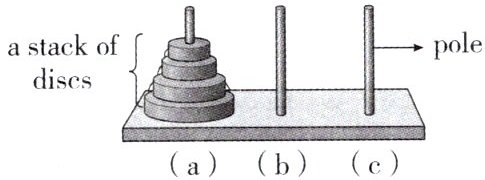
The Tower of Hanoi is made up of three poles and a stack of discs. The discs should be placed from the largest on the bottom to the smallest on the top. The way to play the game is to move the whole stack from Pole(a) to Pole(c). There are three simple rules as follows:
◆Only one disc can be moved at a time.
◆You can only move the top disc of a stack.
◆Each disc can be placed on any pole, but it can't be placed on top of a smaller disc.
The Tower of Hanoi was invented by the French mathematician Édouard Lucas in 1883. A later fictional story about moving 64 golden discs illustrates how challenging the puzzle is. Édouard found the maths problem in the story interesting and tried to work out the minimum (最小的) number of moves to solve the puzzle. Finally, he came up with the formula(公式): $2^n -1$, where "n" is the number of discs. According to the formula, even if the priests made one move every second, it would take 500 billion years to finish. It was an impossible task for them.
Nowadays, the Tower of Hanoi is used in many fields, such as psychological research and computer science. It has made great contributions to human life.
So next time you're looking for a fun and challenging puzzle game, give the Tower of Hanoi a try.
1. What is the main purpose of the first paragraph?
A. To explain how to play the Tower of Hanoi.
B. To introduce a new world record set by an 8-year-old boy.
C. To tell readers the history of the Tower of Hanoi.
D. To show the importance of the Tower of Hanoi in science.
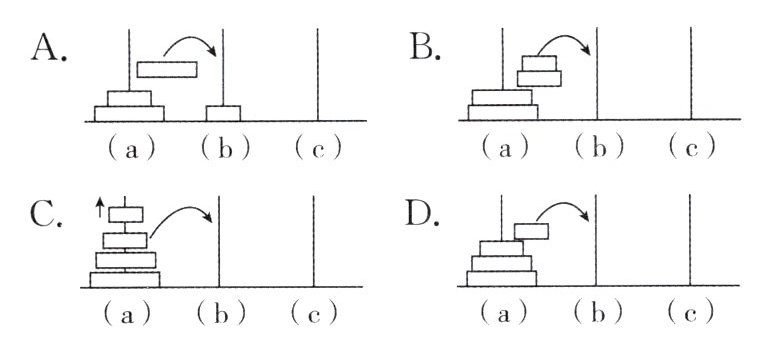
2. 新考法 图示理解 According to the rules of the Tower of Hanoi, which of the following pictures shows the CORRECT move?
3. The formula created by Édouard is used to determine the
A. fewest moves
B. sizes of discs
C. fewest discs
D. speed of moves
4. According to the passage, what is required to solve a Tower of Hanoi puzzle?
A. Strong physical strength and speed.
B. Special tools and equipment(设备).
C. Knowledge of physics and mathematics.
D. The coordination(配合) of brain, eyes and hands.
5. Why does the writer write the passage?
A. To show how popular the Tower of Hanoi is.
B. To introduce the history of the Tower of Hanoi.
C. To attract more people to play the Tower of Hanoi.
D. To explain why the Tower of Hanoi is widely used.
A
跨学科 数学 On February 22, 2023, Guo Hongyi, an 8-year-old boy, solved a 4-level Tower of Hanoi with one hand in 4.305 seconds and set a new world record.
The Tower of Hanoi is a maths puzzle that has been popular for more than a century. To solve a Tower of Hanoi puzzle, it needs your brain, eyes and hands to work together.
The Tower of Hanoi is made up of three poles and a stack of discs. The discs should be placed from the largest on the bottom to the smallest on the top. The way to play the game is to move the whole stack from Pole(a) to Pole(c). There are three simple rules as follows:
◆Only one disc can be moved at a time.
◆You can only move the top disc of a stack.
◆Each disc can be placed on any pole, but it can't be placed on top of a smaller disc.
The Tower of Hanoi was invented by the French mathematician Édouard Lucas in 1883. A later fictional story about moving 64 golden discs illustrates how challenging the puzzle is. Édouard found the maths problem in the story interesting and tried to work out the minimum (最小的) number of moves to solve the puzzle. Finally, he came up with the formula(公式): $2^n -1$, where "n" is the number of discs. According to the formula, even if the priests made one move every second, it would take 500 billion years to finish. It was an impossible task for them.
Nowadays, the Tower of Hanoi is used in many fields, such as psychological research and computer science. It has made great contributions to human life.
So next time you're looking for a fun and challenging puzzle game, give the Tower of Hanoi a try.
1. What is the main purpose of the first paragraph?
A. To explain how to play the Tower of Hanoi.
B. To introduce a new world record set by an 8-year-old boy.
C. To tell readers the history of the Tower of Hanoi.
D. To show the importance of the Tower of Hanoi in science.
2. 新考法 图示理解 According to the rules of the Tower of Hanoi, which of the following pictures shows the CORRECT move?
3. The formula created by Édouard is used to determine the
fewest moves
.A. fewest moves
B. sizes of discs
C. fewest discs
D. speed of moves
4. According to the passage, what is required to solve a Tower of Hanoi puzzle?
A. Strong physical strength and speed.
B. Special tools and equipment(设备).
C. Knowledge of physics and mathematics.
D. The coordination(配合) of brain, eyes and hands.
5. Why does the writer write the passage?
A. To show how popular the Tower of Hanoi is.
B. To introduce the history of the Tower of Hanoi.
C. To attract more people to play the Tower of Hanoi.
D. To explain why the Tower of Hanoi is widely used.
答案
Ⅲ. 1.B 2.D 3.A 4.D 5.C
A
【语篇解读】本文是一篇说明文,主要介绍了汉诺塔游戏的玩法、历史、数学原理和实际应用,并鼓励读者尝试这一益智游戏。
1. B 解析:写作意图题。第一段写8岁的郭弘毅用4.305秒完成四层汉诺塔并创造世界纪录,作用是以一则新纪录引出下文对汉诺塔的介绍。B项与段落内容相符;A、C、D项分别对应后文的玩法、历史和应用,并非第一段的主要作用。故选B。
2. D 解析:图示理解题。根据“Only one disc can be moved at a time.”,“You can only move the top disc of a stack.”和“Each disc can be placed on any pole, but it can't be placed on top of a smaller disc.”可知,汉诺塔的规则是:每次只能移动1个圆盘,只能移动顶部的圆盘;不能把大圆盘放在更小的圆盘上方。对应选项D。A选项把大圆盘放在小的圆盘上方,错误;B选项一次移动了2个圆盘,错误;C选项移动了中间的圆盘,错误。故选D。
3. A 解析:细节理解题。根据第四段“Edouard found ... the minimum number of moves”以及“he came up with the formula”可知,该公式用来计算完成汉诺塔所需的最少移动次数,A项与原文对应。B、C、D项分别把公式的作用误解为圆盘大小、圆盘数量和移动速度。故选A。
4. D 解析:细节理解题。根据第二段“To solve a Tower of Hanoi puzzle, it needs your brain, eyes and hands to work together.”可知,解决汉诺塔需要大脑、眼睛和双手的协调配合,D项是原句的同义转述。故选D。
5. C 解析:写作意图题。文章依次介绍汉诺塔的玩法、由来、公式和应用,最后以“So next time ... give the Tower of Hanoi a try.”直接邀请读者尝试游戏,因此写作目的在于吸引更多人玩汉诺塔。B项只概括了历史这一局部内容,D项只涉及应用,均不能概括全文。故选C。
易错提醒 第5题易误选B,因为文章确实介绍了汉诺塔的历史;但历史只是全文的一部分。判断写作目的时要特别看结尾的态度或号召性语句,本题末句“give the Tower of Hanoi a try”明确表明作者意在鼓励读者尝试该游戏,因此应选C。
