

 登录
登录
任务四:对比现在进行时与一般现在时,用括号内动词的适当形式填空,注意区分两种时态。
1. Harbin (attract) many tourists every year, and now it (welcome) visitors from all over the world.
2. Local people usually (eat) songhua eggs for breakfast, and my uncle (have) noodles with songhua eggs now.
3. The guide (know) a lot about Harbin's history, and she (share) interesting stories with us now.
1. Harbin (attract) many tourists every year, and now it (welcome) visitors from all over the world.
2. Local people usually (eat) songhua eggs for breakfast, and my uncle (have) noodles with songhua eggs now.
3. The guide (know) a lot about Harbin's history, and she (share) interesting stories with us now.
答案
1. attracts; is welcoming
2. eat; is having
3. knows; is sharing
2. eat; is having
3. knows; is sharing
解析
本题考查一般现在时和现在进行时的区分:
1. 一般现在时用于描述客观事实、经常性/习惯性动作,常见标志词有every year、usually等,当主语是第三人称单数时,谓语动词要使用第三人称单数形式;
2. 现在进行时用于描述此时此刻正在发生的动作,常见标志词为now,结构为「am/is/are + 动词现在分词」。
逐题分析:
1. 第一空后有every year表每年的常规情况,主语Harbin是第三人称单数,attract变为第三人称单数形式attracts;第二空有now表此刻正在进行的动作,主语it是第三人称单数,be动词用is,welcome的现在分词为welcoming,填is welcoming。
2. 第一空有usually表习惯性动作,主语Local people是复数,谓语用动词原形eat;第二空有now表正在进行的动作,主语my uncle是第三人称单数,be动词用is,have的现在分词为having,填is having。
3. 第一空是陈述导游熟知哈尔滨历史的客观事实,主语The guide是第三人称单数,know变为第三人称单数形式knows;第二空有now表正在进行的动作,主语she是第三人称单数,be动词用is,share的现在分词为sharing,填is sharing。
1. 一般现在时用于描述客观事实、经常性/习惯性动作,常见标志词有every year、usually等,当主语是第三人称单数时,谓语动词要使用第三人称单数形式;
2. 现在进行时用于描述此时此刻正在发生的动作,常见标志词为now,结构为「am/is/are + 动词现在分词」。
逐题分析:
1. 第一空后有every year表每年的常规情况,主语Harbin是第三人称单数,attract变为第三人称单数形式attracts;第二空有now表此刻正在进行的动作,主语it是第三人称单数,be动词用is,welcome的现在分词为welcoming,填is welcoming。
2. 第一空有usually表习惯性动作,主语Local people是复数,谓语用动词原形eat;第二空有now表正在进行的动作,主语my uncle是第三人称单数,be动词用is,have的现在分词为having,填is having。
3. 第一空是陈述导游熟知哈尔滨历史的客观事实,主语The guide是第三人称单数,know变为第三人称单数形式knows;第二空有now表正在进行的动作,主语she是第三人称单数,be动词用is,share的现在分词为sharing,填is sharing。
B. 语音规则。
Our School Camping Trip
We are having a wonderful camping trip in the mountains! Right now, some students are setting up tents, and others are collecting dry leaves for the fire. Our teacher is showing us how to start a safe campfire(营火)—he is speaking slowly and clearly so everyone can understand.
Lily and Lucy are preparing food. They are cutting vegetables and boiling water for noodles. Tom is not helping with the food—he is climbing a small hill with his friends. They are laughing loudly as they run up the path.
Some girls are singing under a big tree. Their voices are sweet, and many of us are joining in. A few boys are taking photos of the beautiful mountains and rivers. They are trying to capture(记录) every amazing moment.
It is getting dark, but no one feels tired. We are all enjoying this special time together. Camping is such a great experience—we are making new memories and having so much fun!
任务一:请朗读短文,注意动词-ing形式的读音。
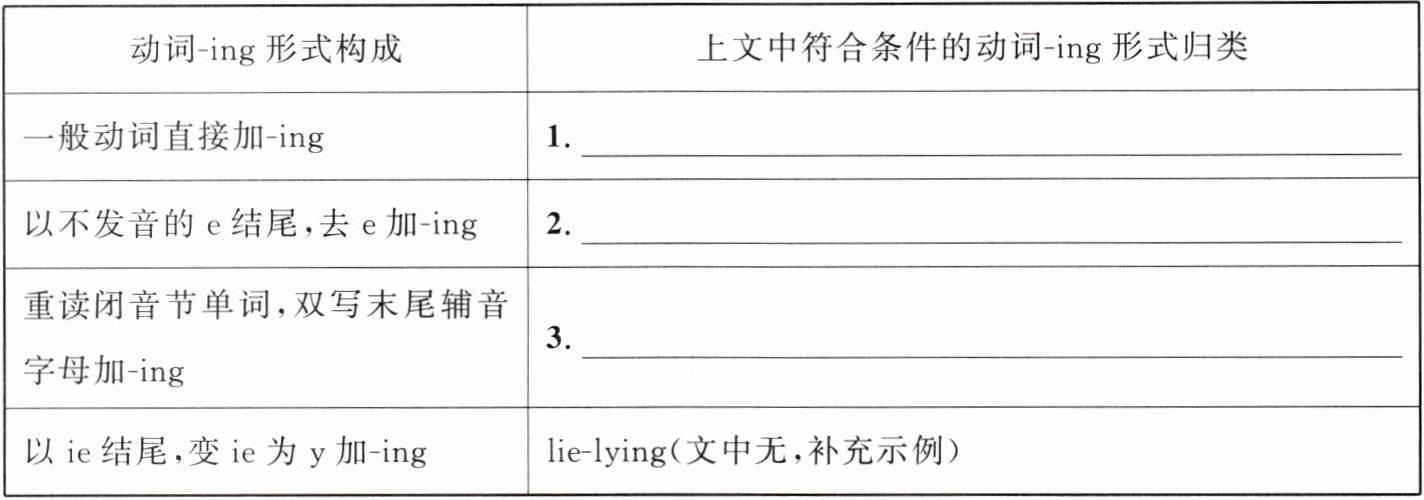
任务二:请将上文中重点标注的动词-ing形式进行分类,填入不同的表格中。
【实践篇】
Our School Camping Trip
We are having a wonderful camping trip in the mountains! Right now, some students are setting up tents, and others are collecting dry leaves for the fire. Our teacher is showing us how to start a safe campfire(营火)—he is speaking slowly and clearly so everyone can understand.
Lily and Lucy are preparing food. They are cutting vegetables and boiling water for noodles. Tom is not helping with the food—he is climbing a small hill with his friends. They are laughing loudly as they run up the path.
Some girls are singing under a big tree. Their voices are sweet, and many of us are joining in. A few boys are taking photos of the beautiful mountains and rivers. They are trying to capture(记录) every amazing moment.
It is getting dark, but no one feels tired. We are all enjoying this special time together. Camping is such a great experience—we are making new memories and having so much fun!
任务一:请朗读短文,注意动词-ing形式的读音。
任务二:请将上文中重点标注的动词-ing形式进行分类,填入不同的表格中。
【实践篇】
答案
1. camping, collecting, showing, speaking, boiling, helping, climbing, laughing, singing, joining, trying, enjoying
2. having, preparing, taking, making
3. setting, cutting, running, getting
2. having, preparing, taking, making
3. setting, cutting, running, getting
解析
首先明确动词-ing形式的三类基础构成规则,再从短文中逐一筛选匹配对应形式:
1. 一般动词直接在词尾加-ing,筛选所有符合该规则的短文中的动词-ing形式;
2. 以不发音的字母e结尾的动词,先去掉末尾不发音的e,再加-ing,匹配短文中对应形式;
3. 以重读闭音节结尾、且末尾仅单个辅音字母的动词,双写末尾辅音字母后再加-ing,找出短文中符合条件的形式。
1. 一般动词直接在词尾加-ing,筛选所有符合该规则的短文中的动词-ing形式;
2. 以不发音的字母e结尾的动词,先去掉末尾不发音的e,再加-ing,匹配短文中对应形式;
3. 以重读闭音节结尾、且末尾仅单个辅音字母的动词,双写末尾辅音字母后再加-ing,找出短文中符合条件的形式。
