

 登录
九、Lily 记录了上周末去北京旅游的经历。从框中选择恰当的单词补全短文。(10 分)
early food trip felt took
Last weekend, I had a wonderful 1.
On the first day, we went to Tian'anmen Square 2.
early food trip felt took
Last weekend, I had a wonderful 1.
trip
with my parents. We went to Beijing. It’s a city full of history and beauty, with many world-famous places to explore.On the first day, we went to Tian'anmen Square 2.
early
in the morning. We enjoyed the beautiful scenery(景色)there and 3. felt
very proud. Then we climbed the Great Wall. It’s long and ancient. We walked along the wall for a long time and 4. took
many beautiful photos to remember the special moment. In the afternoon, we also visited the Palace Museum. It has a long history and amazing collections(收藏品). We also tasted some delicious local 5. food
such as Beijing roast duck.答案
1. trip 2. early 3. felt 4. took 5. food
解析
【分析】
这是一道英语选词填空题,解题思路为:先通读短文,理解短文主题是关于北京旅行的经历;再分析每个空格的句子结构,判断所需词性;最后结合语境、单词词义及时态(短文为过去的经历,动词用过去式)匹配恰当单词。
【解析】
1. 第一空:空前有不定冠词a和形容词wonderful,需填名词,结合语境“和父母有一场很棒的旅行”,选trip。
2. 第二空:修饰动词短语went to Tian'anmen Square,需填副词,结合“早上很早去”的语境,选early。
3. 第三空:后接形容词proud,需填系动词,过去式felt(feel的过去式),构成felt proud(感到自豪),符合语境,选felt。
4. 第四空:固定搭配take photos(拍照),短文为过去时态,take的过去式是took,选took。
5. 第五空:空前有形容词delicious和local,需填名词,结合“北京烤鸭”的例子,选food。
【答案】
1. trip 2. early 3. felt 4. took 5. food
【知识点】
名词词义辨析、副词用法、动词过去式
【点评】
本题为基础选词填空题,考查对常用单词的词义、词性及固定搭配的掌握,结合语境即可轻松选出答案,属于英语基础题型。
【难度系数】
0.9
十、Linda 介绍了她所知道的端午节的活动。阅读短文,完成任务。(15 分)
The Dragon Boat Festival is a traditional Chinese festival to remember Qu Yuan, a great ancient poet. It falls on the 5th day of the 5th lunar month every year. My family has many activities to celebrate this festival.
Early in the morning, my mum and grandma usually make zongzi together. Zongzi is a kind of glutinous rice dumpling wrapped in bamboo leaves. We usually make two kinds: sweet ones with red beans and jujubes(红枣), and salty ones with meat and eggs. After making zongzi, we hang mugwort(艾草)and calamus(菖蒲)at the door. These plants have a special smell that people believe can keep bad things away.
In the afternoon, we often go to the river near our home to watch dragon boat races. Many teams row colourful dragon boats, and people on the bank cheer loudly for their favourite teams. The races are very exciting, and everyone feels happy.
In the evening, we always have a big dinner with zongzi as the main food. My dad often tells us stories about Qu Yuan and the history of the festival. We also talk about our daily life and share interesting things.
This festival not only lets us enjoy delicious food and exciting races, but also teaches us about Chinese history and culture. It’s a great time for families to get together and have fun.
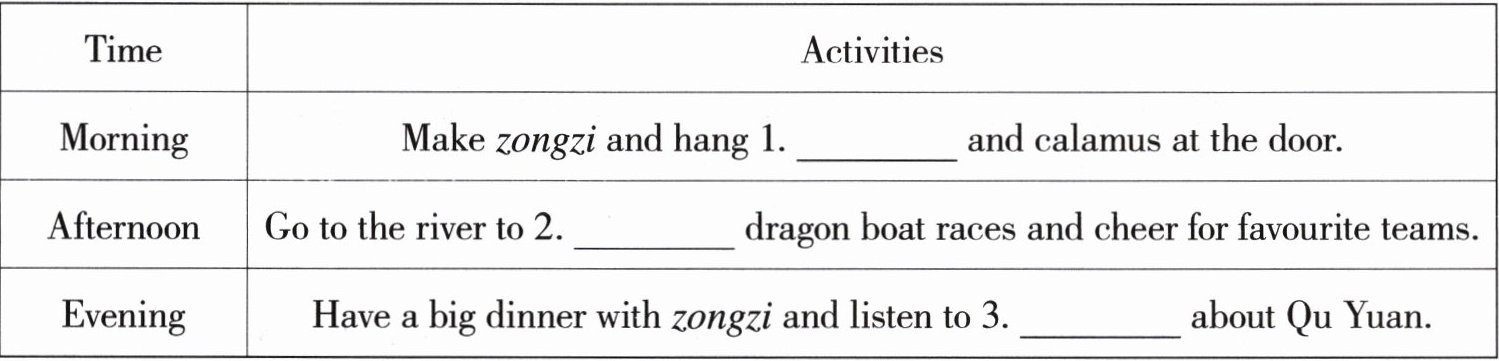
任务一: 根据短文内容补全表格。(3 分)
任务二: 根据短文内容, 选择正确的答案。(6 分)
(
A. To remember the great ancient poet Qu Yuan.
B. To enjoy delicious zongzi with family.
C. To watch exciting dragon boat races.
(
A. Make zongzi more delicious.
B. Keep bad things away.
C. Help people win dragon boat races.
(
A. To win many prizes in the races.
B. To learn how to cook special food.
C. To enjoy good food, exciting activities and family time.
任务三: 根据短文内容, 用完整的句子回答问题。(6 分)
1. What does the writer think of the time spent making zongzi with family?
2. What do people do on the bank when watching dragon boat races?
3. What can people learn from the Dragon Boat Festival according to the passage?
The Dragon Boat Festival is a traditional Chinese festival to remember Qu Yuan, a great ancient poet. It falls on the 5th day of the 5th lunar month every year. My family has many activities to celebrate this festival.
Early in the morning, my mum and grandma usually make zongzi together. Zongzi is a kind of glutinous rice dumpling wrapped in bamboo leaves. We usually make two kinds: sweet ones with red beans and jujubes(红枣), and salty ones with meat and eggs. After making zongzi, we hang mugwort(艾草)and calamus(菖蒲)at the door. These plants have a special smell that people believe can keep bad things away.
In the afternoon, we often go to the river near our home to watch dragon boat races. Many teams row colourful dragon boats, and people on the bank cheer loudly for their favourite teams. The races are very exciting, and everyone feels happy.
In the evening, we always have a big dinner with zongzi as the main food. My dad often tells us stories about Qu Yuan and the history of the festival. We also talk about our daily life and share interesting things.
This festival not only lets us enjoy delicious food and exciting races, but also teaches us about Chinese history and culture. It’s a great time for families to get together and have fun.
任务一: 根据短文内容补全表格。(3 分)
任务二: 根据短文内容, 选择正确的答案。(6 分)
(
A
)1. Why do people celebrate the Dragon Boat Festival?A. To remember the great ancient poet Qu Yuan.
B. To enjoy delicious zongzi with family.
C. To watch exciting dragon boat races.
(
B
)2. What do people believe mugwort and calamus can do?A. Make zongzi more delicious.
B. Keep bad things away.
C. Help people win dragon boat races.
(
C
)3. According to the passage, what is the main meaning of the Dragon Boat Festival for the writer’s family?A. To win many prizes in the races.
B. To learn how to cook special food.
C. To enjoy good food, exciting activities and family time.
任务三: 根据短文内容, 用完整的句子回答问题。(6 分)
1. What does the writer think of the time spent making zongzi with family?
2. What do people do on the bank when watching dragon boat races?
3. What can people learn from the Dragon Boat Festival according to the passage?
答案
任务一: 1. mugwort 2. watch 3. stories
任务二: 1. A 2. B 3. C
任务三:
1. It's a great time for families to get together and have fun.(文章末句。)
2. They cheer loudly for their favourite teams.
3. They can learn about Chinese history and culture.
解析
【分析】
本题是关于端午节的英语阅读理解题,分为三个任务。解题思路为:先通读短文理解大意,再针对每个任务的问题,回到原文定位关键信息;任务一需提取对应时间的活动词汇,任务二通过原文细节匹配选项,任务三需用完整句子准确回答问题,确保答案与原文表述一致。
【解析】
任务一:1. 原文第二段明确提到“we hang mugwort(艾草)and calamus(菖蒲)at the door”,故填mugwort;2. 第三段提到“go to the river near our home to watch dragon boat races”,故填watch;3. 第四段提到“My dad often tells us stories about Qu Yuan”,故填stories。
任务二:1. 原文开头说明端午节是为了纪念诗人屈原,对应选项A;2. 第二段指出人们认为艾草和菖蒲能驱邪,对应选项B;3. 最后一段提到节日能让家人享受美食、活动,还能学习文化,对应选项C。
任务三:1. 原文末句直接给出答案;2. 第三段提到人们在岸边为喜欢的队伍大声加油;3. 最后一段说明能学到中国历史和文化。
【答案】
任务一: 1. mugwort 2. watch 3. stories;任务二: 1. A 2. B 3. C;任务三: 1. It's a great time for families to get together and have fun. 2. They cheer loudly for their favourite teams. 3. They can learn about Chinese history and culture.
【知识点】
英语阅读理解、细节提取、句子表达
【点评】
本题以中国传统节日端午节为主题,考查学生的英语阅读能力,涵盖词汇填空、选择判断和句子回答题型,既贴近生活又传递了传统文化知识,难度适中,适合学生巩固阅读技巧。
【难度系数】
0.6
