

 登录
四、教材语篇回顾。根据课文内容及括号内的提示词填空。(每空一词)
Sally had a birthmark on her face, bright red like 1. strawberry. She often felt people 2. (secret) looking at it but quickly turning away. Because of 3. (hate) the birthmark, she always kept her hair long to 4. (cover) it, especially in crowded places.
One day, a new student named Maddie sat right 5. her. Instead of looking away, Maddie studied the birthmark carefully and said, “6. beautiful!” Her smiling eyes met Sally's. 7. Sally only replied “thank you”, it turned sunny in her heart. Maddie even 8. (paint) a red rose on her own face the next day.
Maddie's kindness has already 9. (change) Sally's view of herself. Sally has learnt everyone has something special, and that's what makes people 10. (difference).
答案
1. a 2. secretly 3. hating 4. cover 5. beside 6. How 7. Although 8. painted
9. changed 10. different
五、语法聚焦。
A. 语法入门:现在完成时(一)
1. 现在完成时表示在以前某个时间已经发生的行为或曾经做过的事情,且对目前有某种影响。句子的谓语由“have / have not (haven't)或has / has not (hasn't)+动词的
2. 大部分动词的过去分词是
3. 现在完成时常与just、
4. 在没有时间状语的情况下,若强调句子中的行为对现在有影响,则用
B. 规则初探:不规则动词的过去式和过去分词的不同变化形式。
根据以下分类罗列动词的不规则变化形式。
AAA型:

AAB型:

ABA型:

ABB型:
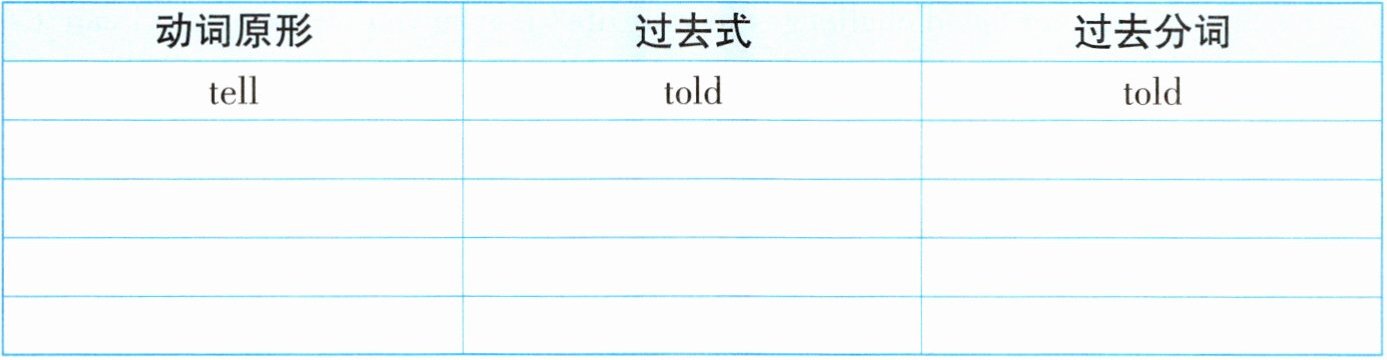
ABC型:
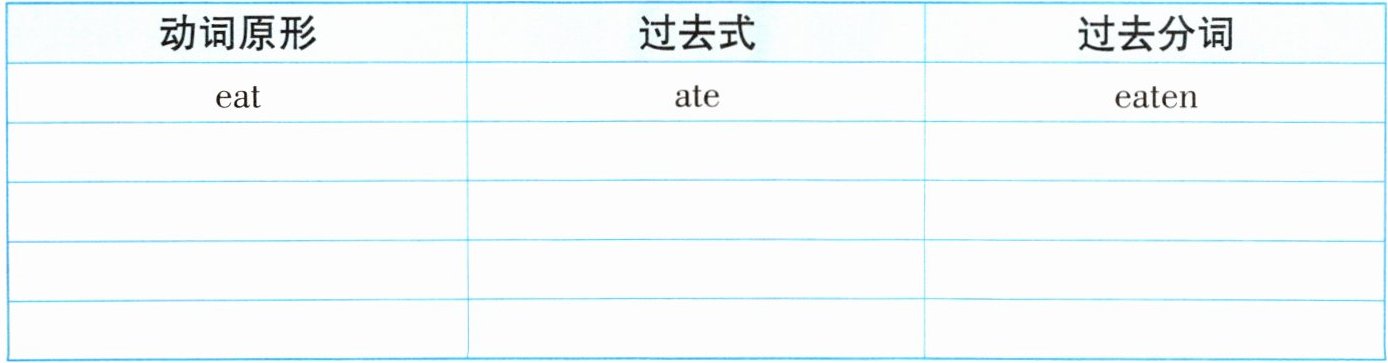
C. 语境运用:用already、just或yet填空。
Yesterday, I went to the cinema to meet my friends John, Eason and Nancy. John was there when I arrived. “I've 1.
A. 语法入门:现在完成时(一)
1. 现在完成时表示在以前某个时间已经发生的行为或曾经做过的事情,且对目前有某种影响。句子的谓语由“have / have not (haven't)或has / has not (hasn't)+动词的
过去分词
”构成。2. 大部分动词的过去分词是
规则
变化的(如:paint—painted—painted),一部分是不规则变化的,需要记忆(如:go—went—gone
)。3. 现在完成时常与just、
already
或yet等表示时间的状语连用。4. 在没有时间状语的情况下,若强调句子中的行为对现在有影响,则用
现在完成
时;若只强调过去某一具体时间发生的事情,则用一般过去
时。B. 规则初探:不规则动词的过去式和过去分词的不同变化形式。
根据以下分类罗列动词的不规则变化形式。
AAA型:
AAB型:
ABA型:
ABB型:
ABC型:
C. 语境运用:用already、just或yet填空。
Yesterday, I went to the cinema to meet my friends John, Eason and Nancy. John was there when I arrived. “I've 1.
just
got a message from Nancy,” he said. “She's nearly here.” A few minutes later, Nancy arrived. “Hello,” she said. “Has anyone seen Eason 2. yet
?” “No,” said John. “It's 3. already
seven o'clock. We'll miss the start of the film!” Then Eason hurried in. “Hi! Sorry I'm late. Have we got the tickets 4. yet
?” “Yes,” said John. “I've got them 5. already
. Let's go!”答案
A: 1. 过去分词 2. 规则, gone 3. already 4. 现在完成,一般过去
B: AAA: put—put—put, hit—hit—hit, cost—cost—cost, hurt—hurt—hurt
AAB: beat—beat—beaten
ABA: come—came—come, run—ran—run
ABB: bring—brought—brought, build—built—built, catch—caught—caught, dig—dug—dug
ABC: begin—began—begun, break—broke—broken, choose—chose—chosen, blow—blew—blown
C: 1. just 2. yet 3. already 4. yet 5. already
