

 登录
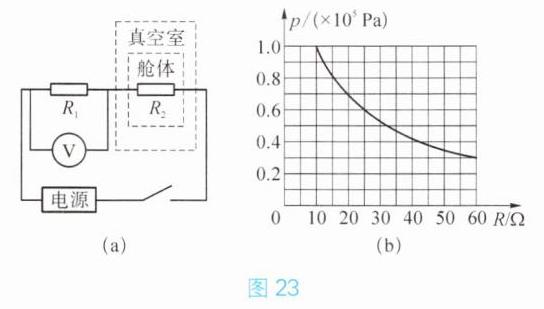
30. 从神舟系列飞船到天宫空间站,我国载人航天工程稳步推进。航天器的舱体密封性始终是保障航天员生命安全与任务成功的关键之一。在太空的真空、强辐射、极端温差环境中,任何微小的泄漏都可能导致舱内气压下降、氧气流失,引发严重后果。因此,舱体在发射前必须通过严格的气密性检测。某科技小组在飞船发射前,设计了一个地面模拟检测电路,用于模拟对飞船舱体进行气密性检验的过程。他们借鉴了工程中的压差检测原理,利用常见电子元件搭建了如图23(a)所示的电路模型。已知电源电压不变,定值电阻$R_1=20\ \Omega$;$R_2$为压力传感器,置于舱体中,且舱体置于真空室中,其阻值随环境气压的变化规律如图23(b)所示。舱体不漏气时,舱体内气压为$1.0×10^5\ \mathrm{Pa}$,此时电压表的示数为12 V。
(1)舱体不漏气时,求通过$R_1$的电流。
(2)求电源电压。
(3)当电压表的示数为8 V时,舱内的气压值为多少?
(1)舱体不漏气时,求通过$R_1$的电流。
(2)求电源电压。
(3)当电压表的示数为8 V时,舱内的气压值为多少?
答案
解:(1) 舱体不漏气时,通过$R_1$的电流:
$I_1=\dfrac{U_1}{R_1}=\dfrac{12\ \mathrm{V}}{20\ \Omega}=0.6\ \mathrm{A}$
(2) 由图(b)可知,舱体不漏气、气压为$1.0×10^5\ \mathrm{Pa}$时,压力传感器的阻值$R_2=10\ \Omega$,
$R_1$与$R_2$串联,电路电流$I=I_1=0.6\ \mathrm{A}$,
$R_2$两端的电压:$U_2=IR_2=0.6\ \mathrm{A}×10\ \Omega=6\ \mathrm{V}$,
电源电压:$U=U_1+U_2=12\ \mathrm{V}+6\ \mathrm{V}=18\ \mathrm{V}$
(3) 当电压表的示数为$8\ \mathrm{V}$时,电路中的电流:
$I'=\dfrac{U_1'}{R_1}=\dfrac{8\ \mathrm{V}}{20\ \Omega}=0.4\ \mathrm{A}$,
此时$R_2$两端的电压:$U_2'=U-U_1'=18\ \mathrm{V}-8\ \mathrm{V}=10\ \mathrm{V}$,
压力传感器的阻值:$R_2'=\dfrac{U_2'}{I'}=\dfrac{10\ \mathrm{V}}{0.4\ \mathrm{A}}=25\ \Omega$,
由图(b)可知,此时舱内的气压值为$0.6×10^5\ \mathrm{Pa}$
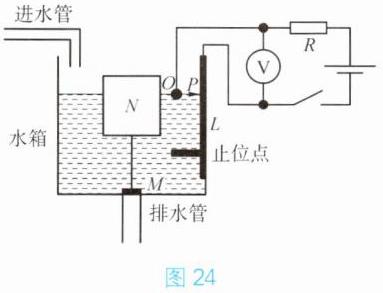
31. 科创小组设计了一款自动排水箱,如图24所示。水箱深度为40 cm;M是面积为20 cm²的排水阀门;N是底面积为100 cm²,高为15 cm,重力为4 N的浮子;M与N用长为20 cm的细绳相连。当水箱里的水面达到一定高度时,M在细绳拉力的作用下被拉开,开始排水。浮球O可带动金属滑片P随水面的变化而始终沿竖直方向上下运动。L是一段长为35 cm,阻值为35 Ω的电阻丝(阻值均匀),L的一端与水箱上边缘齐平,滑片P与L接触良好。电源电压为6 V,定值电阻R=25 Ω,电压表的测量范围为0~3 V。若细绳、排水阀门M的体积和质量均忽略不计,$\rho_{水}=1.0×10^3\ \mathrm{kg/m}^3$,求:
(1) 浮子N漂浮且细绳无作用力时受到的浮力。
(2) 蓄水后闭合开关,水箱中水面高度为25 cm时电压表的示数。
(3) 排水阀门M刚好被拉开时电压表的示数。
(1) 浮子N漂浮且细绳无作用力时受到的浮力。
(2) 蓄水后闭合开关,水箱中水面高度为25 cm时电压表的示数。
(3) 排水阀门M刚好被拉开时电压表的示数。
答案
解:(1) 浮子N漂浮且细绳无作用力时,受力平衡,浮力等于自身重力:
$F_{\mathrm{浮}} = G_N = 4\ \mathrm{N}$
(2) 当水箱中水面高度为25 cm时,滑片P距离电阻丝L上边缘的距离:
$h_1 = 35\ \mathrm{cm} - 25\ \mathrm{cm} = 10\ \mathrm{cm}$
电阻丝L阻值均匀,此时滑片下方接入电路的电阻:
$R_{L1} = \dfrac{10\ \mathrm{cm}}{35\ \mathrm{cm}} × 35\ \Omega = 10\ \Omega$
电路总电阻:
$R_{\mathrm{总1}} = R + R_{L1} = 25\ \Omega + 10\ \Omega = 35\ \Omega$
电路电流:
$I_1 = \dfrac{U}{R_{\mathrm{总1}}} = \dfrac{6\ \mathrm{V}}{35\ \Omega} = \dfrac{6}{35}\ \mathrm{A}$
电压表测定值电阻R两端的电压,示数为:
$U_V = I_1 R = \dfrac{6}{35}\ \mathrm{A} × 25\ \Omega \approx 2.14\ \mathrm{V}$
(3) 排水阀门M刚好被拉开时,设此时细绳拉力为$F_{\mathrm{拉}}$,水对阀门M的压力等于拉力:
设此时水面高度为$h$,水对M的压强$p = \rho_{\mathrm{水}} g h$,水对M的压力$F_{\mathrm{压}} = p S_M = \rho_{\mathrm{水}} g h S_M$
对浮子N受力分析:$F_{\mathrm{浮}}' = G_N + F_{\mathrm{拉}} = G_N + \rho_{\mathrm{水}} g h S_M$
又浮子N的浮力$F_{\mathrm{浮}}' = \rho_{\mathrm{水}} g V_{\mathrm{排}} = \rho_{\mathrm{水}} g S_N h_{\mathrm{浸}}$,细绳长20 cm,浮子高15 cm,因此浮子底部到阀门M的距离为20 cm,浮子浸入水中的深度满足:$h = 20\ \mathrm{cm} + h_{\mathrm{浸}}$
代入数据:
$1.0 × 10^3\ \mathrm{kg/m^3} × 10\ \mathrm{N/kg} × 100 × 10^{-4}\ \mathrm{m^2} × h_{\mathrm{浸}} = 4\ \mathrm{N} + 1.0 × 10^3\ \mathrm{kg/m^3} × 10\ \mathrm{N/kg} × h × 20 × 10^{-4}\ \mathrm{m^2}$
将$h = 0.2\ \mathrm{m} + h_{\mathrm{浸}}$代入解得:$h_{\mathrm{浸}} = 0.12\ \mathrm{m}$,此时水面总高度$h = 0.32\ \mathrm{m} = 32\ \mathrm{cm}$
此时滑片P距离电阻丝L上边缘的距离:
$h_2 = 35\ \mathrm{cm} - 32\ \mathrm{cm} = 3\ \mathrm{cm}$
滑片下方接入电路的电阻:
$R_{L2} = \dfrac{3\ \mathrm{cm}}{35\ \mathrm{cm}} × 35\ \Omega = 3\ \Omega$
电路总电阻:
$R_{\mathrm{总2}} = R + R_{L2} = 25\ \Omega + 3\ \Omega = 28\ \Omega$
电路电流:
$I_2 = \dfrac{U}{R_{\mathrm{总2}}} = \dfrac{6\ \mathrm{V}}{28\ \Omega} = \dfrac{3}{14}\ \mathrm{A}$
电压表示数:
$U_V' = I_2 R = \dfrac{3}{14}\ \mathrm{A} × 25\ \Omega \approx 5.36\ \mathrm{V}$
