

 登录
登录
一 Read and choose.阅读短文,选择正确的答案。
Traditional Festivals in China
There are many traditional festivals in China. They take place on different days and people usually celebrate them in different ways.
The Spring Festival usually comes in late January or early February. It is a time for families. We always have a big family dinner. We often wear new clothes and visit our relatives(亲戚) and friends. Kids can get lucky money during the festival.
Tomb-sweeping Day usually takes place between April 4th and April 6th. It is a time to remember our ancest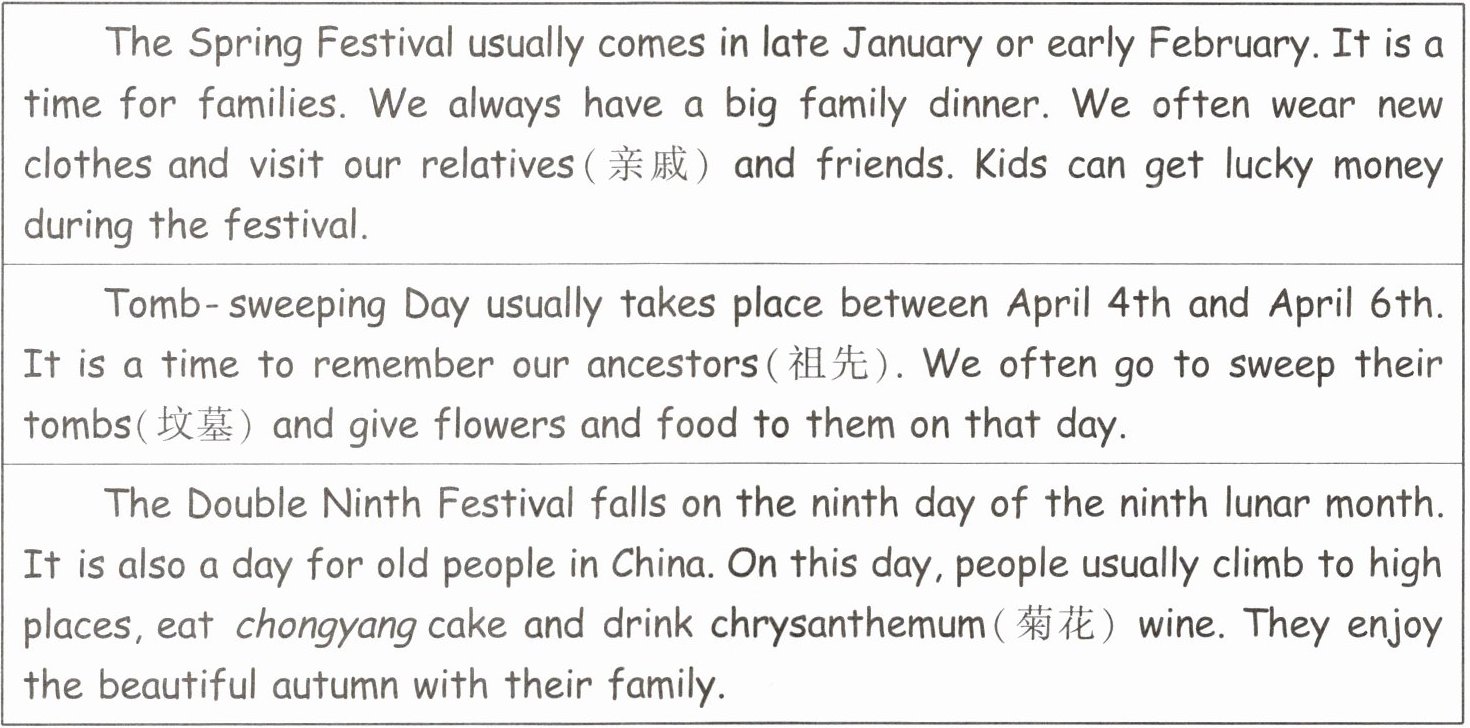 (祖先). We often go to sweep their tombs(坟墓) and give flowers and food to them on that day.
The Double Ninth Festival falls on the ninth day of the ninth lunar month. It is also a day for old people in China. On this day, people usually climb to high places, eat chongyang cake and drink chrysanthemum(菊花) wine. They enjoy the beautiful autumn with their family.
(
A. By having a big family dinner.
B. By sweeping their ancestors' tombs.
C. By eating delicious mooncakes together.
(
A. In late January or early February.
B. Between April 4th and April 6th.
C. On the ninth day of the ninth lunar month.
(
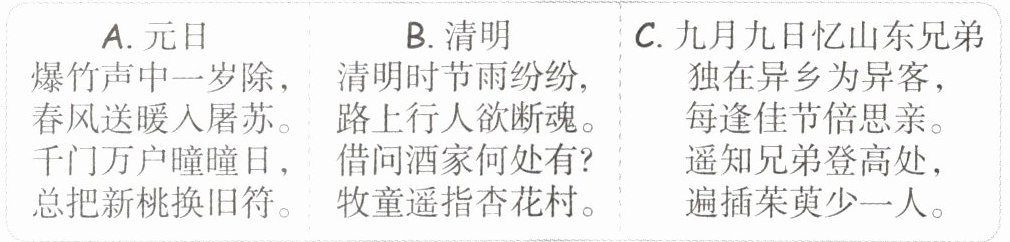
A. 元日
爆竹声中一岁除,
春风送暖入屠苏。
千门万户曈曈日,
总把新桃换旧符。
B. 清明
清明时节雨纷纷,
路上行人欲断魂。
借问酒家何处有?
牧童遥指杏花村。
C. 九月九日忆山东兄弟
独在异乡为异客,
每逢佳节倍思亲。
遥知兄弟登高处,
遍插茱萸少一人。
(
A. In a storybook.
B. In a science book.
C. In a poster.
Traditional Festivals in China
There are many traditional festivals in China. They take place on different days and people usually celebrate them in different ways.
The Spring Festival usually comes in late January or early February. It is a time for families. We always have a big family dinner. We often wear new clothes and visit our relatives(亲戚) and friends. Kids can get lucky money during the festival.
Tomb-sweeping Day usually takes place between April 4th and April 6th. It is a time to remember our ancest
(祖先). We often go to sweep their tombs(坟墓) and give flowers and food to them on that day.The Double Ninth Festival falls on the ninth day of the ninth lunar month. It is also a day for old people in China. On this day, people usually climb to high places, eat chongyang cake and drink chrysanthemum(菊花) wine. They enjoy the beautiful autumn with their family.
(
A
)1. How do people celebrate the Spring Festival?A. By having a big family dinner.
B. By sweeping their ancestors' tombs.
C. By eating delicious mooncakes together.
(
B
)2. When is the Tomb-sweeping Day?A. In late January or early February.
B. Between April 4th and April 6th.
C. On the ninth day of the ninth lunar month.
(
C
)3. Which poem is about the Double Ninth Festival?A. 元日
爆竹声中一岁除,
春风送暖入屠苏。
千门万户曈曈日,
总把新桃换旧符。
B. 清明
清明时节雨纷纷,
路上行人欲断魂。
借问酒家何处有?
牧童遥指杏花村。
C. 九月九日忆山东兄弟
独在异乡为异客,
每逢佳节倍思亲。
遥知兄弟登高处,
遍插茱萸少一人。
(
C
)4. Where can we read this passage?A. In a storybook.
B. In a science book.
C. In a poster.
答案
1. A 2. B 3. C 4. C
解析
【分析】
做这类阅读选择题时,需先通读短文把握核心内容,再针对每个小题的问题,定位到短文中对应的段落,仔细比对选项与原文信息,同时结合文化常识(如古诗对应的节日)判断,逐一排除错误选项得出答案。
【解析】
1. 第1题:定位短文第二段关于春节的内容,文中提到“We always have a big family dinner”,对应选项A;选项B是清明节的活动,选项C是中秋节的活动,均不符合,故选A。
2. 第2题:定位短文第三段关于清明节的内容,文中明确说明“Tomb-sweeping Day usually takes place between April 4th and April 6th”,直接对应选项B;选项A是春节时间,选项C是重阳节时间,排除,故选B。
3. 第3题:选项C的古诗《九月九日忆山东兄弟》,“九月九日”对应短文介绍的重阳节(The Double Ninth Festival falls on the ninth day of the ninth lunar month),且诗中“登高”等习俗也匹配重阳节,故选C;选项A对应春节,选项B对应清明节,排除。
4. 第4题:短文围绕中国传统节日展开介绍,这类宣传类内容通常出现在海报中;故事书以叙事为主,科学书以科学知识为主,均不符合,故选C。
【答案】
1. A 2. B 3. C 4. C
【知识点】
阅读理解、中国传统节日、古诗与节日对应
【点评】
本题围绕中国传统节日设置,考查学生的短文信息定位能力和基础文化常识,题目多为原文细节提取,难度适中,适合巩固相关知识。
【难度系数】
0.6
做这类阅读选择题时,需先通读短文把握核心内容,再针对每个小题的问题,定位到短文中对应的段落,仔细比对选项与原文信息,同时结合文化常识(如古诗对应的节日)判断,逐一排除错误选项得出答案。
【解析】
1. 第1题:定位短文第二段关于春节的内容,文中提到“We always have a big family dinner”,对应选项A;选项B是清明节的活动,选项C是中秋节的活动,均不符合,故选A。
2. 第2题:定位短文第三段关于清明节的内容,文中明确说明“Tomb-sweeping Day usually takes place between April 4th and April 6th”,直接对应选项B;选项A是春节时间,选项C是重阳节时间,排除,故选B。
3. 第3题:选项C的古诗《九月九日忆山东兄弟》,“九月九日”对应短文介绍的重阳节(The Double Ninth Festival falls on the ninth day of the ninth lunar month),且诗中“登高”等习俗也匹配重阳节,故选C;选项A对应春节,选项B对应清明节,排除。
4. 第4题:短文围绕中国传统节日展开介绍,这类宣传类内容通常出现在海报中;故事书以叙事为主,科学书以科学知识为主,均不符合,故选C。
【答案】
1. A 2. B 3. C 4. C
【知识点】
阅读理解、中国传统节日、古诗与节日对应
【点评】
本题围绕中国传统节日设置,考查学生的短文信息定位能力和基础文化常识,题目多为原文细节提取,难度适中,适合巩固相关知识。
【难度系数】
0.6
