

 登录
登录
第二节 根据短文内容,从选项中选出能填入空白处的最佳选项。选项中有两项为多余选项。
Traveling is exciting, but it can also be challenging. 16.
His first lesson happened in Bulgaria. He wanted to say "Yes" to a shopkeeper offering him coffee, so he nodded his head with a smile. 17.
18.
Even something like calling someone over can be different. In the USA, Peter uses his index finger(食指) to ask his friends to come over. 20.
Finally, Peter learned an important
lesson: when you travel, you should "listen" with your eyes and "watch" your hands as carefully as your words to avoid silly mistakes.
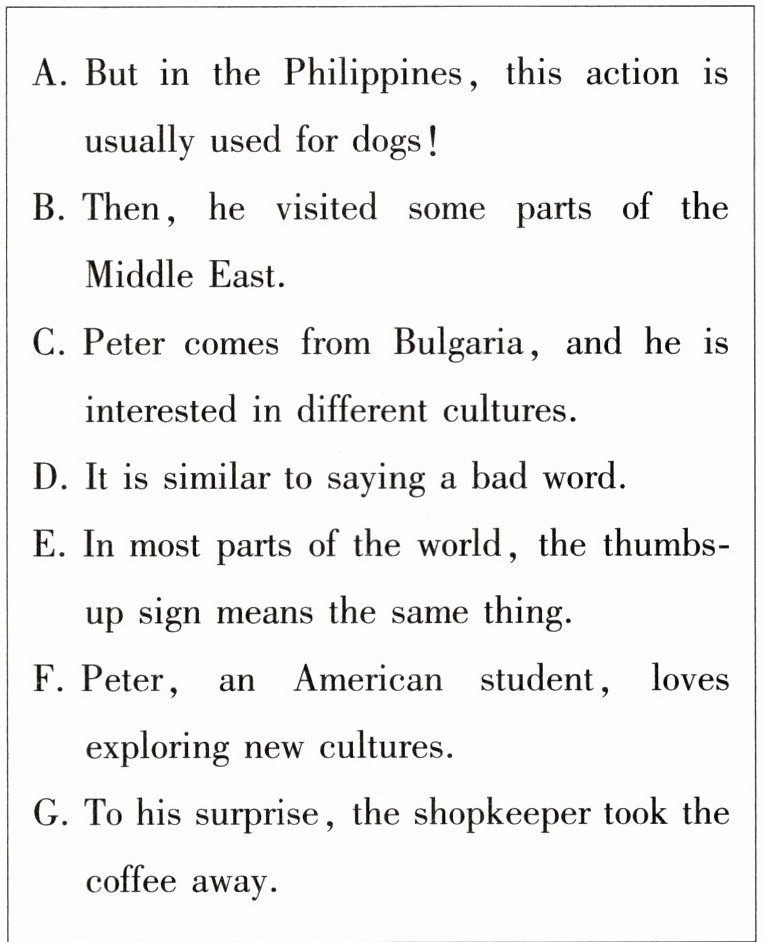
A. But in the Philippines, this action is usually used for dogs!
B. Then, he visited some parts of the Middle East.
C. Peter comes from Bulgaria, and he is interested in different cultures.
D. It is similar to sag a bad word.
E. In most parts of the world, the thumbs-up sign means the same thing.
F. Peter, an American student, loves exploring new cultures.
G. To his surprise, the shopkeeper took the coffee away.
Traveling is exciting, but it can also be challenging. 16.
F
He thought knowing a few foreign words was enough because body language helps a lot, but he soon realized his body was sometimes "speaking" the wrong language!His first lesson happened in Bulgaria. He wanted to say "Yes" to a shopkeeper offering him coffee, so he nodded his head with a smile. 17.
G
Later, Peter learned that in Bulgaria, nodding your head actually means "No", and shaking your head from side to side means "Yes". He had been saying the opposite of what he meant!18.
B
After a fast taxi ride, he gave the driver a big "thumbs-up" (竖起大拇指) to show he was happy with the service. The driver suddenly looked very angry and shouted at him. Peter was shocked. He didn't know that the "thumbs-up" sign is very impolite in that area. 19. D
Even something like calling someone over can be different. In the USA, Peter uses his index finger(食指) to ask his friends to come over. 20.
A
To call a person over politely, they turn their palm(手掌) down and wave their fingers toward themselves.Finally, Peter learned an important
lesson: when you travel, you should "listen" with your eyes and "watch" your hands as carefully as your words to avoid silly mistakes.
A. But in the Philippines, this action is usually used for dogs!
B. Then, he visited some parts of the Middle East.
C. Peter comes from Bulgaria, and he is interested in different cultures.
D. It is similar to sag a bad word.
E. In most parts of the world, the thumbs-up sign means the same thing.
F. Peter, an American student, loves exploring new cultures.
G. To his surprise, the shopkeeper took the coffee away.
答案
16. F 17. G 18. B 19. D 20. A
解析
【分析】
这是一道英语七选五阅读理解题,解题思路如下:1. 先通读全文,明确文章主旨:讲述美国学生Peter旅行时因不了解不同国家肢体语言的文化差异而闹出的趣事;2. 逐空分析上下文的逻辑关系:①16空后出现人称代词“He”,需前文介绍Peter的身份,选项F符合;②17空前文提到Peter点头要咖啡,后文说明保加利亚点头表示“不”,故此处应是店主拿走咖啡,对应选项G;③18空前文是保加利亚的经历,后文转向中东的出租车事件,需承上启下的句子,选项B符合;④19空前文指出竖起大拇指在该地区不礼貌,需解释其不礼貌的程度,选项D符合;⑤20空前文提到美国用食指叫人,需说明其他地方的不同做法,选项A符合。
【解析】
16. 选F:后文的“He”指代选项F中的“Peter”,且F介绍Peter是热爱探索新文化的美国学生,引出下文旅行的内容,符合语境;
17. 选G:前文提到Peter点头表示要咖啡,后文说明保加利亚点头意为“不”,因此店主拿走咖啡(G)是合理结果,衔接自然;
18. 选B:前文讲述Peter在保加利亚的经历,后文转向中东的出租车事件,选项B“然后他参观了中东的一些地方”起到承上启下的作用,符合事件顺序;
19. 选D:前文指出竖起大拇指在该地区非常不礼貌,选项D“类似说脏话”进一步解释其不礼貌的程度,逻辑通顺;
20. 选A:前文提到美国用食指叫人,选项A“但在菲律宾,这个动作通常用于狗”说明不同地区的差异,衔接后文的正确做法,符合语境。
【答案】
16.F 17.G 18.B 19.D 20.A
【知识点】
英语七选五、文化差异、上下文逻辑推理
【点评】
本题围绕旅行中的肢体语言文化差异展开,考查学生对文章上下文逻辑的把握能力,需结合语境和文化背景解题,难度适中。
【难度系数】
0.6
这是一道英语七选五阅读理解题,解题思路如下:1. 先通读全文,明确文章主旨:讲述美国学生Peter旅行时因不了解不同国家肢体语言的文化差异而闹出的趣事;2. 逐空分析上下文的逻辑关系:①16空后出现人称代词“He”,需前文介绍Peter的身份,选项F符合;②17空前文提到Peter点头要咖啡,后文说明保加利亚点头表示“不”,故此处应是店主拿走咖啡,对应选项G;③18空前文是保加利亚的经历,后文转向中东的出租车事件,需承上启下的句子,选项B符合;④19空前文指出竖起大拇指在该地区不礼貌,需解释其不礼貌的程度,选项D符合;⑤20空前文提到美国用食指叫人,需说明其他地方的不同做法,选项A符合。
【解析】
16. 选F:后文的“He”指代选项F中的“Peter”,且F介绍Peter是热爱探索新文化的美国学生,引出下文旅行的内容,符合语境;
17. 选G:前文提到Peter点头表示要咖啡,后文说明保加利亚点头意为“不”,因此店主拿走咖啡(G)是合理结果,衔接自然;
18. 选B:前文讲述Peter在保加利亚的经历,后文转向中东的出租车事件,选项B“然后他参观了中东的一些地方”起到承上启下的作用,符合事件顺序;
19. 选D:前文指出竖起大拇指在该地区非常不礼貌,选项D“类似说脏话”进一步解释其不礼貌的程度,逻辑通顺;
20. 选A:前文提到美国用食指叫人,选项A“但在菲律宾,这个动作通常用于狗”说明不同地区的差异,衔接后文的正确做法,符合语境。
【答案】
16.F 17.G 18.B 19.D 20.A
【知识点】
英语七选五、文化差异、上下文逻辑推理
【点评】
本题围绕旅行中的肢体语言文化差异展开,考查学生对文章上下文逻辑的把握能力,需结合语境和文化背景解题,难度适中。
【难度系数】
0.6
项目式作业——语言迷你海报
Goal: Learn about a kind of language and try to introduce it in English.
Step 1 Choose one language you like.
Step 2 Make a short title in English.
Step 3 Complete the poster.
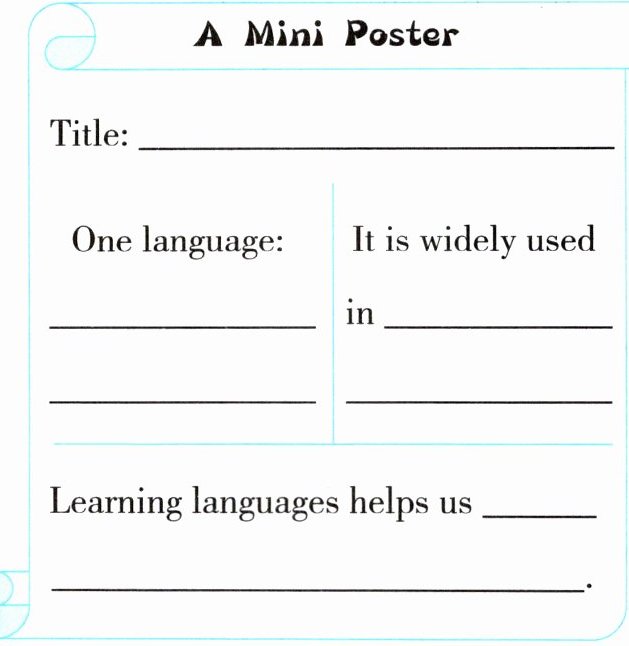
Goal: Learn about a kind of language and try to introduce it in English.
Step 1 Choose one language you like.
Step 2 Make a short title in English.
Step 3 Complete the poster.
答案
参考填写示例:
Title: The Charm of Chinese
One language: Chinese. It is the mother tongue of over 1.3 billion people.
It is widely used in China, many Asian countries and various international cultural exchange activities.
Learning languages helps us learn about different cultures and communicate with people from all over the world conveniently.
Title: The Charm of Chinese
One language: Chinese. It is the mother tongue of over 1.3 billion people.
It is widely used in China, many Asian countries and various international cultural exchange activities.
Learning languages helps us learn about different cultures and communicate with people from all over the world conveniently.
解析
【分析】本题是项目式英语实践作业,要求制作语言迷你海报,解题思路为:1. 先选定一种熟悉的语言(如中文);2. 拟定贴合主题的英文标题;3. 按照海报的四个板块(标题、语言名称、使用范围、学习语言的帮助),结合语言常识和英语表达习惯填写内容,确保语句通顺、符合逻辑。
【解析】根据海报结构,依次填写:标题需简洁点明介绍的语言主题,如“The Charm of Chinese”;明确语言名称为“Chinese”,补充其基本属性(如母语使用者数量);使用范围要具体,如中国、亚洲多国及国际文化交流活动;学习语言的帮助要贴合实际,如了解不同文化、与世界各地的人交流。
【答案】Title: The Charm of Chinese
One language: Chinese. It is the mother tongue of over 1.3 billion people.
It is widely used in China, many Asian countries and various international cultural exchange activities.
Learning languages helps us learn about different cultures and communicate with people from all over the world conveniently.
【知识点】英语书面表达、语言常识、英文写作
【点评】本题为实践类英语作业,考查学生的英语运用能力与对语言文化的认知,要求结合实际完成海报填写,难度适中,能锻炼学生的综合实践能力。
【难度系数】0.5
【解析】根据海报结构,依次填写:标题需简洁点明介绍的语言主题,如“The Charm of Chinese”;明确语言名称为“Chinese”,补充其基本属性(如母语使用者数量);使用范围要具体,如中国、亚洲多国及国际文化交流活动;学习语言的帮助要贴合实际,如了解不同文化、与世界各地的人交流。
【答案】Title: The Charm of Chinese
One language: Chinese. It is the mother tongue of over 1.3 billion people.
It is widely used in China, many Asian countries and various international cultural exchange activities.
Learning languages helps us learn about different cultures and communicate with people from all over the world conveniently.
【知识点】英语书面表达、语言常识、英文写作
【点评】本题为实践类英语作业,考查学生的英语运用能力与对语言文化的认知,要求结合实际完成海报填写,难度适中,能锻炼学生的综合实践能力。
【难度系数】0.5
