

 登录
Ⅱ. 从方框中选择最佳选项完成对话。(有两项多余)
A: Hello, 2789 - 4536.
B: Hello, 1. ______
A: 2. ______... I’m sorry she isn’t here right now.
B: Is that Lily?
A: No. 3. ______ 4. ______
B: Certainly. We’re going to have a party next week. Please ask Lucy to bring some fruit.
A: OK. 5. ______
B: Thanks a lot. Bye.
A: Bye.
A. This is Mary speaking.
B. I’m Mary.
C. May I speak to Lucy?
D. Just a moment.
E. Hold on, please.
F. I’ll give her the message.
G. Can I take a message for her?
答案
1. C
2. E
3. A
4. G
5. F
2. E
3. A
4. G
5. F
Ⅲ. 阅读短文,完成表格内容。(每空一词)
Weeks before Tomb - Sweeping Day in April this year, hundreds of qingtuan were sold each day. The snack was still a must - have for many people.
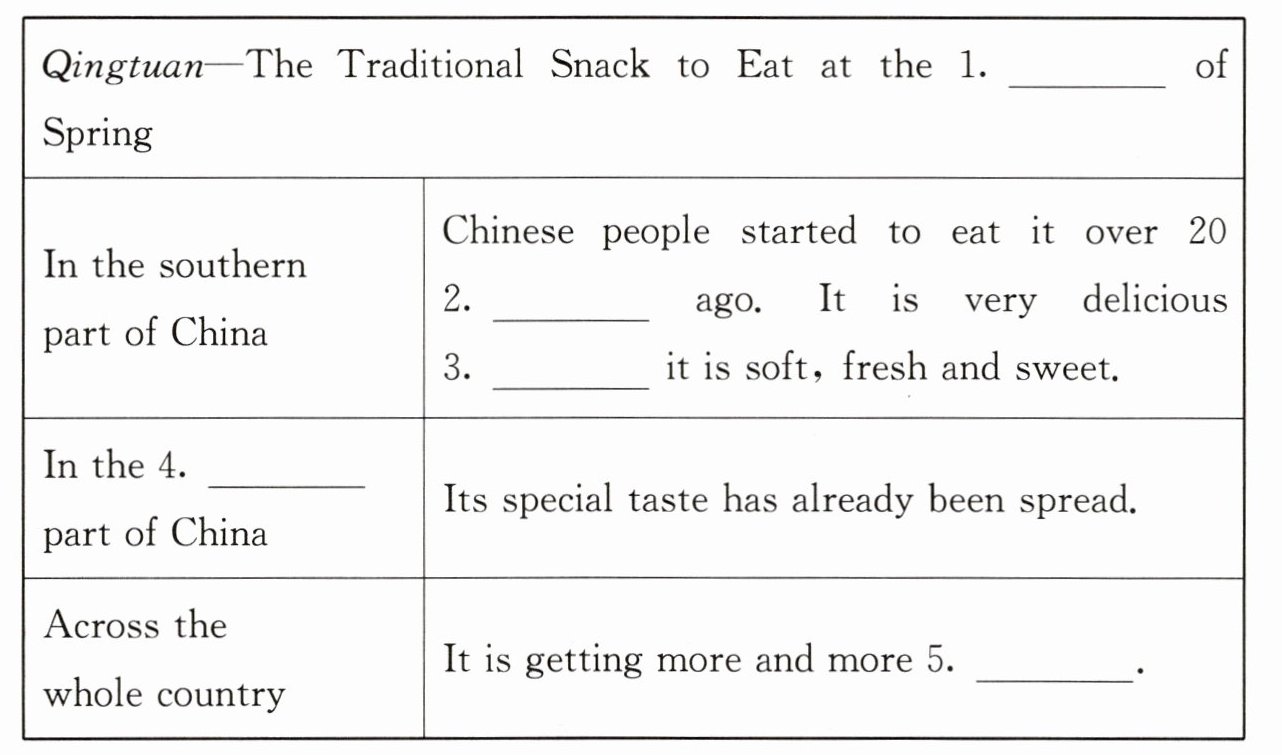
In the southern part of China, eating qingtuan at the beginning of spring is a kind of tradition. Chinese people started to eat it more than 2,000 years ago. Making it really takes time and energy, and it is very delicious due to its softness, freshness and sweetness. The secret behind its mouth - watering taste is one of its materials—mugwort(艾蒿) leaves. The mugwort plant is mainly found in the Yangtze River Delta where it has perfect conditions to grow.
Now, qingtuan has already spread its special taste to the northern part of China. Li Yuan, a 30 - year - old engineer who grew up in Zhejiang Province, brought qingtuan back to Beijing where he works. “It tastes different in and out of my hometown,” he said. “There’s no place like home.”
Qingtuan is getting more and more popular across the whole country. Even though there is warm weather and green leaves in spring, the season wouldn’t be complete without a taste of qingtuan.
Weeks before Tomb - Sweeping Day in April this year, hundreds of qingtuan were sold each day. The snack was still a must - have for many people.
In the southern part of China, eating qingtuan at the beginning of spring is a kind of tradition. Chinese people started to eat it more than 2,000 years ago. Making it really takes time and energy, and it is very delicious due to its softness, freshness and sweetness. The secret behind its mouth - watering taste is one of its materials—mugwort(艾蒿) leaves. The mugwort plant is mainly found in the Yangtze River Delta where it has perfect conditions to grow.
Now, qingtuan has already spread its special taste to the northern part of China. Li Yuan, a 30 - year - old engineer who grew up in Zhejiang Province, brought qingtuan back to Beijing where he works. “It tastes different in and out of my hometown,” he said. “There’s no place like home.”
Qingtuan is getting more and more popular across the whole country. Even though there is warm weather and green leaves in spring, the season wouldn’t be complete without a taste of qingtuan.
答案
1. Beginning 2. centuries 3. because 4. northern 5. popular
