

 登录
Are you having a hard time sticking to your daily schedule? That's a problem many people have. Here are some tips that might help you.
Start with anchor habits. An anchor habit is something you do at a particular time of day that you're not at risk of skipping. It will help shape and structure your day. 1.
Be very consistent for about three months. A daily schedule is a series of behaviours. Behaviours only become automatic if you keep how, when, and where you do them consistently for about three months. 2.
Plan your rewards. Plan rewards and link them to the schedule you're trying to keep up with in natural ways. Structure rewards around daily tasks, such as watching a video after a period of study and scheduling walks as enjoyable motivations. 3.
Use tools to support you. Tools can help you maintain a schedule. Kitchen equipment might help support a cooking schedule. 4.
5.
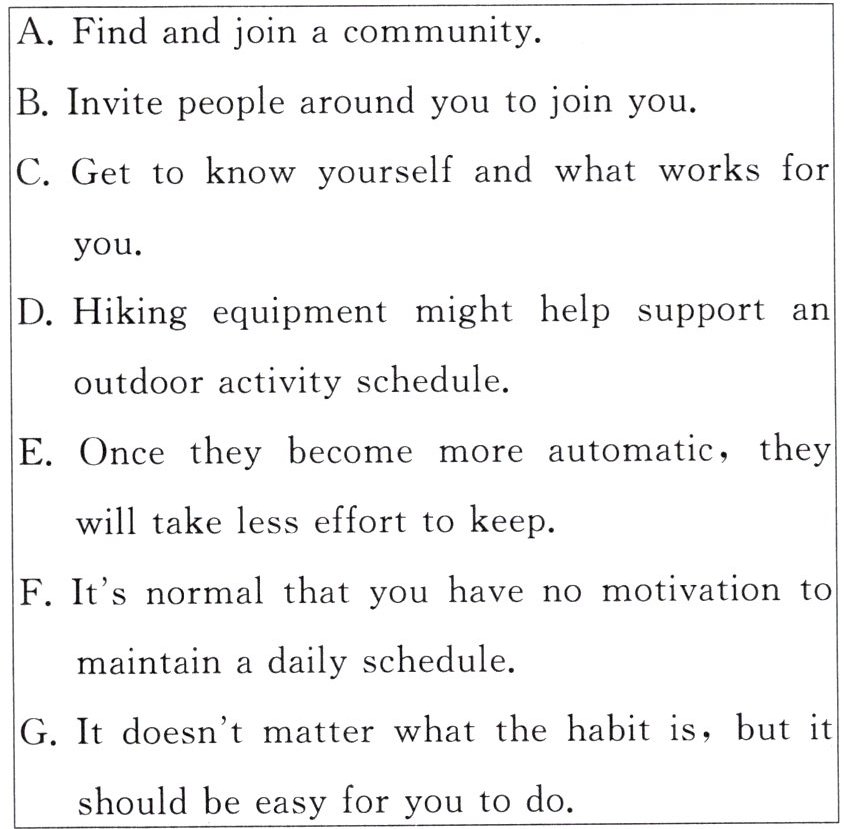
A. Find and join a community.
B. Invite people around you to join you.
C. Get to know yourself and what works for you.
D. Hiking equipment might help support an outdoor activity schedule.
E. Once they become more automatic, they will take less effort to keep.
F. It's normal that you have no motivation to maintain a daily schedule.
G. It doesn't matter what the habit is, but it should be easy for you to do.
Start with anchor habits. An anchor habit is something you do at a particular time of day that you're not at risk of skipping. It will help shape and structure your day. 1.
G
Don't choose something you struggle to get done as an anchor habit.Be very consistent for about three months. A daily schedule is a series of behaviours. Behaviours only become automatic if you keep how, when, and where you do them consistently for about three months. 2.
E
Plan your rewards. Plan rewards and link them to the schedule you're trying to keep up with in natural ways. Structure rewards around daily tasks, such as watching a video after a period of study and scheduling walks as enjoyable motivations. 3.
C
What do you want to do as a reward either during or after the daily behaviour you're trying to maintain?Use tools to support you. Tools can help you maintain a schedule. Kitchen equipment might help support a cooking schedule. 4.
D
However, keep in mind that these tools don't magically do the work for you.5.
A
It's much harder to keep up any behaviour or schedule if it isn't normal for the people around you. Therefore, find a community where the schedule or behaviours you're trying to maintain are normal and join it.A. Find and join a community.
B. Invite people around you to join you.
C. Get to know yourself and what works for you.
D. Hiking equipment might help support an outdoor activity schedule.
E. Once they become more automatic, they will take less effort to keep.
F. It's normal that you have no motivation to maintain a daily schedule.
G. It doesn't matter what the habit is, but it should be easy for you to do.
答案
1.G 2.E 3.C 4.D 5.A
1. G 根据上文“An anchor habit is something you do at a particular time of day that you're not at risk of skipping. It will help shape and structure your day.”(锚定习惯是你每天固定时间做、不会轻易跳过的事,它能帮你规划一天的节奏)以及下文“Don't choose something you struggle to get done as an anchor habit.”(不要选你难以完成的事当锚定习惯)可知,此处说明锚定习惯的选择标准。选项 G“习惯是什么不重要,重要的是它得是你容易做到的事”符合语境,衔接上下文对锚定习惯的要求。故选 G。
2. E 根据上文“Behaviours only become automatic if you keep how, when, and where you do them consistently for about three months.”(如果你坚持三个月,保持做事情的方式、时间和地点一致,行为就会变成自发的习惯)可知,此处承接行为自动化的话题,说明其带来的好处。选项 E“一旦它们变得更自动化,坚持起来就不用耗费太多精力”符合语境,承接上文的结论,说明坚持的意义。故选 E。
3. C 根据上文“Structure rewards around daily tasks, such as watching a video after a period of study and scheduling walks as enjoyable motivations.”(围绕日常任务设置奖励,比如学习一段时间后看视频,把散步安排成愉悦的动力)以及下文“What do you want to do as a reward either during or after the daily behaviour you're trying to maintain?”(你想在坚持日常行为的过程中或之后用什么当奖励呢)可知,此处说明奖励设置的原则,即要适合自己。选项 C“了解你自己,知道什么对你有效”符合语境,承上启下引出对奖励的个性化选择。故选 C。
4. D 根据上文“Tools can help you maintain a schedule. Kitchen equipment might help support a cooking schedule.”(工具能帮你坚持日程。厨具可以支撑烹饪日程)可知,此处承接“工具支撑日程”的举例,补充另一种工具的例子。选项 D“徒步装备可以支撑户外活动日程”符合语境,与上文的厨具例子形成并列,对应工具的作用。故选 D。
5. A 根据下文“It's much harder to keep up any behaviour or schedule if it isn't normal for the people around you. Therefore, find a community where the schedule or behaviours you're trying to maintain are normal and join it.”(如果你周围的人都不这么做,那坚持行为或日程就会难得多。因此,找一个和你坚持相同日程或行为习惯的社群并加入它)可知,此处作为段首主题句,概括加入社群的建议。选项 A“找到并加入一个社群”符合语境,总领本段内容。故选 A。
D
Straight or arched, thick or thin—eyebrows(眉毛) come in many shapes and sizes. But what are eyebrows even for? They don't keep us warm like our hair, or help us breathe like our noses. So why do we have them? 1.
Early humans had large brow ridges(眉骨). 2.
But this is not the only purpose of our eyebrows. 4.
5.
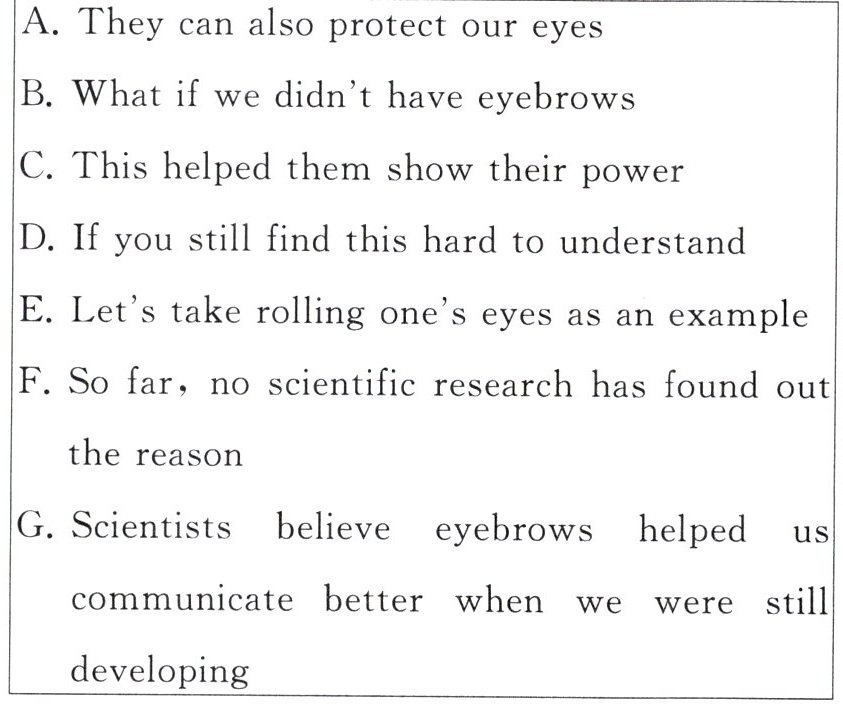
Straight or arched, thick or thin—eyebrows(眉毛) come in many shapes and sizes. But what are eyebrows even for? They don't keep us warm like our hair, or help us breathe like our noses. So why do we have them? 1.
G
.Early humans had large brow ridges(眉骨). 2.
C
. Later, as the human face became smaller and flatter, our eyebrows helped us to express different feelings, as well as better understand others' feelings. For example, a quick flash of the eyebrows ... This is a sign that someone is willing to communicate with others, while pulling our eyebrows up in the middle is an expression of sympathy(同情). 3. D
, just draw a simple face on a piece of paper and draw a line above the eyes. You can draw lines in different shapes and directions. You will find that it is very easy to show anger, fear or surprise on a face.But this is not the only purpose of our eyebrows. 4.
A
. Their arched shape can help to move rain or sweat around to the sides of our faces, keeping our eyes dry. Together with our eyelashes(眼睫毛), eyebrows can also help to keep dust and other things out of our eyes.5.
B
? In that case, some scientists believe that we would have developed some other facial features to perform the same role. That could make us look quite different.答案
1.G 2.C 3.D 4.A 5.B
1. G 空前提出疑问“So why do we have them?”(那么我们为什么长眉毛呢?),空后第二段详细讲述了眉毛在人类进化过程中帮助表达情感和交流的作用。选项 G“Scientists believe eyebrows helped us communicate better when we were still developing”(科学家认为,在我们仍在进化时,眉毛帮助我们更好地交流)直接给出了前文问题的科学解释,并总领后文关于眉毛进化与沟通功能的详细说明,承前启后。故选 G。
2. C 空前提到“早期人类有突出的眉骨”,空后提到“后来,随着人类面部变得更小,更平坦,我们的眉毛帮助我们表达不同的情感”。选项 C“This helped them show their power”(这帮助他们显示力量)中的“This”指代前文的“大眉骨”,解释了早期人类眉骨的作用,并与后文现代人类眉毛的作用形成演进与对比。故选 C。
3. D 空前列举了眉毛表达情感的例子,空后是一组祈使句“只需在纸上画一张简单的脸……你会发现很容易在脸上表现出愤怒、恐惧或惊讶”。选项 D“If you still find this hard to understand”(如果你仍然觉得这很难理解)引导读者通过动手实验来直观感受眉毛表达情绪的作用,与后文的实验说明形成自然的条件关系,承前启后。故选 D。
4. A 空前指出“但这并不是我们眉毛的唯一目的”,说明本段将介绍眉毛的其他作用。空后具体描述了眉毛可以导流雨水和汗水、阻挡灰尘等。选项 A“They can also protect our eyes”(它们还能保护眼睛)直接点明了眉毛的另一个重要功能,与后文关于保护眼睛的具体描述相呼应,承前启后。故选 A。
5. B 空后提到“In that case ... the same role.”(在那种情况下,一些科学家认为我们会进化出其他面部特征来发挥同样的作用)。选项 B“What if we didn't have eyebrows”(如果我们没有眉毛会怎样)通过假设引出后文科学家对替代方案的思考,与后文内容形成因果关联,承前启后。故选 B。
