

 登录
Ⅳ.补全对话(每小题2分,共12分)
从下面的方框中选择合适的句子,填到横线上,使对话意思完整。
A:Hi, Li Hua. I heard you are from Xinjiang. 59
B:Yes. I have lived in Urumqi for 15 years.
A:Great! How is your hometown nowadays?
B: 60
A:What are the biggest changes?
B: 61 Roads are wider and high-speed trains make trips easier. Besides, more green trees are planted around the city.
A:Sounds amazing! 62
B:Yes. More tourists come to enjoy local food and beautiful views now.
A: 63
B:Many delicious foods like nang and dapanji.
A:I hope I can visit Xinjiang one day.
B: 64 You will fall in love with this beautiful land.
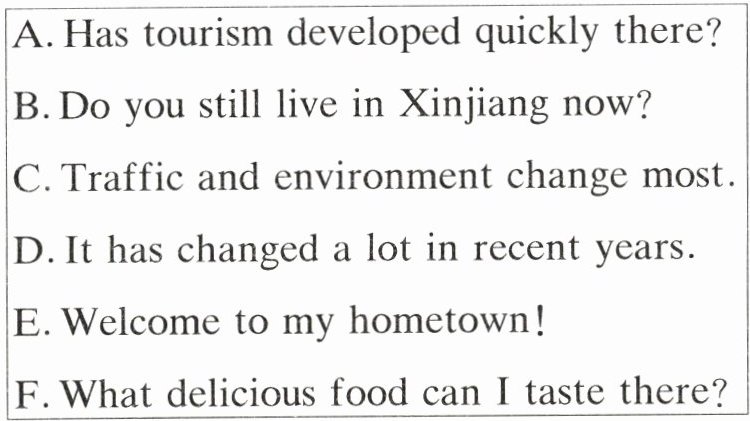
A. Has tourism developed quickly there?
B. Do you still live in Xinjiang now?
C. Traffic and environment change most.
D. It has changed a lot in recent years.
E. Welcome to my hometown!
F. What delicious food can I taste there?
59.
从下面的方框中选择合适的句子,填到横线上,使对话意思完整。
A:Hi, Li Hua. I heard you are from Xinjiang. 59
B:Yes. I have lived in Urumqi for 15 years.
A:Great! How is your hometown nowadays?
B: 60
A:What are the biggest changes?
B: 61 Roads are wider and high-speed trains make trips easier. Besides, more green trees are planted around the city.
A:Sounds amazing! 62
B:Yes. More tourists come to enjoy local food and beautiful views now.
A: 63
B:Many delicious foods like nang and dapanji.
A:I hope I can visit Xinjiang one day.
B: 64 You will fall in love with this beautiful land.
A. Has tourism developed quickly there?
B. Do you still live in Xinjiang now?
C. Traffic and environment change most.
D. It has changed a lot in recent years.
E. Welcome to my hometown!
F. What delicious food can I taste there?
59.
B
60. D
61. C
62. A
63. F
64. E
答案
59.B 60.D 61.C 62.A 63.F 64.E
Ⅴ.读写题(本题共分为两节,共15分)
The three Rs—reduce, reuse, recycle—are important for protecting the environment.
At many historical sites, littering is a big problem. It not only makes the place dirty but also pollutes the environment. Recently, a well-known scenic site in Dunhuang, Gansu Province, came up with a clever way to put this idea into practice.
During the busy tourist season, the site has had about 20,000 visitors every day since July. With so many people, there was a lot of dust and litter, which made the cleaners very busy. So the site started a fun activity called “Trash Hunt for Gifts”. Visitors are given rubbish bags and asked to pick up litter around the site. In return, they get small gifts that show Dunhuang’s rich culture. This activity is a good example of the three Rs spirit. The
“Trash Hunt” programme is not just a trick to get attention. It truly encourages visitors to take responsibility and care for the environment. It turns every tourist into an environmental guardian. The idea is spreading. Other places in China are also doing similar things. It is wonderful to see tourists not only enjoying the beautiful scenes but also helping to protect them. This new and exciting way keeps our scenic spots clean and beautiful for everyone. It reminds us that while we enjoy the beauty around us, we also have the duty to protect it.
第一节 阅读短文,根据语篇内容,在方框内的缩写文章中,填入与短文意思最符合的单词,每空一词。(每小题1分,共6分)
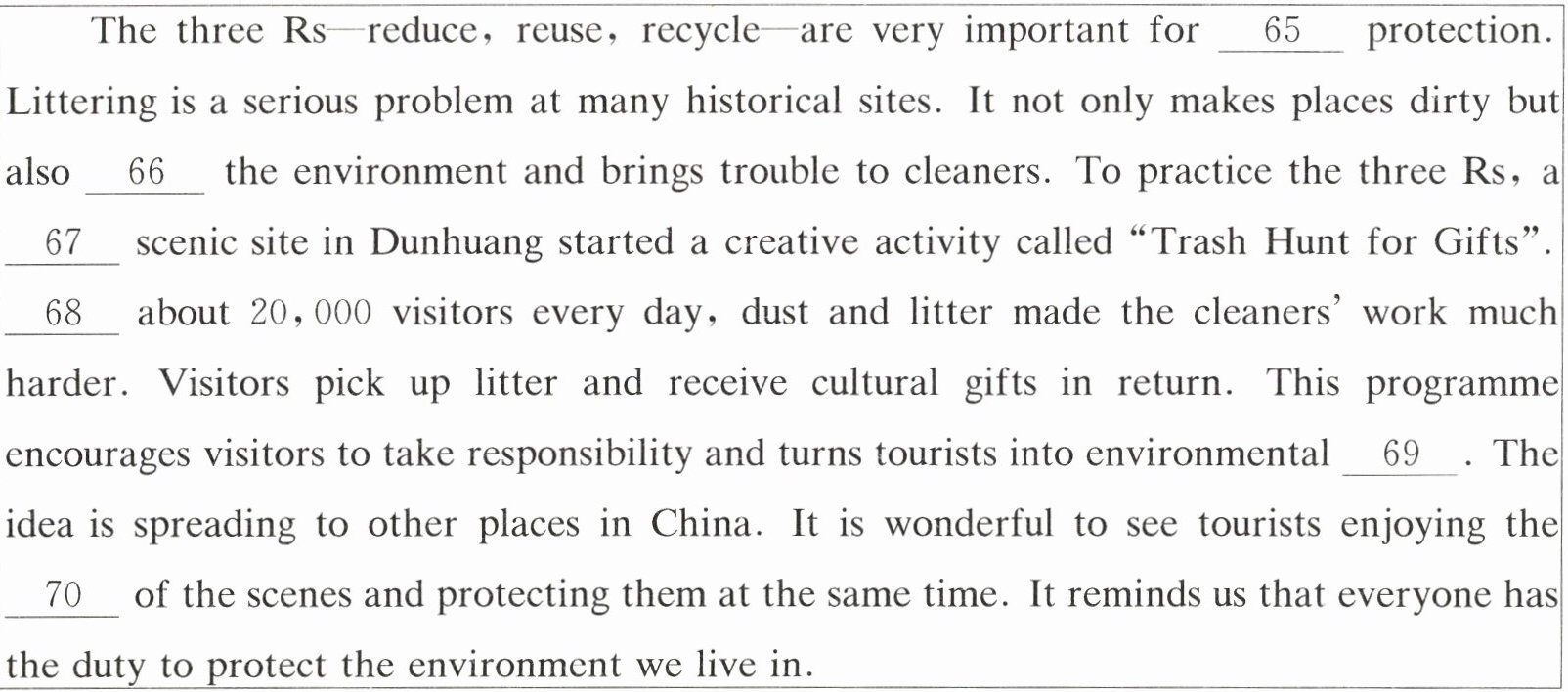
65.
第二节 阅读短文,根据语篇内容,回答问题。(每小题3分,满分9分)
71. Does “Trash Hunt for Gifts” encourage environmental care?
72. What do visitors get in return for picking up litter?
73. Why is the “Trash Hunt” programme not just a trick?
The three Rs—reduce, reuse, recycle—are important for protecting the environment.
At many historical sites, littering is a big problem. It not only makes the place dirty but also pollutes the environment. Recently, a well-known scenic site in Dunhuang, Gansu Province, came up with a clever way to put this idea into practice.
During the busy tourist season, the site has had about 20,000 visitors every day since July. With so many people, there was a lot of dust and litter, which made the cleaners very busy. So the site started a fun activity called “Trash Hunt for Gifts”. Visitors are given rubbish bags and asked to pick up litter around the site. In return, they get small gifts that show Dunhuang’s rich culture. This activity is a good example of the three Rs spirit. The
“Trash Hunt” programme is not just a trick to get attention. It truly encourages visitors to take responsibility and care for the environment. It turns every tourist into an environmental guardian. The idea is spreading. Other places in China are also doing similar things. It is wonderful to see tourists not only enjoying the beautiful scenes but also helping to protect them. This new and exciting way keeps our scenic spots clean and beautiful for everyone. It reminds us that while we enjoy the beauty around us, we also have the duty to protect it.
第一节 阅读短文,根据语篇内容,在方框内的缩写文章中,填入与短文意思最符合的单词,每空一词。(每小题1分,共6分)
65.
environmental
66. pollutes
67. well-known/famous
68. With
69. guardians
70. beauty
第二节 阅读短文,根据语篇内容,回答问题。(每小题3分,满分9分)
71. Does “Trash Hunt for Gifts” encourage environmental care?
Yes, it does./Yes.
72. What do visitors get in return for picking up litter?
Small gifts that show Dunhuang's rich culture.
73. Why is the “Trash Hunt” programme not just a trick?
Because it encourages visitors to take responsibility, turns them into environmental guardians, and keeps the site clean while tourists enjoy it.(言之有理即可)
答案
65.environmental 66.pollutes 67.well-known/famous
68.With 69.guardians 70.beauty
71.Yes, it does./Yes.
72.Small gifts that show Dunhuang's rich culture.
73.Because it encourages visitors to take responsibility, turns them into environmental guardians, and keeps the site clean while tourists enjoy it.(言之有理即可)
