

 登录
13.若$4x^2 + kx + 9$是完全平方式,则$k=$
$\pm12$
。答案
13. $\pm12$
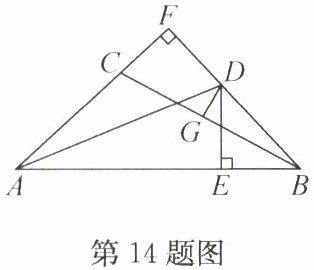
14. 如图,$∠ BAC$的平分线与BC的垂直平分线相交于点D,$DE⊥ AB$,$DF⊥ AC$,垂足分别为E,F,连接BD,若$AB=11$,$AC=5$,则$BE=$
3
。答案
14. 3 解析:连接 CD,
$\because AD$ 是 $∠ BAC$ 的平分线, $DE⊥ AB,DF⊥ AC$,
$\therefore DF=DE,∠ F=∠ DEB=90°,∠ ADF=∠ ADE$,
$\therefore AE=AF$.
$\because DG$ 是 $BC$ 的垂直平分线,
$\therefore CD=BD$.
在 $\mathrm{Rt}△ CDF$ 和 $\mathrm{Rt}△ BDE$ 中,
$\begin{cases}CD=BD,\\DF=DE,\end{cases}$
$\therefore \mathrm{Rt}△ CDF≌\mathrm{Rt}△ BDE(\mathrm{HL})$,
$\therefore BE=CF$,
$\therefore AB=AE+BE=AF+BE=AC+CF+BE=AC+2BE$,
$\because AB=11,AC=5$,
$\therefore BE=\frac{1}{2}(11-5)=3$.
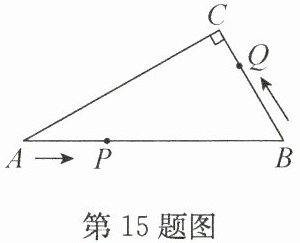
15. 如图,在$\mathrm{Rt}△ ABC$中,$∠ C=90°$,$∠ A=30°$,$BC=6$,若点$P$是边$AB$上的一个动点,以每秒3个单位长度的速度按照按$A\to B\to A$运动,同时点$Q$以每秒1个单位长度的速度按$B\to C$运动,当一个动点到达终点时,另一个动点也随之停止运动。在运动过程中,设运动时间为$t$秒,若$△ BPQ$为直角三角形,则$t$的值为
$\frac{12}{5}$或$\frac{24}{7}$或$\frac{24}{5}$
。答案
15. $\frac{12}{5}$或$\frac{24}{7}$或$\frac{24}{5}$ 解析:①如图①,当$∠ BQP=90°$时,$∠ BPQ=30°,BP=2BQ$,
若 $0<t<4$,则 $BP=12-3t,BQ=t$,
$\therefore 12-3t=2t$,
解得 $t=\frac{12}{5}$;
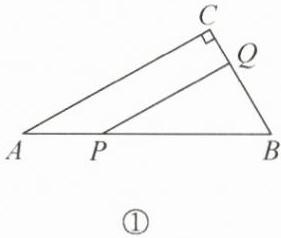
若 $4<t≤6$,则 $BP=3t-12,BQ=t$,
$\therefore 3t-12=2t$,解得 $t=12$(舍).
②如图②,当$∠ QPB=90°$时,
$\because ∠ A=30°,\therefore ∠ B=60°,\therefore ∠ BQP=30°,\therefore BQ=2BP$,
若 $0<t<4$,
则 $t=2(12-3t)$,
解得 $t=\frac{24}{7}$;
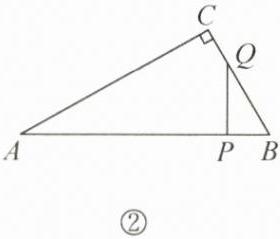
若 $4<t≤6$,则 $t=2(3t-12)$,解得 $t=\frac{24}{5}$.
三、解答题(本大题共8小题,共75分.解答应写出文字说明、证明过程或演算步骤)
16.(6分)计算:
(1)$-2^2 - (-\dfrac{1}{3})^{-2} + 4×(-1)^{2025} + (π - 199)^0$;
(2)$(x - 2y + 3)(x + 2y + 3)$.
答案
16. 解:(1)$-2^2 -(-\dfrac{1}{3})^{-2} + 4×(-1)^{2025} + (π - 199)^0$
$=-4-9+4×(-1)+1$
$=-13-4+1$
$=-16$.
(2)$(x-2y+3)(x+2y+3)$
$=(x+3)^2-(2y)^2$
$=x^2+6x+9-4y^2$.
17. (8分)把下列各式分解因式:
(1)$2a(x-y)-6b(y-x)$;
(2)$(y^2 -1)^2 -6(y^2 -1)+9$。
答案
17. 解:(1)$2a(x-y)-6b(y-x)$
$=2a(x-y)+6b(x-y)$
$=2(x-y)(a+3b)$.
(2)$(y^2-1)^2-6(y^2-1)+9$
$=(y^2-1-3)^2$
$=(y^2-4)^2$
$=(y+2)^2(y-2)^2$.
