

 登录
一、根据句意及汉语提示写出单词
1. A
2. There are more than eight
3. With the development of science, we will be able to fly to other
4. Her
5. China’s first Mars
6. Through a
1. A
spacecraft
(宇宙飞船)is a vehicle that is used for travel in space.2. There are more than eight
billion
(十亿)people in the world now.3. With the development of science, we will be able to fly to other
galaxies
(星系)in the future.4. Her
mission
(任务)in work is to serve the customers.5. China’s first Mars
rover
(探测器)is Zhurong, which sounds so romantic.6. Through a
telescope
(望远镜), we can see things clearly in the distance.答案
1. spacecraft
2. billion
3. galaxies
4. mission
5. rover
6. telescope
2. billion
3. galaxies
4. mission
5. rover
6. telescope
解析
【分析】
解题思路:先通读每个句子理解句意,再结合括号内的汉语提示回忆对应的英文单词,同时注意单词的形式变化(如名词单复数),确保填入的单词符合语法和语境要求。
【解析】
1. 句意:宇宙飞船是用于太空旅行的交通工具。“宇宙飞船”对应的英文单词是spacecraft,该词单复数同形,符合语境。
2. 句意:现在世界上有超过八十亿人。“十亿”对应的英文是billion,前面有具体数词eight时,billion用原形。
3. 句意:随着科学发展,未来我们能飞往其他星系。“星系”是galaxy,other后需接可数名词复数,因此填galaxies。
4. 句意:她的工作任务是服务顾客。“任务”对应的英文是mission,符合语境。
5. 句意:中国首个火星探测器是祝融,听起来很浪漫。“探测器”此处对应火星车的英文表述为rover,符合常识与语境。
6. 句意:通过望远镜,我们能清晰看到远处的东西。“望远镜”对应的英文是telescope,符合语境。
【答案】
1. spacecraft
2. billion
3. galaxies
4. mission
5. rover
6. telescope
【知识点】
单词拼写;名词单复数
【点评】
本题考查基础词汇的运用,要求学生掌握常见词汇的词义及形式变化,结合语境准确填写,属于英语基础题型。
【难度系数】
0.5
二、任务型阅读
China’s Space Exploration Milestones(里程碑)
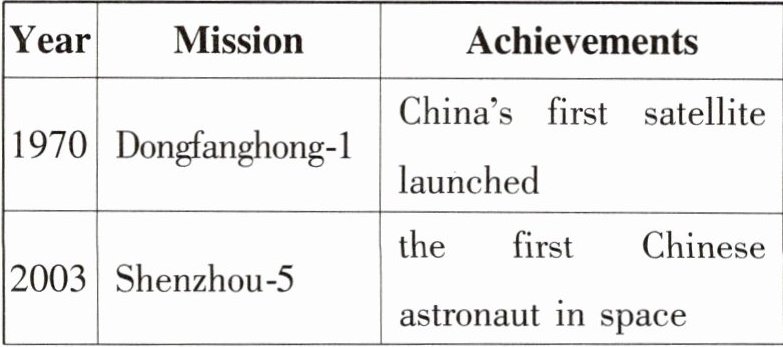
Year Mission Achievements
1970 Dongfanghong-1 China’s first satellite launched
2003 Shenzhou-5 the first Chinese astronaut in space
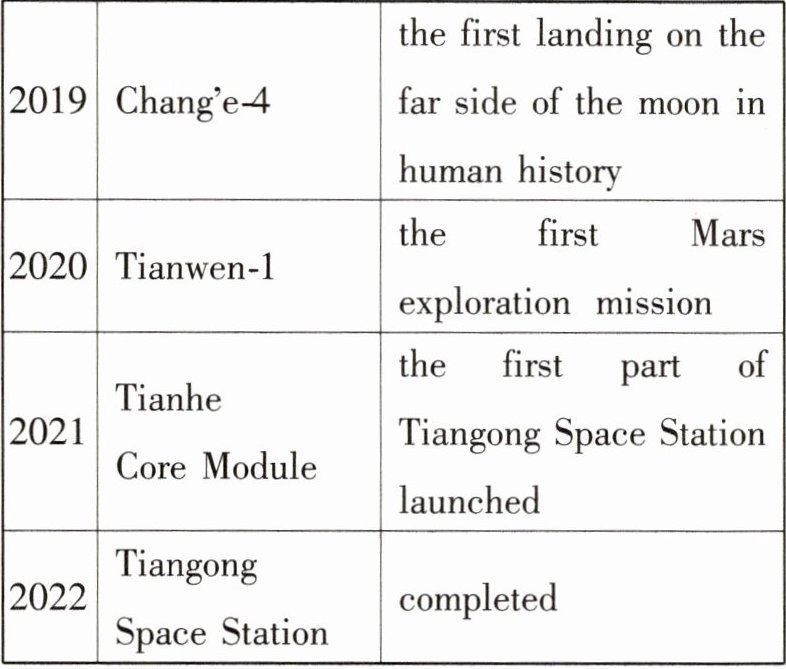
2019 Chang’e-4 the first landing on the far side of the moon in human history
2020 Tianwen-1 the first Mars exploration mission
2021 Tianhe Core Module the first part of Tiangong Space Station launched
2022 Tiangong Space Station completed
Xi’an: A City of Space Dreams
Xi’an, the capital of Shaanxi Province, is not only famous for the Terracotta Warriors but also plays an important role in China’s space industry. Many space technologies are developed in Xi’an. The city is called the “Hometown of China’s Space Power”.
1. When was China’s first satellite launched?
It was launched .
2. What was the achievement of the Shenzhou-5 mission?
It took to space.
3. Which mission achieved the first landing on the far side of the moon?
It is .
4. When was the Tiangong Space Station completed?
It was completed .
5. Why is Xi’an called the “Hometown of China’s Space Power”?
Because it plays an important role in .
.
China’s Space Exploration Milestones(里程碑)
Year Mission Achievements
1970 Dongfanghong-1 China’s first satellite launched
2003 Shenzhou-5 the first Chinese astronaut in space
2019 Chang’e-4 the first landing on the far side of the moon in human history
2020 Tianwen-1 the first Mars exploration mission
2021 Tianhe Core Module the first part of Tiangong Space Station launched
2022 Tiangong Space Station completed
Xi’an: A City of Space Dreams
Xi’an, the capital of Shaanxi Province, is not only famous for the Terracotta Warriors but also plays an important role in China’s space industry. Many space technologies are developed in Xi’an. The city is called the “Hometown of China’s Space Power”.
1. When was China’s first satellite launched?
It was launched .
2. What was the achievement of the Shenzhou-5 mission?
It took to space.
3. Which mission achieved the first landing on the far side of the moon?
It is .
4. When was the Tiangong Space Station completed?
It was completed .
5. Why is Xi’an called the “Hometown of China’s Space Power”?
Because it plays an important role in .
.
答案
1. in 1970
2. the first Chinese astronaut
3. Chang’e-4
4. in 2022
5. China’s space industry
2. the first Chinese astronaut
3. Chang’e-4
4. in 2022
5. China’s space industry
解析
【分析】本题为任务型阅读的细节查找类题目,解题思路是:先明确每个问题的核心关键词,再带着关键词定位到原文的表格或对应段落,提取与问题匹配的准确信息,确保答案符合原文内容,不添加额外信息。
【解析】1. 问题询问中国第一颗卫星的发射时间,定位到表格中1970年对应的Dongfanghong-1任务行,可知发射时间为1970年,故填in 1970;2. 问题询问神舟五号任务的成就,定位到表格中2003年对应的Shenzhou-5任务行,其成就为将中国首位宇航员送入太空,故填the first Chinese astronaut;3. 问题询问首次月球背面着陆的任务,定位到表格中2019年对应的Chang’e-4任务行,可知是嫦娥四号,故填Chang’e-4;4. 问题询问天宫空间站的完成时间,定位到表格中2022年对应的Tiangong Space Station行,可知完成时间为2022年,故填in 2022;5. 问题询问西安被称为“中国太空动力之乡”的原因,定位到短文中关于西安的段落,可知是因为它在中国航天工业中发挥重要作用,故填China’s space industry。
【答案】1. in 1970
2. the first Chinese astronaut
3. Chang’e-4
4. in 2022
5. China’s space industry
【知识点】细节理解,任务型阅读
【点评】本题考查任务型阅读中快速定位原文细节的能力,题目信息均直接来源于原文,难度较低,只要仔细阅读原文即可准确作答。
【难度系数】0.8
